Dajueshan stands in Zixi county of Fuzhou, on the western foot of the Wuyi Mountains, its main peak at 1,396 metres. The rock is red sandstone, and the scenery of gorge, cliff and wooded slope is the Danxia kind. That puts it in the same family as Longhu in Yingtan and Guifeng in Shangrao, and in a different family from the granite of Lushan, Sanqingshan and Wugong. A reader who has walked any of those will recognise the colour of the cliffs and the way the water has cut them.
From the journal
Red rock above Zixi
Dajueshan is a Danxia mountain in the far east of Jiangxi, where a monastery sits among red cliffs.
In the same city · Fuzhou ↗The other red mountains
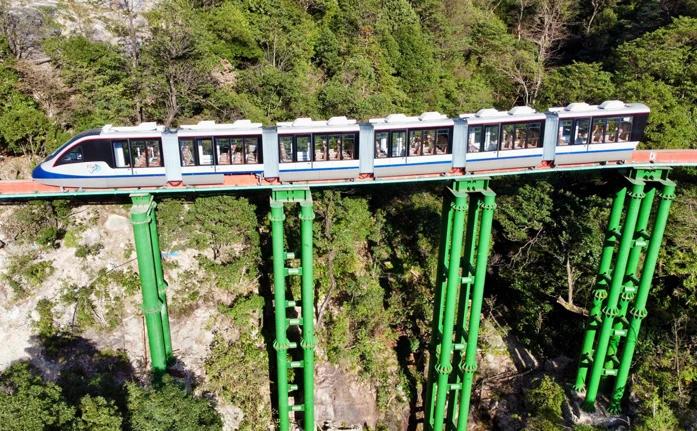
A monastery in the crags
A Buddhist monastery stands among the cliffs on the mountain, and the scenic area was rated a national AAAAA site in 2017. A monastery in a Danxia gorge is a specific kind of building problem: the rock gives you shelter, colour and enclosure, and the builders used it. Zixi itself is a county in the mountains of eastern Fuzhou, and the mountain's position, on the border with Fujian's Wuyi range, is also the reason the scenery is continuous across the provincial line rather than stopping at it.
Reading the province by its stone
Jiangxi turns out to be legible in rock. Granite in the north and centre, at Lushan, Sanqingshan, Wugong and Mingyue; red sandstone in the east and the south, at Longhu, Guifeng and Dajueshan; red-soil hills and forest in the middle, at Jinggangshan. Holding that distinction in the hand stops a reader from flattening the province into one landscape, and it explains why a mountain article from one corner of Jiangxi does not automatically apply to another.