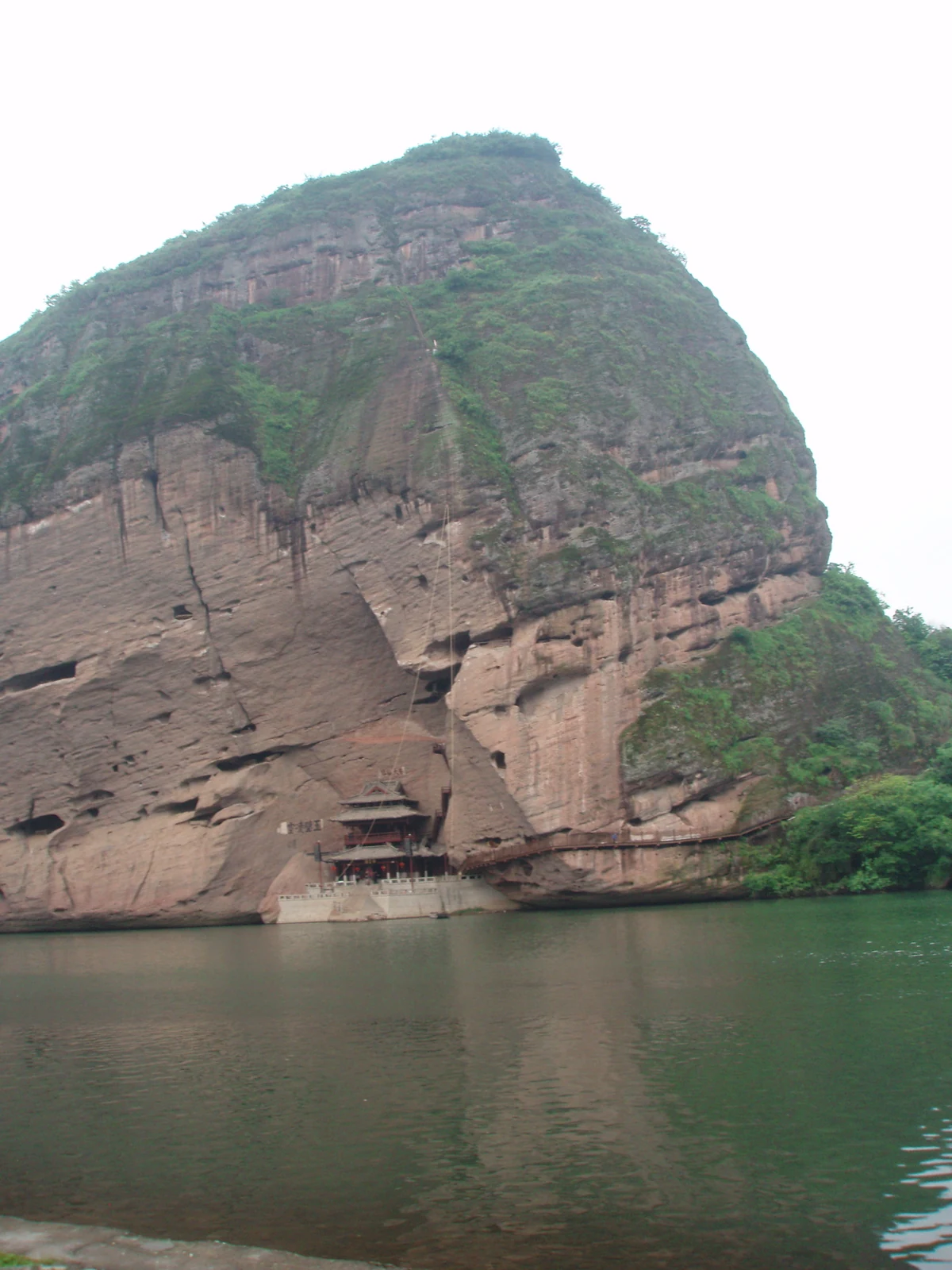
The southern hills of Yingtan are typical Danxia landform: red sandstone laid down in ancient river beds and then cut back into cliffs, isolated peaks and deep gullies. Where other Jiangxi mountains are granite, these are red rock, and the difference is visible in the colour of the walls and in the way the rock shelters caves and overhangs. It is a different geology from Lushan or Sanqingshan, and a reader who has seen those will recognise immediately that this is another kind of mountain.
From the journal
Red rock, and the seat of a Daoist school
The Longhu Mountains are Danxia sandstone, and they have been the seat of the Zhengyi tradition for nearly two thousand years.
In the same city · Yingtan ↗What the hills are made of
The Heavenly Master Mansion
The mountains are one of the four sacred mountains of Daoism and the seat of the Zhengyi school. Zhang Sheng, a descendant of Zhang Ling, settled here in the Three Kingdoms or Western Jin period and established the Sihan Heavenly Master Mansion, the seat of the hereditary masters known as Zhang Heavenly Masters; in the Yuan dynasty the Zhang was honoured as leader of the Zhengyi faith and of the talismans of the Three Mountains. The Shangqing Palace, rebuilt by a descendant of Wang Lin in the Ming Jingtai reign, was renamed the Great Shangqing Palace by the Kangxi Emperor. The town of Shangqing below is on China's list of historic towns.
The tombs in the cliff
The mountain also holds something much older. The Xianshuiyan cliff tombs, cut by the ancient Yue people more than two thousand years ago, are listed among the national key protected relics, and the mountain's Daoist buildings sit alongside them. That combination is the point of the place: the same sandstone that took a tomb was later used for a temple, a tower and a ritual site. Walk the river path below the cliffs and both histories are in the rock at once, which is a different way of reading a sacred mountain from a listing in a guidebook.