At Yin Xu, on both banks of the Huan River in Anyang's northern suburbs, the material that carries the Shang state is small enough to hold in two hands. Tortoise plastrons and ox scapulae were prepared for heat, then inscribed with the questions a king asked his ancestors: about harvests, about war, about a hunt, about the day on which a sacrifice should be made. The Anyang municipal government describes Yin Xu as the first late Shang capital that can be confirmed by documents, by excavation and by oracle-bone inscriptions at the same time, and as the most frequently and longest excavated ancient capital in the country, a reputation that earned it the name of the cradle of modern Chinese archaeology. Xinhua's account notes that the discovery of oracle-bone script opened a direct line between past and present and pushed China's documented history forward by roughly a thousand years.
From the journal
The Questions on the Bones: Reading a Shang Capital at Anyang
At Yin Xu outside Anyang, a new museum presents nearly four thousand objects from the late Shang capital, including the oracle bones on which royal questions were recorded.
In the same city · Anyang ↗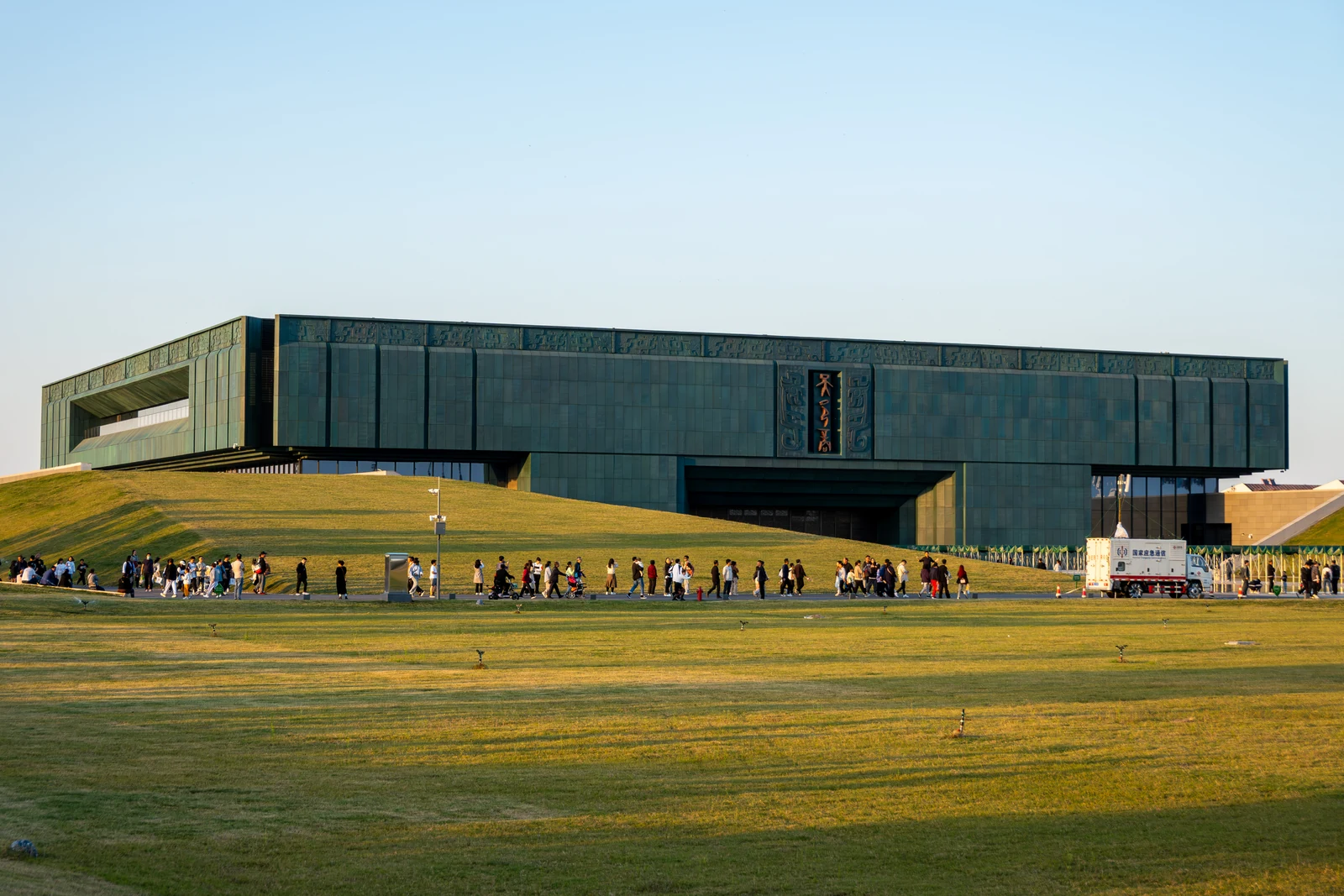
Plastrons and scapulae, read as records
A hall built into the ground beside the river
The new museum stands on the Huan River opposite the palace and temple precinct, built as a joint project of the Anyang municipal government and the Institute of Archaeology of the Chinese Academy of Social Sciences. The municipal account gives the scale: an investment of about 1.06 billion yuan on 262.5 mu of land, a building of 51,000 square metres, exhibition space of roughly 22,000 square metres, four storeys of which one is underground, 22 metres high and 146 metres wide. The design was chosen through a global competition and follows an architect from South China University of Technology; it takes the 'Shang Ode' of the Book of Songs as its starting point and is described in terms of green fields, a tripod standing on the ground, layered depth and bronze cladding. Visitors move through three permanent galleries, four special exhibitions and one immersive digital show.
A queen with an army, back in the gallery
In 2026, the provincial cultural heritage authority hosted an opening event at the palace and temple precinct of Yin Xu for a programme called 'Hello, Fu Hao!', marking the fiftieth anniversary of the excavation of her tomb. The Henan heritage bureau's report describes Fu Hao as the first female general in Chinese history with a verifiable record, and as the wife of King Wu Ding. The event staged her as several characters at once - warrior, queen, priestess, collector and presenter - and laid out a route through a drill ground, a dressing table, a divination table and a treasury of treasures, with a character for the oracle-bone word 'chariot' welcoming visitors at the entrance. That word, drawn in oracle-bone script and laid out on the ground, is the smallest proof that the script on display inside the museum was also a working script, used for days that mattered.