The county government’s description of the park at Xixia divides its work into five parts: a geological science square, the egg site itself, the fossil egg museum, a dinosaur hall and a park of life-size reconstructions. Two of them do the real talking. In the museum, the eggs sit behind glass in a collection of specimens, and the museum’s claim to standing is institutional: it was one of the first three branch museums established by the Geological Museum of China anywhere in the country. The egg site works in the opposite way. There the eggs are not behind glass at all but underground, and the exhibition was made by digging — a tunnel cut through the matrix so that the arrangement in which the eggs lay can be read from inside the ground itself, with the rock and sediment left as they were.
From the journal
A Tunnel Cut Through the Nest at Xixia
The dinosaur park near Xixia shows fossil eggs twice: in cases, and inside a gallery cut through the ground they were buried in.
In the same city · Nanyang ↗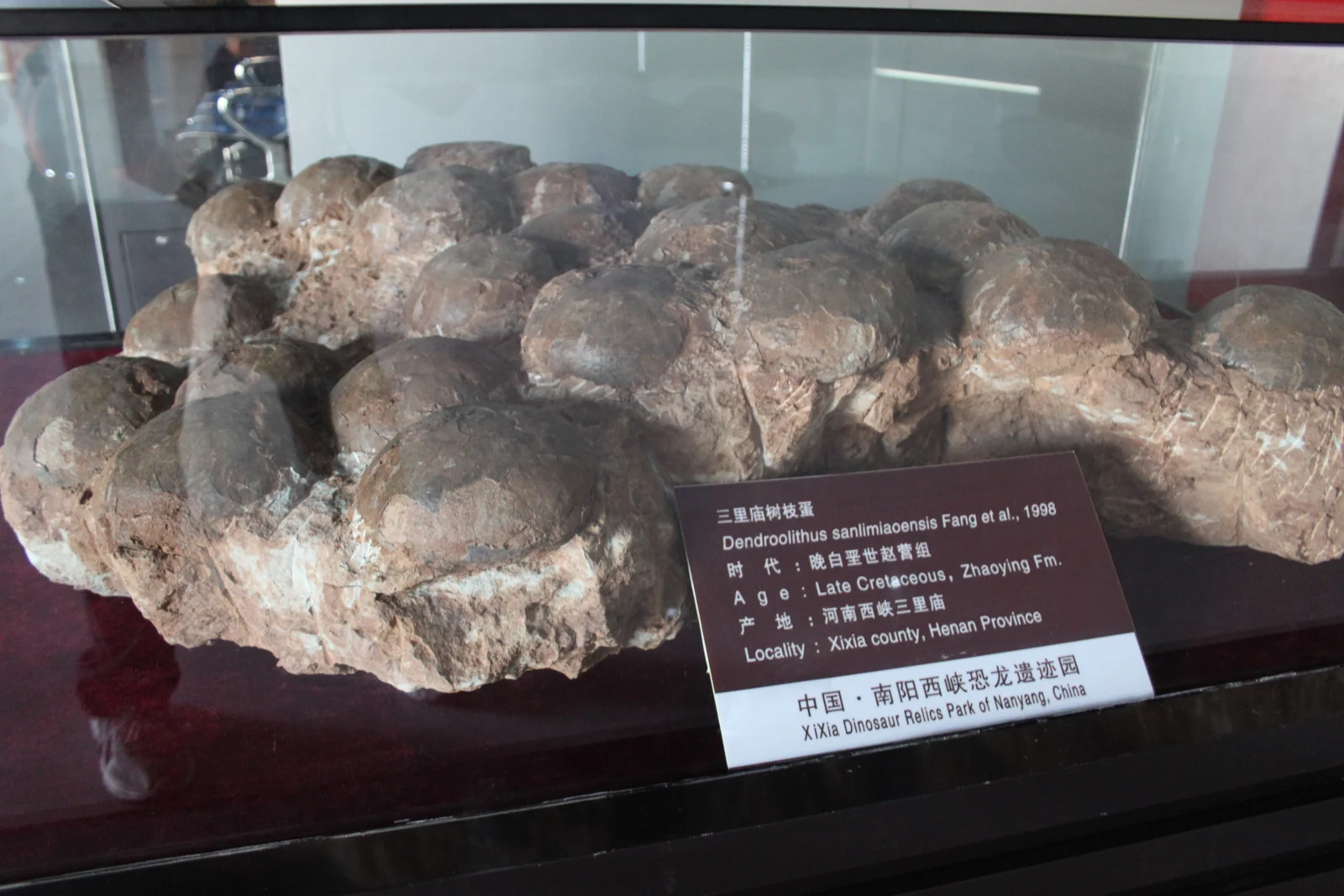
Two Ways of Showing the Same Eggs
Three and a Half Years of Digging, 398 Million Yuan
The park was built and run by the Henan Longcheng group, which put in 398 million yuan in stages; it opened to the public in July 2006, and in April 2013 the last of the three main exhibition halls was finished. The town it stands in, Dan Shui, lies twenty-five kilometres from the county seats of Xixia, Neixiang and Xichuan, which puts it inside the mountainous belt where the Funiu range meets the borders of Henan, Hubei and Shaanxi. The same page also notes the position the park occupies in the landscape: it is in the core area of the Funiu Mountains world geopark and in the core zone of the Nanyang dinosaur egg fossil nature reserve. The distinction matters for a visitor, because the park sits inside a protected landscape rather than beside one.
What Was Added in 2025
The newest work at the park is the loudest. In 2025 the county records a further 30 million yuan invested in two attractions: a flight theatre and a volcano hall. The theatre, which opened for trial operation on 27 September 2025 at a cost of 10.88 million yuan, seats eighty-eight people around a 180-degree high-definition LED ring screen of 236 square metres, with motion seats and effects that carry visitors through the Cretaceous. The volcano hall, built for over sixteen million yuan, wraps a sixteen-metre diameter screen with a thirteen-and-a-half-metre sky screen above it and a six-degree-of-freedom platform in the middle. Since the two spaces began trial operation at the Spring Festival, they have received more than thirty thousand visitors, which is how a geology park becomes a place families queue for.