Wuyuan was one of the six counties of the old Huizhou prefecture and is named as one of the birthplaces of Huizhou culture. Its administrative history follows the prefecture's: under the Northern Song, when Shezhou was renamed Huizhou in 1121, Wuyuan became part of it; in 1277 it was placed under the new Huizhou circuit; in 1295 it was raised to Wuyuan Prefecture, and in 1369 lowered back to a county under Huizhou Prefecture. It is administered by Jiangxi today, and it was a Huizhou county for several centuries before that.
From the journal
Huizhou villages inside Jiangxi
Wuyuan belongs to Jiangxi and to the Huizhou culture at once, and saying which is which is the first job of a reader.
In the same city · Shangrao ↗One of the six counties of Huizhou
What the houses look like
The village architecture is the Huizhou type: whitewashed walls, dark fired-tile roofs, narrow lanes and a bridge over a stream. The county's listed villages include the Qinghua Rainbow Bridge, which is about eight hundred years old, and Liken, Jiangwan, Wangkou, Hongguan and Yan. The Rainbow Bridge was struck by an extraordinary flood on 8 July, which took part of its deck, and it was repaired; the fact that such a structure is still a village crossing rather than a monument is the point of the place.
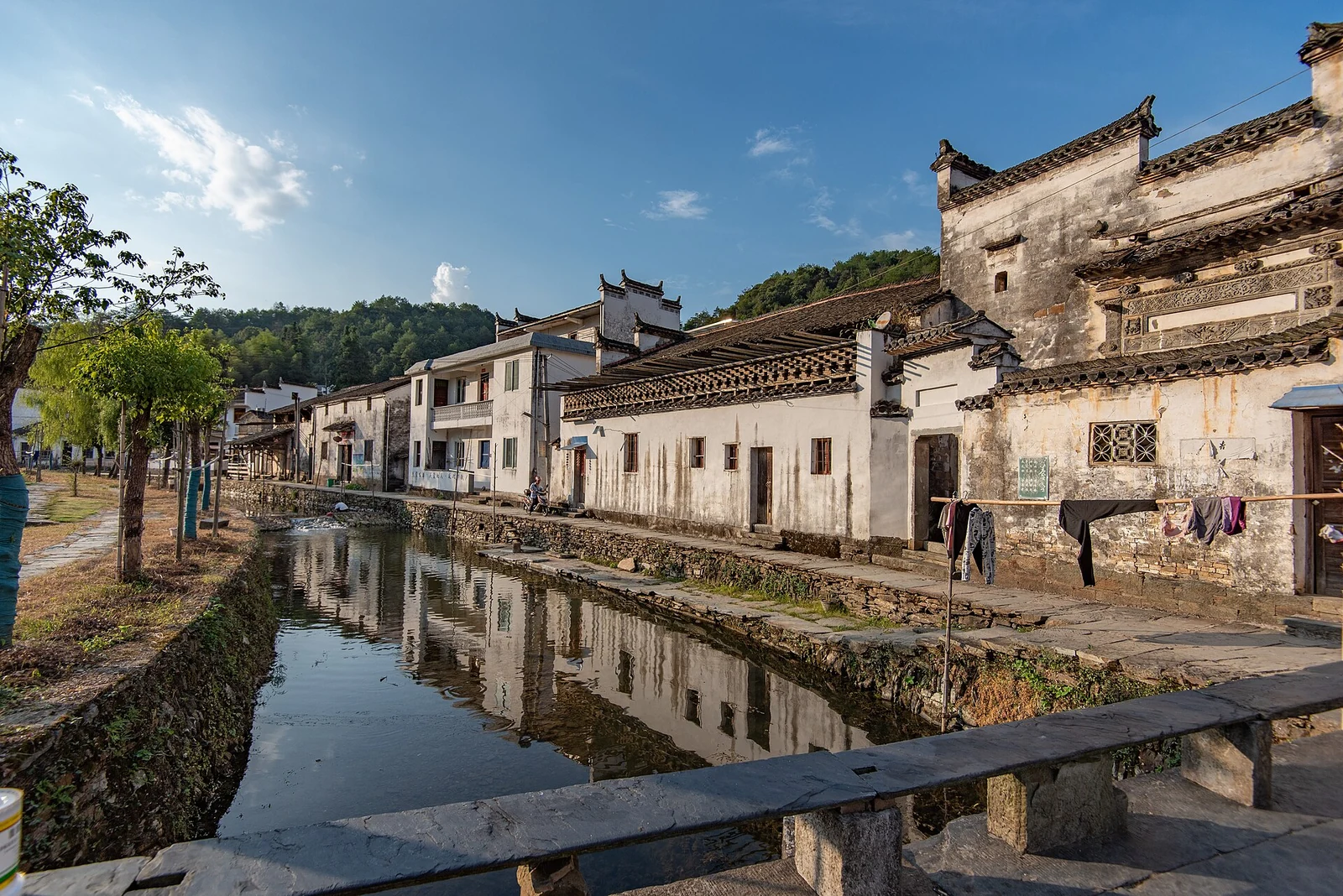
A neighbour inside the province
It would be easy, and wrong, to present Wuyuan as typical Jiangxi. It is a Jiangxi county, administered by Jiangxi, with Jiangxi's geography of hills and streams, but the houses, the clan structures and the aesthetic of white and black are Huizhou, and Huizhou is a cultural region spanning parts of three provinces. Naming that honestly is not a correction of the visitor's expectations; it is what makes the county interesting. Jiangxi is a province of several peoples, and here one of them sits just inside its eastern border.