The Nen River encloses Mingyue Island northwest of Qiqihar. Its history as a public destination grew around Wanshou Temple: in 1925, four temples were built in a diamond arrangement on the island. The provincial culture and tourism department records that Qiqihar decided in 1981 to establish a scenic area around the temple grounds. The island’s religious architecture thus preceded its modern recreation role. Water defines the setting, but the built complex gave residents a reason to gather there long before the scenic-area label.
From the journal
Mingyue Island in the Nen River
Four temples built in a diamond arrangement in 1925 formed Wanshou Temple; in 1981 Qiqihar turned the river island around it into a scenic area later named Mingyue Island.
In the same city · Qiqihar ↗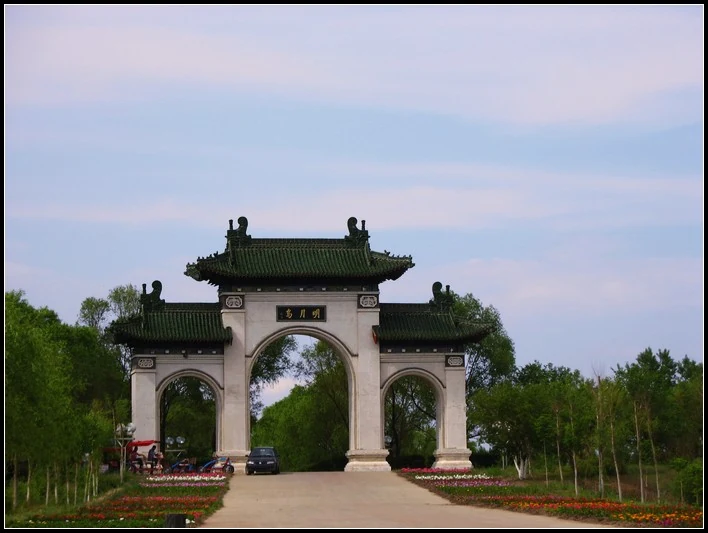
An island gathered by the river
Different layers on one island
The island later became a place of collective civic work. A provincial account recalls that state-owned enterprises and city departments contributed labor to build the surrounding embankment and protective tree belt. In 1984, provincial governor Chen Lei visited and named it Mingyue Island, echoing Harbin’s Sun Island. During the 1980s and 1990s, Qiqihar residents came for group outings, picnics and swimming. That memory connects a constructed landscape—embankment, trees, temples and paths—to ordinary leisure, rather than reducing the island to a view from the river.