From the journal

Guangfu: a walled town in the marsh and the tai chi it taught

Guangfu is a walled town on a peninsula in the Yongnian marsh, with a Ming brick wall, a wide moat and the former houses of the founders of Yang- and Wu-style tai chi. Its streets and gates still follow the plan of a prefecture seat.

In the same city · Handan ↗

A wall built against water

Guangfu sits on a peninsula in the Yongnian marsh, a wetland of about 28 square kilometres in Yongnian District, Handan. Water surrounds the town. The moat runs for five kilometres, three and a half metres deep and a hundred metres wide; behind it stands a brick wall twelve metres high and eight metres thick, on a circuit of four and a half kilometres.

The wall was not always brick. It began as an earthen rampart in the Tang, between the seventh and ninth centuries, and was faced in masonry under the Yuan and Ming. In 1542, in the Jiajing reign, the prefect of Guangping, Chen Zu, brought labourers from thirteen counties and spent thirteen years turning the earthwork into brick. In 1564 his successor Cui Dade added an outer dike and four barbicans, to keep the marsh water out. The gates were later increased from four to eight, with double gate towers.

Two steles survive at the gates and say what the town wanted protected. The western one records Chen Zu's rebuilding. The eastern one is a prohibition: no digging at the foot of the wall, no farming on it, no cutting of its trees, no taking of its fish and lotus. A wall in a marsh is not only a defence against enemies; it is a dam, and the rules on the stele are the rules of maintenance.

Inside, the plan is remembered as a cow. The town faces northwest, its gates sit at the corners, and it is called the lying cow city. The streets are counted in a formula: four great streets, eight small ones, seventy-two turns.
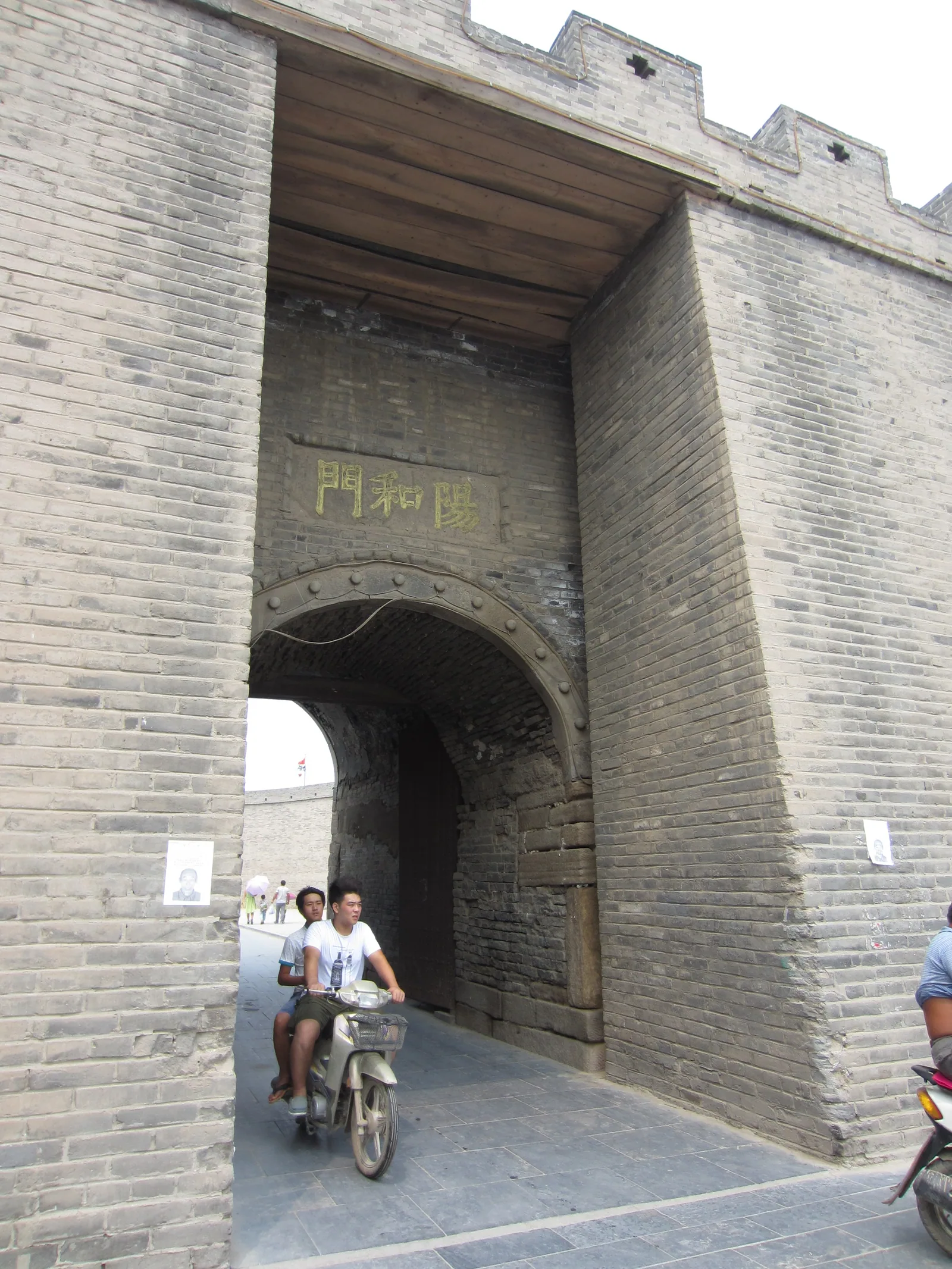
The Yanghe gate of Guangfu Ancient City in Yongnian, the walled town that keeps the memory of Yang-style tai chi.

A marsh that made a strongpoint

The name Guangfu is a contraction of Guangpingfu, the prefecture of which this was the seat under the Ming; the older name of the place, Yongnian, survives as the district. The marsh explains the town's military history. In 619, at the end of the Sui, the rebel Dou Jiande took the city and made it the capital of a short-lived Xia state, and a Tang prince, Li Shentong, was held in its prison. After Dou was captured at Hulao in 621, a few hundred of his cavalry escaped to the city, looted its treasury and surrendered it to the Tang.

His officer Liu Heita rose again, defeated the Tang nearby with Turkic help, occupied the city and called his realm Handong. Li Shimin, the future Taizong emperor, broke him by damming the nearby Ming River and releasing the water over the Handong army. Liu returned with more Turkic help and was defeated again; he was executed in Guangping's marketplace in the first month of 623.

Water made the town difficult to take in later wars too. In 1945, as the war with Japan ended, a local force holding the city with Nationalist backing was supplied by air and held out for two years. It broke out in October 1947, and the town changed hands. The new authorities demolished the north and south barbicans for traffic, leaving the two on the east and west.

What the record shows is a place chosen for a reason and defended for the same reason. The marsh fed the moat, the moat made the wall worth building, and the wall turned a small prefecture seat into a strongpoint that outlasted the states that fought over it.

Two teachers and a rebuilt town

Tai chi is the town's other export. In the nineteenth century Guangfu was home to Yang Luchan (1796-1872) and Wu Yuxiang (1812-1880), the founders of Yang-style and Wu-style tai chi, two of the largest schools of the art in the world. Their former houses have been converted into public museums. In Yongnian, tai chi is taught as part of school physical education, and the district has held exchange events since the 1990s. Local accounts date the art's beginning here to the Daoguang reign of the Qing.

The walled area has been refurbished since China's opening up. The historical area inside the walls covers 1.5 square kilometres, and current construction imitates the town's appearance under the Ming. In 2017 the site was rated AAAAA by the national tourism administration. A television drama, Guangfu Tai Chi, was filmed on location in 2007 and broadcast in 2010.

The two subjects do not quite meet. One is a fabric of brick, water and stone, repaired by prefects and maintained by prohibitions; the other is a set of movements transmitted through families and now through schools and museums. What they share is a habit of keeping a form: a wall held against the marsh, a sequence held against the erosion of a generation.

That is the argument for taking the place as a whole rather than as a backdrop. The moat, the gates, the stele against digging, the houses of the two teachers and tai chi on the school curriculum all describe the same discipline, the daily upkeep of something that would otherwise be lost.

Continue exploring · Guangfu Ancient City ↗
Photo credits and rights
  1. The Yanghe gate of Guangfu Ancient City in Yongnian, the walled town that keeps the memory of Yang-style tai chi.我乃野云鹤 · CC BY-SA 4.0 Photo source ↗ Rights information ↗ Converted to WebP.