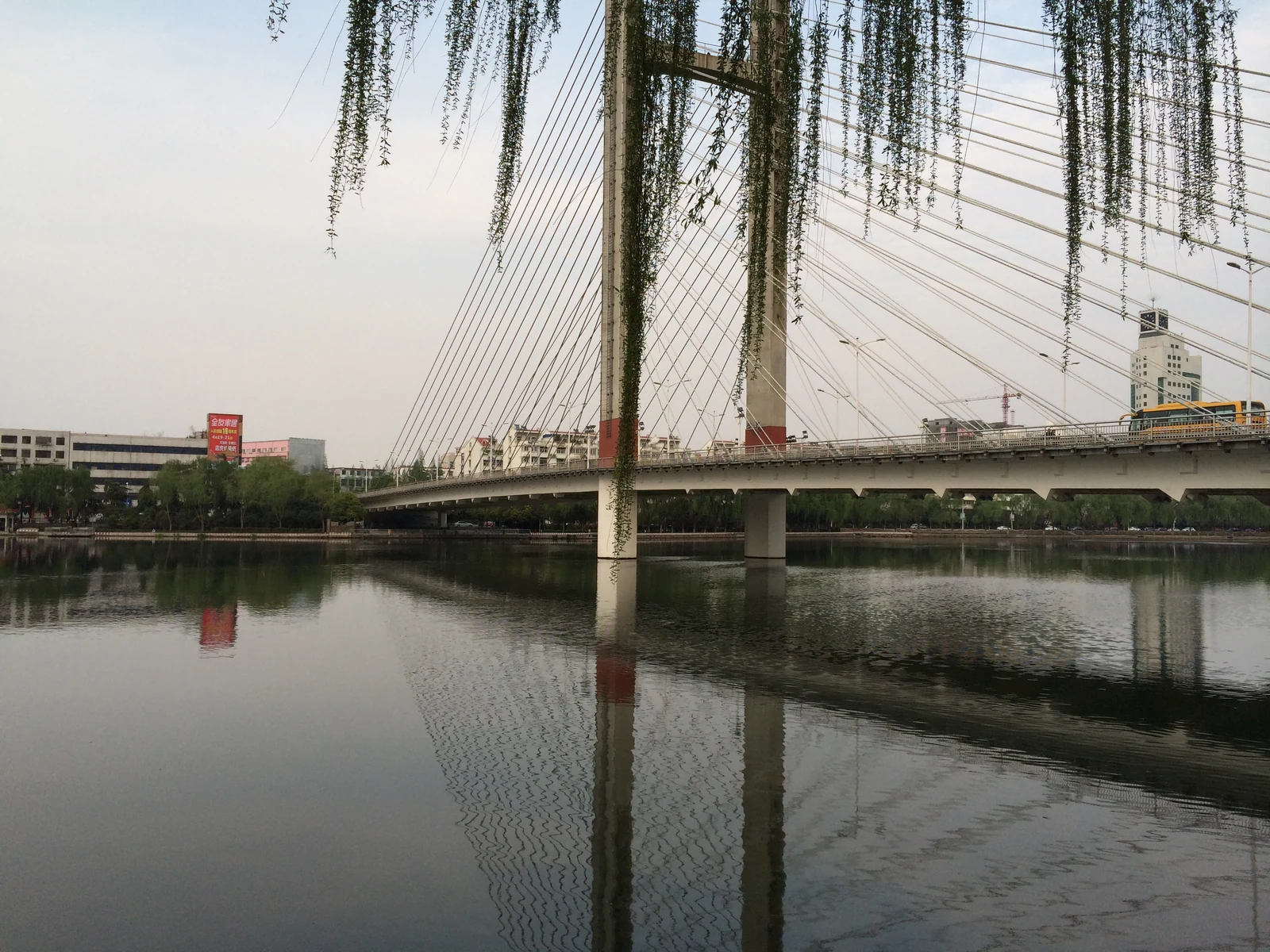
Shihe is the district that contains the city's old core and most of its scenery. Its own introduction gives 1,778 square kilometres, nine townships and ten subdistricts, and a population of nearly 800,000. It describes the district as ringing Nanwan Lake on the west and resting on the Dabie Mountains to the south, in a monsoon climate transitional between subtropical and warm temperate, mild, with abundant light and rain falling in the same season as the heat, and four distinct seasons. That sentence is official geography, but it explains the itinerary: tea in spring, water and shade in summer, rice and reed in autumn, and a lake that stays open in winter. The province listed Shihe and Xinxian as national all-for-one tourism demonstration areas.
From the journal
Four Seasons in Shihe
Shihe district holds the city's old core, its mountain, its lake and most of its A-level scenic areas; its own lists explain how the parts are meant to be read.
The District Shape
The Official Inventory
The district publishes its own inventory of what it holds. The natural list is Jigongshan, Nanwan Lake, Siwang Mountain, Heilongtan, Bailongtan, Linglong Lake and Wuqu Gorge; the cultural list is Xianyin Temple, the Dacheng Hall of the Confucian temple, Zhunti Nunnery, the tomb of He Jingming, one of the first seven masters of the Ming, the tomb of Feng Gao, the Song Shijie site and the eight new sights of Shihe. Reading the two lists together is more useful than reading either alone: the first is water and mountain, the second is buildings and graves inside the old town and on its edge. The list is also a limit. What the district names is what the district promotes, and a reader should treat silence in it as silence, not as a verdict.
Twelve Scenic Areas
The city's tourism bureau publishes a table of A-level scenic areas with counts by district, and the counts are a quick measure of where the visitors are. Shihe has twelve, more than any other district in the city: Jigongshan at 5A; Nanwan Lake, Wenxin Tea Village, Linglong Lake and Hejiazhai campsite at 4A; and Wuqu Gorge forest park and others at 3A. Pingqiao, across the river, has six, among them the Chengyang city-site archaeological park at 4A and Haotang at 3A. The whole table runs to 110 scenic areas. For a reader planning two days, the useful fact is not the total but the concentration: the 5A mountain, the lake, the tea village and the campsite all sit within one district, and the distances between them are short.
The Village That Tidied
Improvements in Shihe have lately been measured in metres and households. A township report from Shihegang, published in December 2025, counts 52 courtyards rebuilt with the help of a volunteer team, 1,200 metres of permeable brick path, 35 solar street lights, and seven Xinyang courtyards made out of unused space planted with tea, vegetables and fruit. The same report says the township linked its red-history sites with Wenxin Tea Village and the Siwang Mountain ecological area to make two touring routes, and counted more than 117,000 visitors over one National Day holiday, with average household income up 10,000 yuan. These are the township's own figures. They describe a method rather than a triumph: small works, spread across households, in a district whose main attractions are already famous.