Yim Tin Tsai’s name remembers salt-making, once a pillar of its island economy alongside fishing. The government’s account says Catholic missionaries began preaching there in 1864, and St Joseph’s Chapel was built in 1890. Those two histories occupy the same small island but describe different kinds of community life. Salt pans belonged to work and livelihood; the chapel became a visible centre of Catholic identity within a Hakka village. The government describes Yim Tin Tsai as one of the few Hakka villages with strong Catholic characteristics. The chapel was graded as a Grade 2 historic building in 2010, recognizing its architectural and cultural value. The coastal settlement developed a distinctive Catholic character while retaining the saltpans and place-name shaped by earlier livelihoods.
From the journal
Salt and Light on Yim Tin Tsai
The island’s restored saltpans and St Joseph’s Chapel hold two strands of Yim Tin Tsai’s story: work by the shore and Catholic village life.
In this district · Sai Kung ↗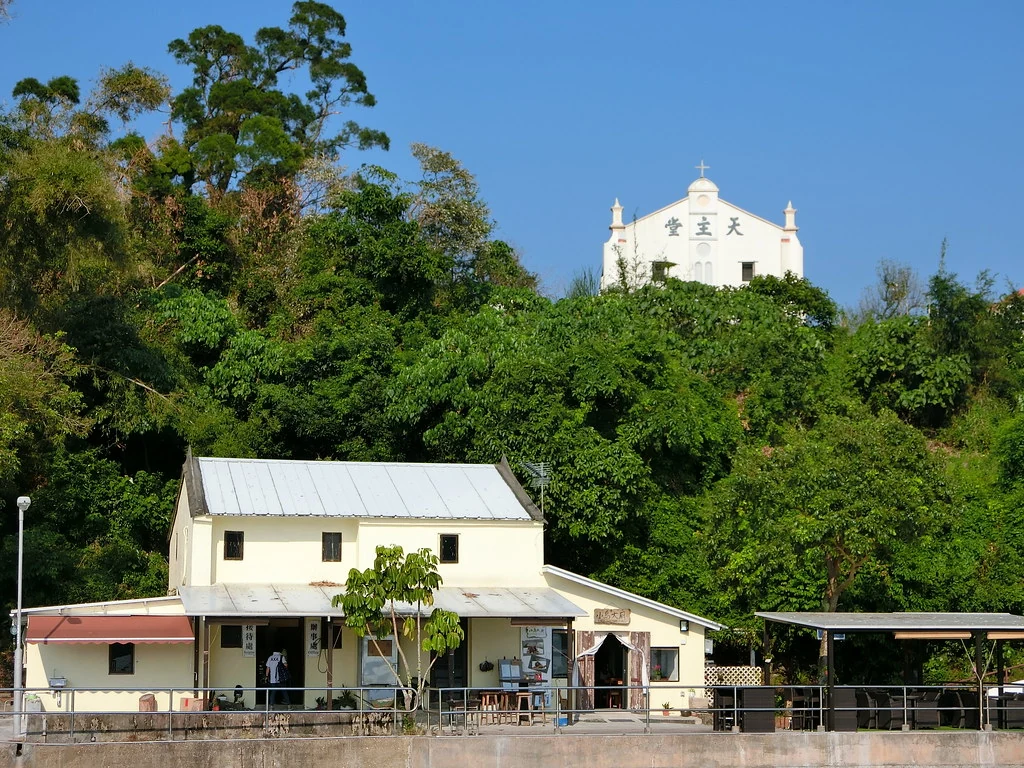
Salt pans and a chapel
A village left empty
From the 1960s, residents moved away to study or work, and the island became uninhabited. The Countryside Conservation Office dates the village’s abandonment to the 1990s, when the last family left. The departure affected village houses and saltpans, whose use depended on local knowledge and everyday work. Later preservation began with those places left behind: the saltpans, homes and chapel that held different parts of the island’s history.
Restoring a practice and a place
Villagers established the Salt and Light Preservation Centre to restore saltpans and village houses and to conduct conservation and education programs. The revitalization brought back traditional salt-making through guided visits and demonstrations, reconnecting the island with a nearly lost craft. The chapel’s restoration received an Award of Merit in 2005, while the saltpan project received an Award of Distinction in 2015 through the UNESCO Asia-Pacific Awards for Cultural Heritage Conservation. These projects preserve different forms of heritage: one is a religious building, the other a landscape of work. Together, they help visitors understand how salt and Catholic life shaped Yim Tin Tsai, and how conservation has given the island new ways to remember both.