From the journal

Yongding or Nanjing? Two Ways into Fujian’s Tulou Country

Compare Yongding and Nanjing through their villages, house plans and landscapes, from Hongkeng and Chuxi to Tianluokeng.

In the same city · Longyan ↗

A building tradition across a county line

A photograph of a circular earthen house rarely tells you which valley it belongs to. That is why Yongding and Nanjing can seem interchangeable before you arrive. On the ground, the useful unit is smaller: a named village, a cluster of buildings, sometimes a single house. Yongding is a district of Longyan; Nanjing is a county of Zhangzhou. Their shared building tradition crosses that administrative boundary.

The UNESCO property called Fujian Tulou brings together selected buildings in both areas and in Hua’an. Its name is an umbrella for a serial heritage site, not the name of one village. A journey can therefore move between different local settings while remaining within the same architectural story. The first choice is what you want to understand: the arrangement of a house, the relationship between several houses, or the village and cultivated ground around them.
Yongding offers three different scales

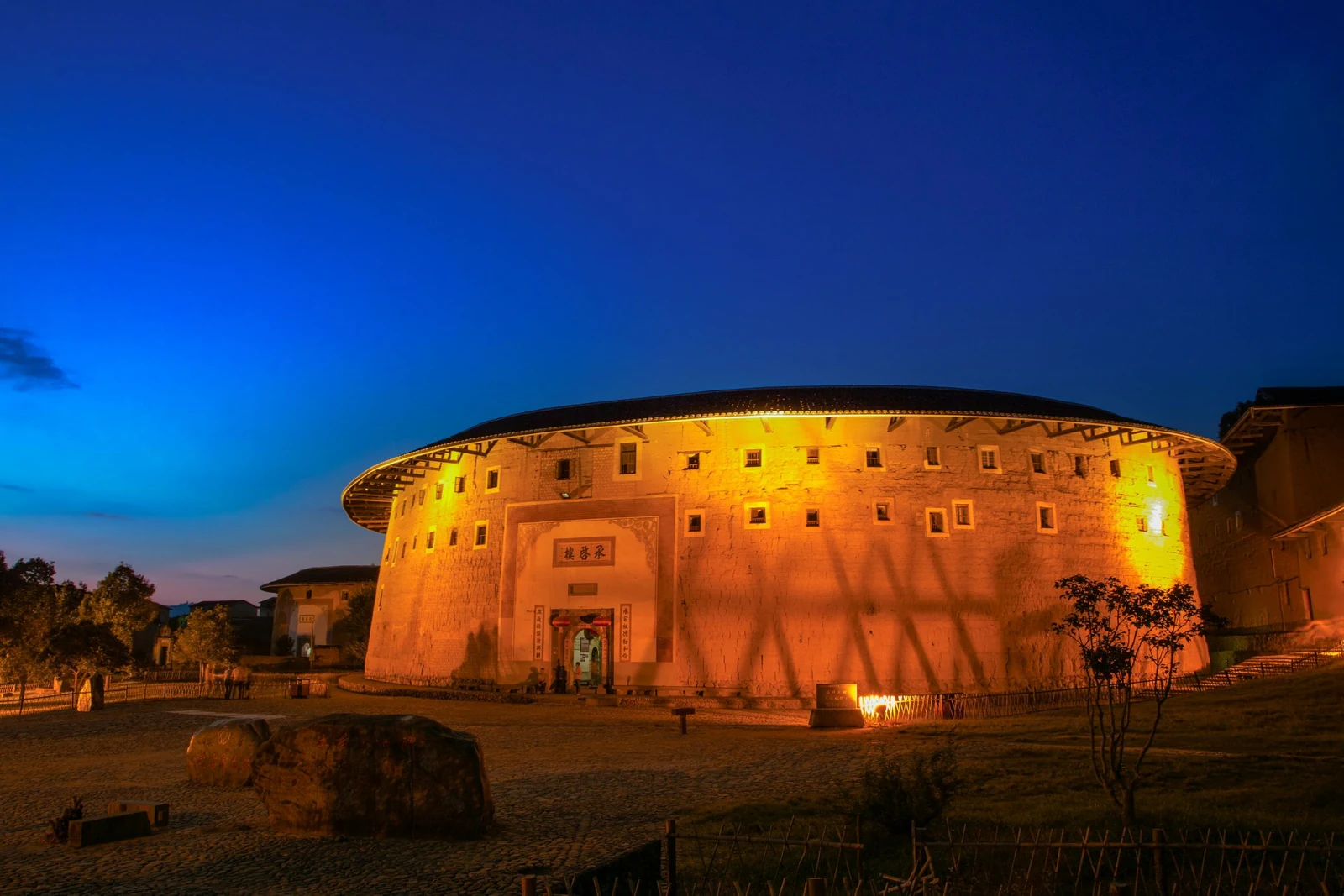
In Yongding, Hongkeng, Gaobei and Chuxi make a particularly useful set of contrasts. Hongkeng rewards attention to variety: circular buildings share a village with residences whose courtyards and halls follow a more strongly axial order. Gaobei brings the eye towards Chengqilou, where nested rings organize a dense interior. Chuxi invites a wider frame, with large houses set against slopes and a stream.

These are differences in emphasis rather than competing rankings. A reader fascinated by how many households fit beneath one roof may find Gaobei especially revealing. Someone interested in how buildings sit within agricultural land has a different question to carry to Chuxi. Hongkeng makes it easier to see that a shared material and social tradition can produce quite different silhouettes.

The broad circular earthen facade of Chengqi Lou under a deep blue evening sky.
Chengqi Lou in Gaobei, illuminated after dusk.

Nanjing changes the comparison

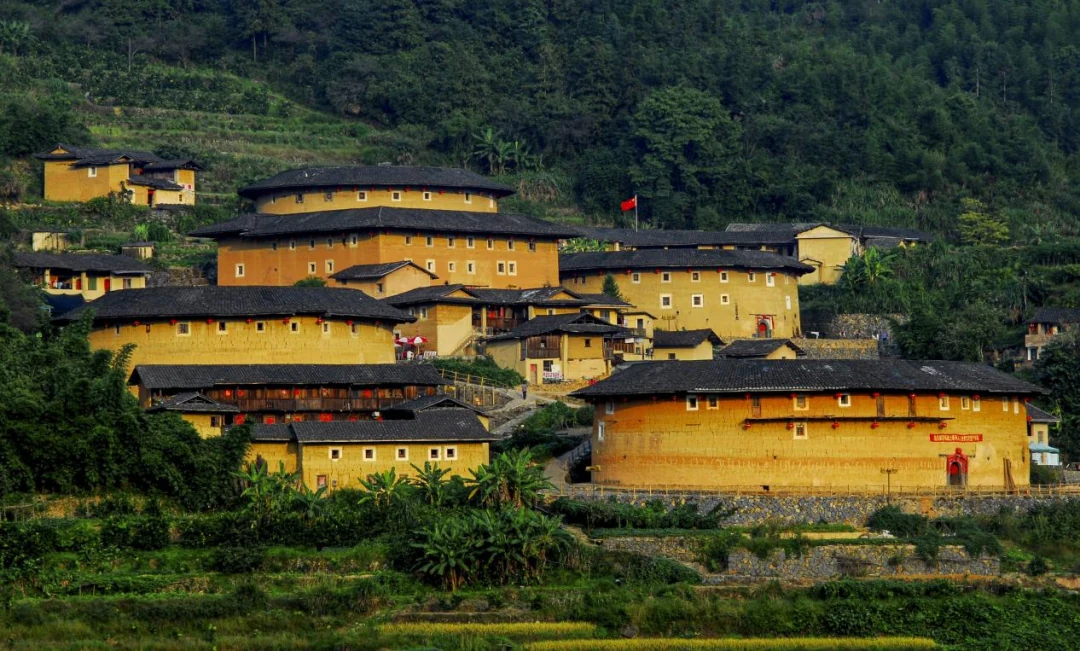
Across the boundary, Tianluokeng offers a compact grouping whose forms are readily understood together from above. Hekeng presents another village-scale arrangement. The important comparison is between compositions: the space separating buildings, their orientation, and the way paths and fields connect them. A dramatic overhead view is a beginning; the entrances and ground between the houses explain how a cluster actually works.

Nanjing also supplies a contemporary example of the pressures inside old houses. A 2023 provincial report described kitchen electrification and wiring improvements, including the concerns of Yuchanglou resident Liu Yifeng about cooking fires. That small domestic detail changes the meaning of preservation. A building that photographs beautifully still has to accommodate meals, power and safe movement. Its residents experience those questions every day.

Yellow earthen walls and black tiled roofs rise in tiers against a wooded hillside.
Tianluokeng’s earthen buildings step up the hillside.

Follow the differences all the way home

“Hakka” is essential to Yongding’s cultural history, but the wider Fujian tulou tradition also belongs to Minnan communities. Neither a round outline nor an earthen wall identifies every resident’s language and ancestry. National heritage documentation also emphasizes that square tulou are widespread in Yongding itself. The famous circle is a memorable ambassador for a much larger family of buildings.

The most satisfying comparison therefore leaves room for ordinary things: a doorway within a monumental wall, the distance from a house to its fields, a cooking space altered for modern needs. Choose the village whose questions interest you, and allow its particular arrangement to emerge. Yongding and Nanjing become more rewarding when their buildings acquire individual names and purposes, rather than merging into a single spectacular photograph.

Continue exploring · Yongding ↗
Photo credits and rights
  1. Chengqi Lou in Gaobei, illuminated after dusk.福建省客家土楼旅游发展有限公司 · Rights status unspecified Photo source ↗ Original aspect ratio retained. Display copies resized only when needed; no enlargement, crop or retouching.
  2. Tianluokeng’s earthen buildings step up the hillside.福建省住房和城乡建设厅 · Rights status unspecified Photo source ↗ Original aspect ratio retained. Display copies resized only when needed; no enlargement, crop or retouching.