From the journal

Chuxi: Returning the Tulou to Its Mountain Village

Chuxi’s stream, slopes and clustered roofs reveal the landscape around Yongding’s earthen houses, while Jiqinglou opens another story inside.

In the same city · Longyan ↗

The space outside the walls

A close photograph can make a tulou seem self-contained. Chuxi offers a reason to step back. Here the houses belong to a mountain village, with the stream, rising ground and routes between buildings remaining essential to the composition. The large circular roofs catch the eye first; the surrounding land explains how a settlement extends beyond its monumental walls.

Chuxi lies in Yongding’s Xiayang area. Its inscribed cluster is one component of the wider Fujian Tulou World Heritage property. The village and the heritage component are related scales, rather than interchangeable names for every structure in view. Looking across the settlement, the mixture of round and rectilinear buildings keeps the scene from resolving into one repeated shape.
A house has a catchment of daily work

The stream establishes a line through the landscape; paths and cultivated ground introduce others. Together they suggest the practical reach of a house. Domestic life draws on land outside the enclosure, while building materials, food and people must travel back towards it. The threshold belongs to a network.

This is why a photograph showing only the largest building tells a different story from a view that retains the slope and watercourse. In the wider frame, the wall’s scale can be judged against the valley. Several roof heights reveal the village’s accumulated growth. The relation between shelter and open land becomes visible before any room count is considered.

UNESCO’s conservation account treats the farmed and forested setting as part of the tulou’s significance. Chuxi gives that principle an especially clear visual form.

Jiqinglou and the many ways upstairs

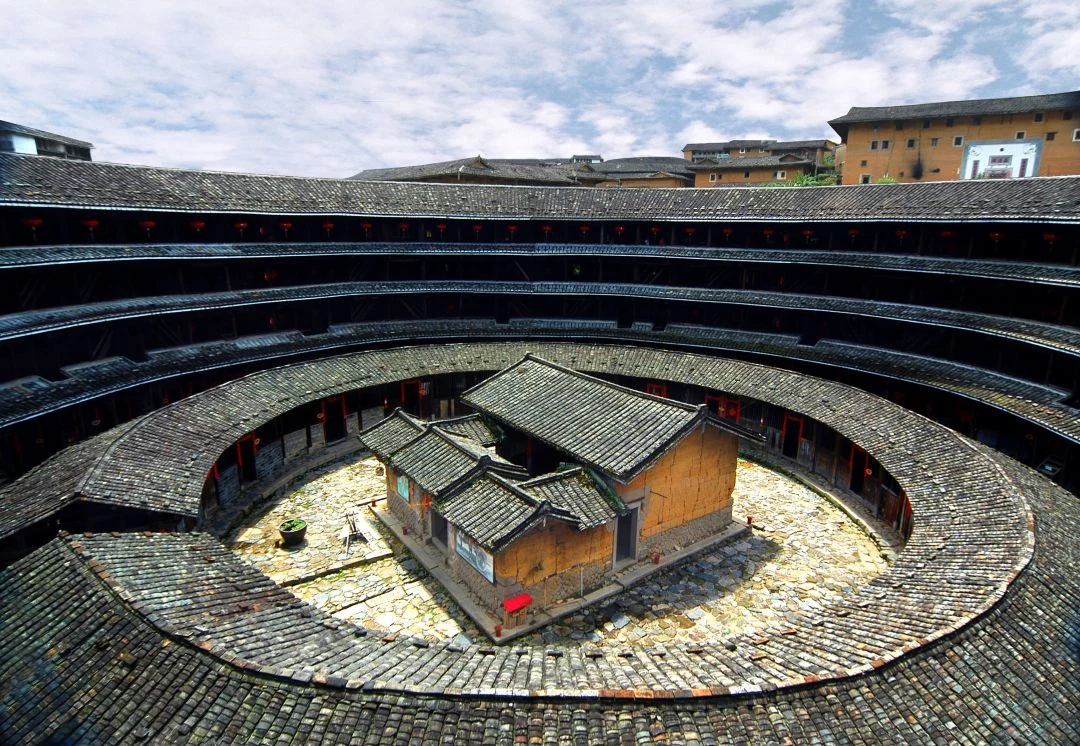
Inside Jiqinglou, stairs provide a more intimate clue. The scenic-area operator dates the building’s foundation to 1419 and describes 72 stairways dividing its interior into separate units. Its timber partitions and joinery therefore deserve as much attention as the outer circle. A shared enclosure could accommodate a surprisingly individualized pattern of movement.

The stairs complicate the idea that every tulou worked through one continuous public gallery. Repeated vertical routes allow households to maintain their own connections between floors. It is possible to share a large structure while carefully distinguishing the paths through it.

The workmanship also belongs to a building tradition rather than a single miraculous trick. Timber connections, partitions and stairs are useful because of how they fit and function together. Their relationship to the whole house is more revealing than a slogan about the absence of nails.

Circular tiers of tiled galleries surround a central cluster of low courtyard buildings.
The inner galleries and courtyard of Jiqing Lou in Chuxi.

Harvest, display and continuing care

Chuxi’s agricultural setting also appears in contemporary cultural events. In September 2025, an organized harvest-season display at Jiqinglou arranged bamboo trays and crops across its circular roofscape. Seen in a photograph, such a display can look like an unchanging village custom. Knowing its event context gives it a different interest: an old architectural form is being used to present rural heritage to a modern audience.

The buildings require less spectacular work as well. Official fire inspections in 2024 included Jiqinglou and other Chuxi houses, connecting the preservation of historic timber to present-day safety.

Chuxi holds these scales together: the hillside settlement, the elaborate household routes, and the current work of caring for a heritage place. The great round house remains the visual anchor, but the village around it supplies the larger story.

Continue exploring · Chuxi Tulou Cluster ↗
Photo credits and rights
  1. The inner galleries and courtyard of Jiqing Lou in Chuxi.福建省客家土楼旅游发展有限公司 · Rights status unspecified Photo source ↗ Original aspect ratio retained. Display copies resized only when needed; no enlargement, crop or retouching.