From the journal

Hongkeng: A Tulou Village Beyond the Circle

Zhenchenglou’s iron railings and Fuyulou’s ordered courts show the architectural range of Hongkeng in Yongding.

In the same city · Longyan ↗

Several answers to the same question

At Hongkeng, in Yongding’s Hukeng area, the most useful first impression is variety. The village brings together houses with different outlines, internal arrangements and decorative ambitions. Zhenchenglou supplies the famous circular enclosure. Fuyulou draws attention to a sequence of halls and courts. Other buildings make the range feel like a local conversation rather than a catalogue of isolated monuments.

Each answers a recognizable problem: how to gather related households, protect their property and make room for ceremony and daily work. The answer need not be circular. Even the word tulou, literally an earth building, points first towards a construction tradition. Its social purpose and materials allow more possibilities than the silhouette on a souvenir.
Iron flowers inside earthen walls

Zhenchenglou repays a close look at the meeting of materials. The operator’s description identifies stone-carved column bases, carved wooden elements, glazed ceramic details and patterned cast-iron gallery railings. Plum, orchid, bamboo and chrysanthemum motifs give the metalwork a delicacy quite unlike the building’s heavy outer wall.

Partitions divide the circular body into sectors, while the central hall provides a place for communal gatherings. The contrast is especially telling: the exterior encloses; the interior subdivides and connects. Ironwork, brick, timber and earth contribute different textures and functions. Calling the whole structure an earthen house is accurate, but only the beginning of its material story.

From the courtyard, the repeated openings make the circle legible. At close range, a railing or column base introduces the individual decisions that a distant view smooths away.

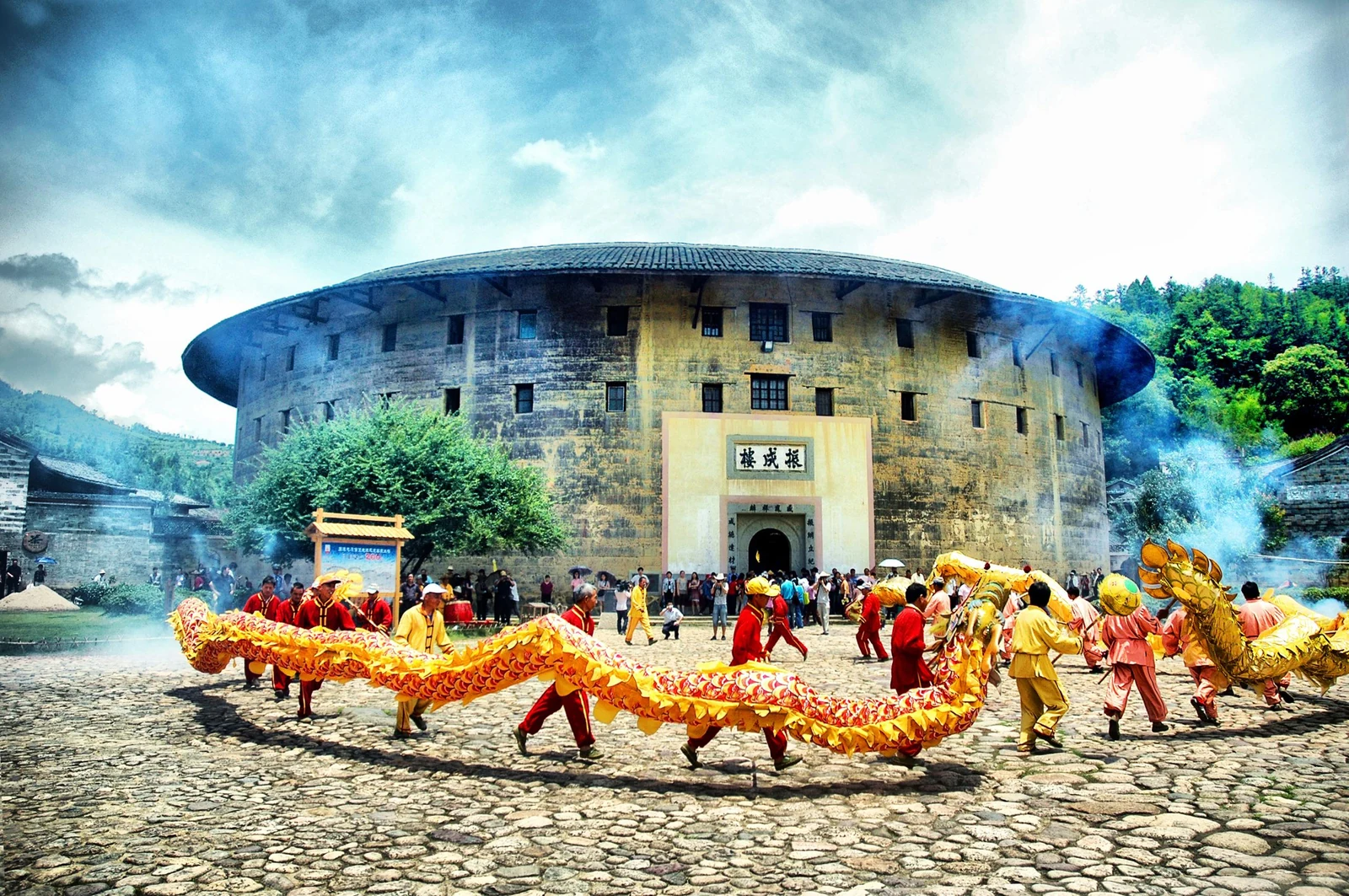
Performers carry a yellow dragon across the cobbled forecourt of a circular tulou.
A dragon dance outside Zhencheng Lou in Hongkeng.

The authority of an axis

Fuyulou changes the rhythm. Its mansion-like arrangement gives greater emphasis to halls, courtyards and a central axis. Where a ring carries the eye sideways, an axial residence encourages it to look through successive spaces. The distinction can be understood without memorizing a specialist classification: ask whether the building’s strongest visual movement is around a centre or towards a hall beyond another court.

These alternatives also change the appearance of the roofscape. Several roofs and levels can articulate a residence’s hierarchy, while a circular outer ring produces a more continuous edge. Hongkeng allows both principles to be considered within one village. Its interest lies partly in the way similar needs generate different architectural experiences.

The village had connections beyond its valley

The national heritage record connects the flourishing of Yongding’s building culture with economic success, including tobacco production and trade. This helps explain why a rural setting can contain such ambitious houses. Wealth did not have to originate entirely within the fields immediately outside a doorway; trade could return to the valley in the form of construction, decoration and family investment.

The buildings also depend on craft knowledge that remains active in repair. In a published interview with the China Architecture Culture Center, craftsman Zhang Canjin describes teaching while working with teams skilled in earth walls, carpentry and other trades. A magnificent old house survives through many such decisions about materials and workmanship.

Hongkeng rewards moving between these scales: the village, the house, the carved or cast detail. A circle draws you in. The differences between buildings give you a richer picture to take away.

Continue exploring · Hongkeng Tulou Cluster ↗
Photo credits and rights
  1. A dragon dance outside Zhencheng Lou in Hongkeng.福建省客家土楼旅游发展有限公司 · Rights status unspecified Photo source ↗ Original aspect ratio retained. Display copies resized only when needed; no enlargement, crop or retouching.