From the journal

Quanzhou String Puppetry: The Art above the Strings

Look beyond the miniature character to the timing, music and trained hands that animate Quanzhou’s string-puppet theatre.

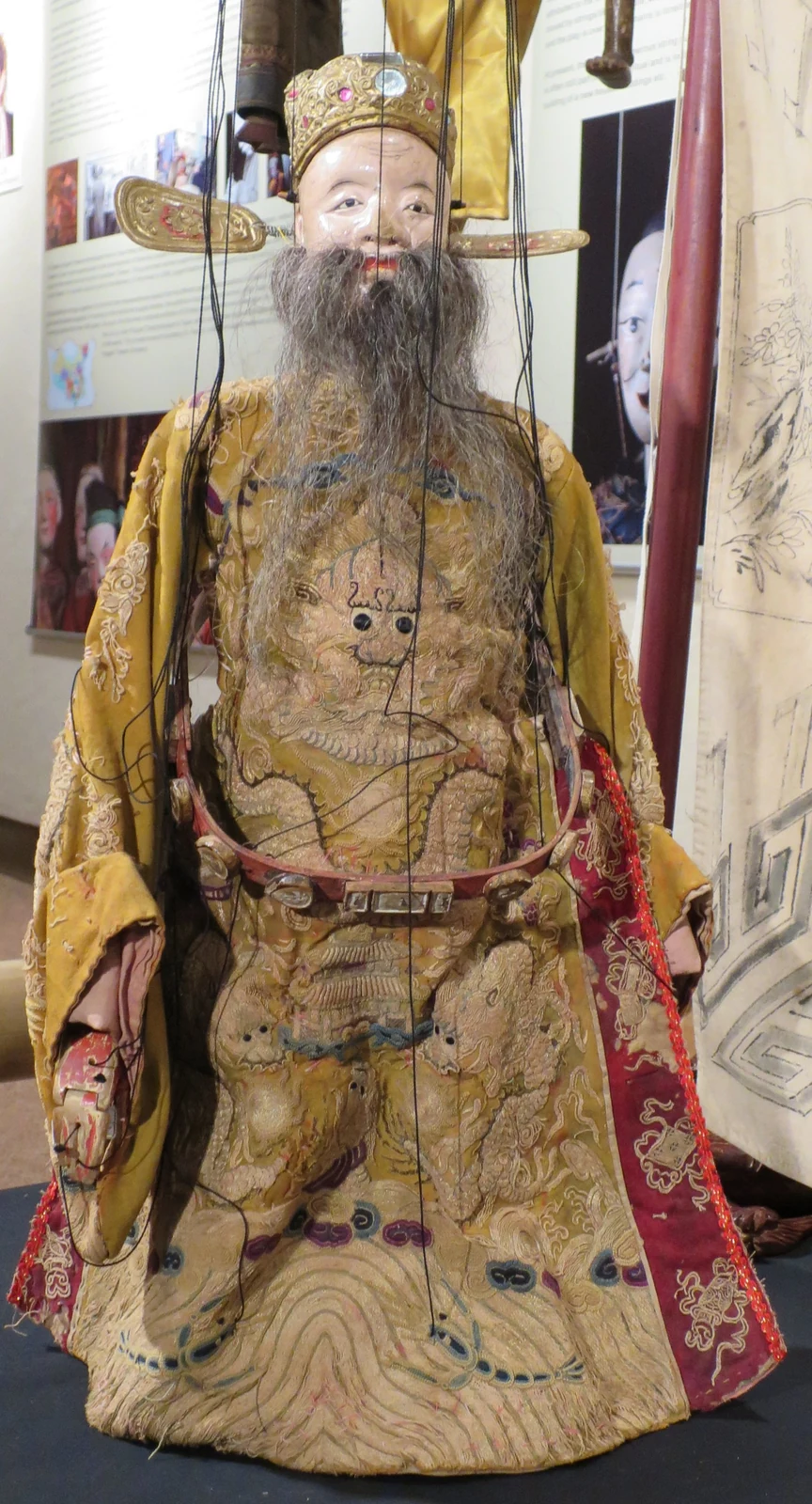
A carved puppet figure in embroidered robes with a long beard, displayed upright.
A 19th-century marionette figure from Quanzhou.

The convincing part is often small

A puppet’s turn of the head can be more absorbing than a spectacular leap. For a moment, a carved face appears to notice something. A foot seems to accept weight. Cloth follows the movement just late enough to suggest a body beneath it. Quanzhou string puppetry makes such tiny changes legible, allowing wood, costume and suspended limbs to become a character.

The English word marionette helps explain the basic arrangement: the figure is operated by strings from above. This is different from hand or glove puppetry, in which the performer’s hand works inside the figure. Fujian is home to both traditions. In Quanzhou’s string theatre, the space between performer and puppet is crossed by lines that can be visible without spoiling the illusion. Knowing how the movement is made often increases its pleasure.

Two bodies, one gesture

Try watching the puppet and then the operator, if the staging allows both to be seen. A movement that looks effortless below may require a carefully limited adjustment above. Gravity is always present: the figure hangs, settles and changes direction. The performer’s task is to make those physical conditions serve the character rather than overwhelm it.

The training described by Wang Jingxian and Hong Shijian in their 2020 practitioner report joins string control to spoken delivery and singing. New performers were assigned dramatic role types, then worked one-to-one with experienced teachers on these connected skills. They developed them through traditional short plays and larger productions, including The Orphan of Zhao. The small pause that makes a wooden face seem attentive belongs to this wider theatrical education: movement has to carry a role, a voice and a moment in a story.

A theatre made by several crafts

The Quanzhou tradition includes puppet-head carving, the construction and dressing of figures, established operating techniques and its own musical repertoire, known as kuileidiao. A practitioner report by Wang Jingxian and Hong Shijian describes the documentation of plays, music and line techniques alongside the training of younger artists. Preserving the object alone would leave much of the theatre out.

A costume has to look right when still and behave well in motion. Music gives a gesture its setting in time. The dramatic role makes a movement meaningful to an audience. These elements are most revealing when considered together: a beautifully carved face is one achievement, while making that face seem to listen is another. Traditional stories and newer productions also place different demands on the same shared craft, keeping technique connected to the needs of a particular performance.

What has to pass from hand to hand

In 2012, UNESCO selected a strategy for training future Fujian puppetry practitioners for its register of good safeguarding practices. The recognition concerned a programme of transmission covering string and hand puppetry, rather than designating a single show as a World Heritage monument. Its central difficulty is familiar in demanding crafts: acquiring the skill takes time, while the circumstances in which people learn and work keep changing.

For an audience, a short performance can reveal the result without revealing all those years. Let the skill remain visible. Applaud the human judgement behind the apparently independent figure, and listen as carefully as you watch. A puppet is a small body carrying a large collaboration. The moment it seems alive belongs to the carver, maker, musician and performer together, renewed each time a movement has to be made again.

Continue exploring · Quanzhou ↗
Photo credits and rights
  1. A 19th-century marionette figure from Quanzhou.Hiart, CC0, via Wikimedia Commons · CC0 Photo source ↗ Rights information ↗ Original aspect ratio retained. Display copies resized only when needed; no enlargement, crop or retouching.