From the journal

Listening to Quanzhou Nanyin for the First Time

A horizontal lute, bamboo flute and carefully shaped voice offer a way into Nanyin, the musical tradition shared by Minnan communities.

Let the phrase take its time

The first adjustment is a small one: resist waiting for the music to hurry. In Nanyin, a phrase can seem to hang in the space between breath, plucked string and the next syllable. Instead of searching immediately for a tune to hum, notice how a sound begins and how it is allowed to finish. The pauses and held notes are part of the encounter, not empty stretches on the way to a climax.

Nanyin belongs to Minnan, the southern Fujian cultural and language region of which Quanzhou is a major centre. Its name is often rendered as southern music. Here it identifies a particular tradition, with instruments, repertoire and ways of singing that reward close attention even when the words are unfamiliar. Understanding every lyric is one possible pleasure, not the only entrance.
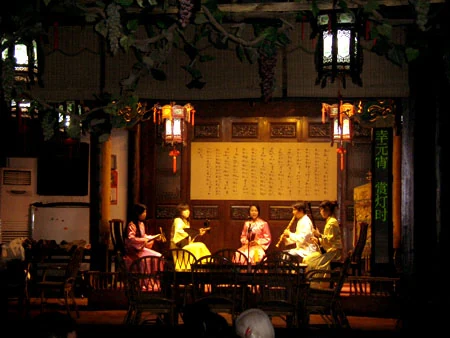
Seated musicians perform on a softly lit indoor stage, with tables and chairs in the foreground.
Nanyin performers in a teahouse, illustrated on Quanzhou’s official tourism portal.

The instruments explain something before they sound

Look first for the pipa, a plucked lute held horizontally, and the dongxiao, a long bamboo flute. In the core ensemble described by China’s national heritage register, these join the sanxian, a three-stringed plucked instrument, and erxian, a bowed string instrument; the singer holds wooden clappers. Different ways of producing sound sit beside one another: breath, plucking, bowing and a struck beat.

For a first hearing, try following one of those sound qualities for a short passage, then let the whole ensemble return. A plucked note has an audible edge; a breath-driven tone can extend differently. Listening this way makes the ensemble less like a single unfamiliar texture and more like an exchange between recognizable actions. Watch hands and breath when the setting permits, without assuming that more visible movement means a more important musical part.

Words live inside the sound

Nanyin has three broad repertoire categories. Zhi are linked suites with words, notation and instructions for pipa fingering. Pu are instrumental suites without lyrics; their titles can evoke flowers, birds or the seasons. Qu are individual vocal pieces accompanied by the main instruments, often drawing on stories from earlier drama and literature. A concert selection therefore belongs to a larger musical world, with different relationships between singing, instrumental sound and narrative.

The singing uses the Quanzhou language tradition, with careful attention to the shaping and ending of syllables. Even without translation, the voice can draw attention to the physical work of articulation. If a programme provides a story or lyric synopsis, read it before the piece; then return attention to the performance. A few lines of context can free the ear from trying to solve every word while it is being sung.

A tradition sustained in company

UNESCO placed Nanyin on its Representative List of Intangible Cultural Heritage in 2009. Its social life reaches beyond the formal stage into gatherings and associations, and beyond Fujian into overseas Minnan communities. The music travels through people who practise together, learn a shared repertoire and continue finding occasions to perform it.

That is a different kind of continuity from keeping a stone building standing. It depends on repeated decisions to listen, rehearse and teach. A polished concert and a community gathering can offer different windows into the same broad tradition; neither needs to stand for the whole. Let a first encounter be modest: recognize the horizontal lute, attend to the shaping of one phrase, and notice how the musicians stay together. The city’s history then enters through time and sound rather than through a monument’s date.

Continue exploring · Quanzhou ↗
Photo credits and rights
  1. Nanyin performers in a teahouse, illustrated on Quanzhou’s official tourism portal.泉州市人民政府旅游栏目 · Rights status unspecified Photo source ↗ Original aspect ratio retained. Display copies resized only when needed; no enlargement, crop or retouching.