From the journal

Qingyuan Mountain: Laozi between Rock and City

At Quanzhou’s northern mountain edge, a monumental seated Laozi turns a natural boulder into a meeting of sculpture, landscape and Daoist thought.

In the same city · Quanzhou ↗

A large figure at ease

The seated Laozi at the foot of Qingyuan Mountain is monumental without appearing restless. His body settles into the rock; a hand rests on a support, another on his knee. The size is impressive, but the pose draws attention toward composure rather than exertion. It is an unusual way for a great stone image to command a view.

The carving dates to the Song period and rises more than five metres high. It was made from a large natural rock at the mountain’s southern foot, north of Quanzhou’s historic city. That origin matters to the encounter. The material has not simply been brought into a garden as a finished object. The mountain supplies the body of the sculpture, making the boundary between a figure and its surroundings especially interesting to look at.
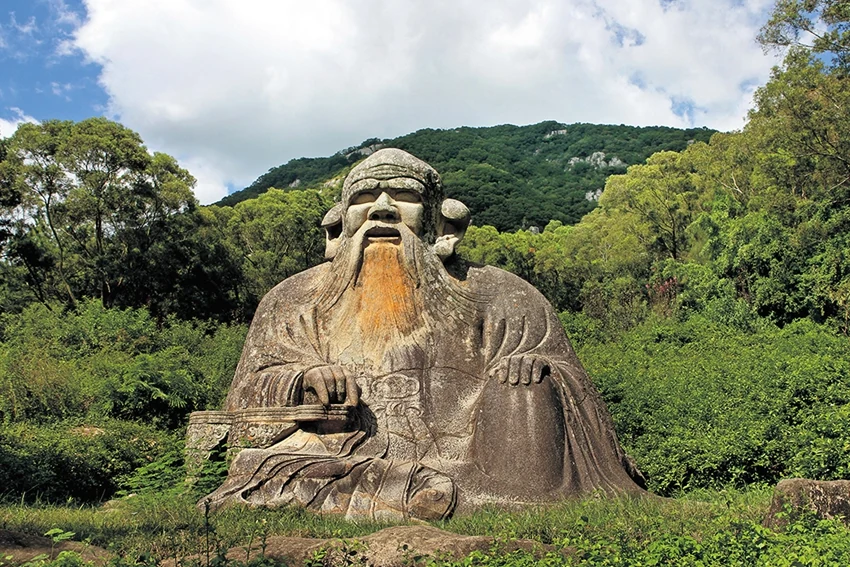
A monumental seated stone figure stands against a wooded hillside.
The Laozi carving at Qingyuan Mountain.

Who is Laozi?

Laozi, also written Lao Tze, is the figure traditionally associated with the Daodejing, one of the central texts of Daoist thought. In religious Daoism he also has a divine identity, commonly approached through the title Laojun, the Old Lord. The local name Laojun Rock therefore places the image within a religious world as well as a history of philosophy.

Those overlapping roles are useful to keep in mind. Someone can encounter the figure through a text, through devotion or through the visual force of the sculpture. The carving need not be reduced to an illustrated quotation. Its scale, posture and setting do their own work. A body apparently at ease can lead a viewer to consider the relation between power and restraint, or between human activity and a larger landscape, without requiring a lesson in every branch of Daoist history.

Follow the maker’s decisions

Look where a recognizable feature becomes less distinctly human: at the edges of a robe, around the seat, or where the bulk of the body meets the rock beneath it. Sculpture is a series of decisions about what to remove and what to leave. Here the original mass remains part of the figure’s authority. The mountain has not disappeared behind the carved person.

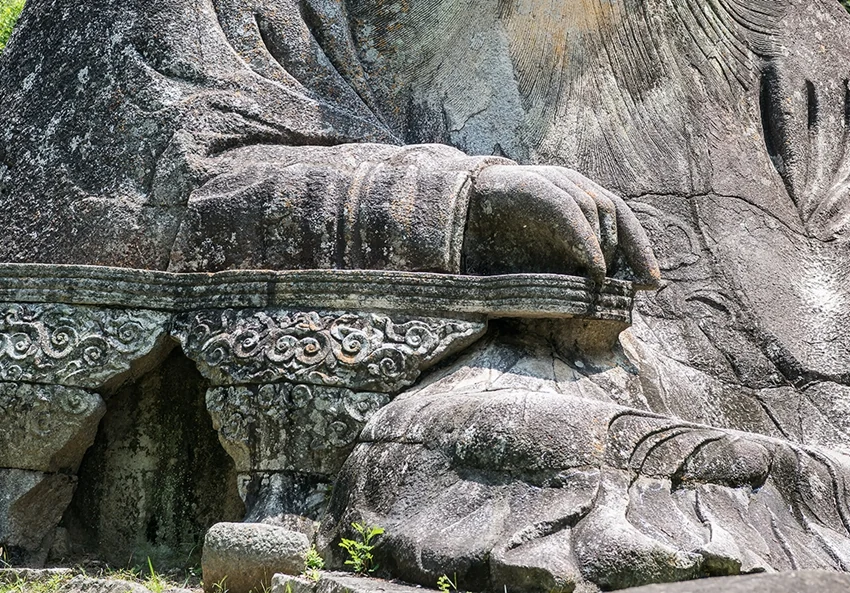
The face asks for a different distance from the full body. Viewed as a whole, the image is a landmark; viewed in detail, it becomes a set of worked surfaces and carefully arranged proportions. Moving between these views is more rewarding than trying to take in the entire figure at once. The support under the right hand, including its cloud decoration, introduces another scale of craft within the large, apparently simple composition.

Close view of fingers, drapery and curling ornament cut into stone.
The hand, robe and carved seat of the Laozi statue.

A mountain edge to a maritime story

The UNESCO component is the Statue of Lao Tze, a specific monument within the Qingyuan Mountain setting. The designation does not turn every path, facility or viewpoint on the mountain into a medieval component. This precise focus makes the connection with Quanzhou clearer: the maritime city also had a religious and cultural landscape on its inland edge.

The statue faces toward the city and port to the south, according to the official heritage account. That orientation makes an instructive companion to the usual outward-looking picture of Quanzhou. A city sending goods and people overseas still looked toward mountains, cultivated local sacred places and gave physical form to ideas with deep roots in China. The quiet seated figure belongs to that larger view. Maritime history here has room for stillness as well as movement, and for the rock above the city as well as the waters beyond it.

Continue exploring · Qingyuan Mountain ↗
Photo credits and rights
  1. The Laozi carving at Qingyuan Mountain.泉州市人民政府美食之都申创官方网站 · Rights status unspecified Photo source ↗ Original aspect ratio retained. Display copies resized only when needed; no enlargement, crop or retouching.
  2. The hand, robe and carved seat of the Laozi statue.泉州市人民政府美食之都申创官方网站 · Rights status unspecified Photo source ↗ Original aspect ratio retained. Display copies resized only when needed; no enlargement, crop or retouching.