From the journal

Mawei Shipbuilding: Why a Shipyard Needed a School

At Fuzhou’s Mawei shipyard, learning French, English and mathematics was part of learning to build and navigate a modern ship.

In the same city · Fuzhou ↗

Machines were only a beginning

A steamship could be bought. The capacity to design, build, maintain and navigate one was harder to acquire. That distinction lies at the heart of the Fujian shipbuilding enterprise established at Mawei in 1866. Its workshops and schools belonged to the same project: imported equipment would be of limited use without people able to understand what it did.

Zuo Zongtang initiated the undertaking; Shen Baozhen became its leading administrator. The French naval officer Prosper Giquel helped recruit foreign specialists and obtain machinery. Their work brought engineers, teachers, craftspeople and students into one riverside enterprise. The shipyard was therefore also an experiment in how knowledge could move between languages and become practical skill.
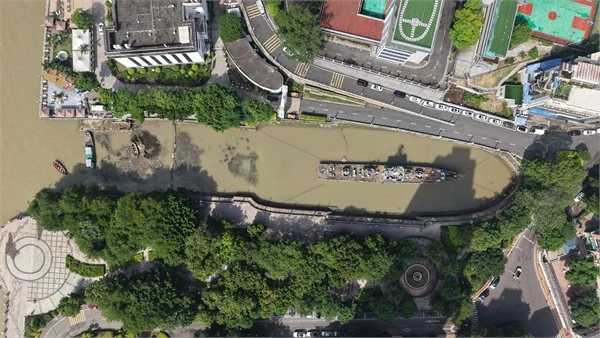
A long water-filled dock with a vessel, trees and surrounding roads viewed from above.
An aerial view of the No. 1 Dock at Mawei’s Ship Administration heritage site.

Two languages, different technical worlds

The manufacturing school used French and taught subjects including mathematics, physics, mechanics and ship construction. The navigation school used English, with geography, navigation and astronomy among its subjects. The division reflected the expertise the enterprise sought from France and Britain.

Language learning was not an ornamental addition to a technical education. A drawing needed to be read; a teacher’s explanation needed to be understood; a calculation needed to produce an answer that would work outside the classroom. Navigation added another difficulty: the position of a moving vessel had to be established using observations and mathematical knowledge. The school joined abstract study to consequences that could be tested in metal, timber and water. A mistranslated term or misunderstood measurement was more than an examination mistake.

From a vessel to a capability

The early ship Wan Nian Qing embodied the first stage of this effort. The enterprise used steam propulsion with a stern screw rather than the conspicuous side paddles of some earlier vessels. Subsequent work involved changing materials and structural methods as shipbuilding itself developed.

One milestone was Yixin, begun in 1875 and designed by graduates of the shipyard school. Its significance lay not simply in adding another hull to the water, but in the transfer of design responsibility. Teaching could now feed back into production. The shipyard later moved through iron-and-wood construction toward steel vessels. Each change required more than replacing a material: it altered the work that had to be organised, the skills needed and the relationship between a design and its manufacture.

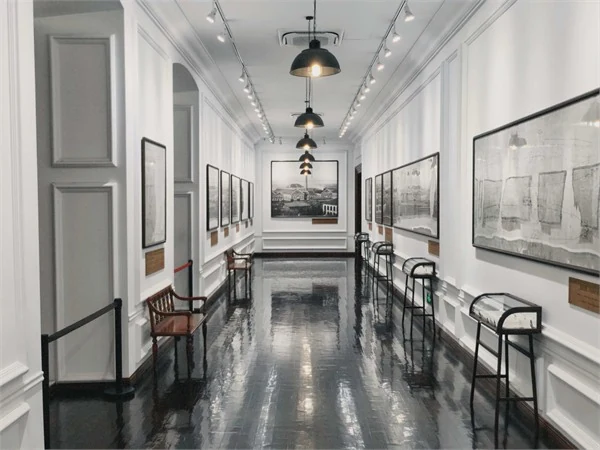
Framed drawings line a bright corridor with white panelled walls and a dark floor.
Historic drawings displayed in the Huishi drawing office at Mawei’s Ship Administration heritage site.

A student carries knowledge elsewhere

Yan Fu studied navigation in this educational world and later continued his training at Greenwich in Britain. He became known far beyond the navy as a translator and thinker. His career shows how a technical school could have consequences outside its intended profession: the encounter with new languages and ideas travelled onward with its students.

At Mawei, surviving industrial fabric, such as the iron-rib workshop, gives this story a physical scale. Museum displays and models help explain processes, while conserved workshops belong to the production landscape itself. Their different roles complement one another. The most important object is not necessarily a complete ship. A school, a workshop and the record of a student’s training together reveal the ambition behind the enterprise: to make learning reproducible, so that the next vessel could depend on knowledge already present at home.

Continue exploring · Mawei Shipbuilding Heritage ↗
Photo credits and rights
  1. An aerial view of the No. 1 Dock at Mawei’s Ship Administration heritage site.中国船政文化景区 · Rights status unspecified Photo source ↗ Original aspect ratio retained. Display copies resized only when needed; no enlargement, crop or retouching.
  2. Historic drawings displayed in the Huishi drawing office at Mawei’s Ship Administration heritage site.中国船政文化景区 · Rights status unspecified Photo source ↗ Original aspect ratio retained. Display copies resized only when needed; no enlargement, crop or retouching.