From the journal

Leba Valley’s Cliff Carvings: Reading an Old Tibetan Inscription

A 2024 scholarly survey examines an eight-line Old Tibetan inscription and nearby Buddhist carvings at the mouth of Leba Valley.

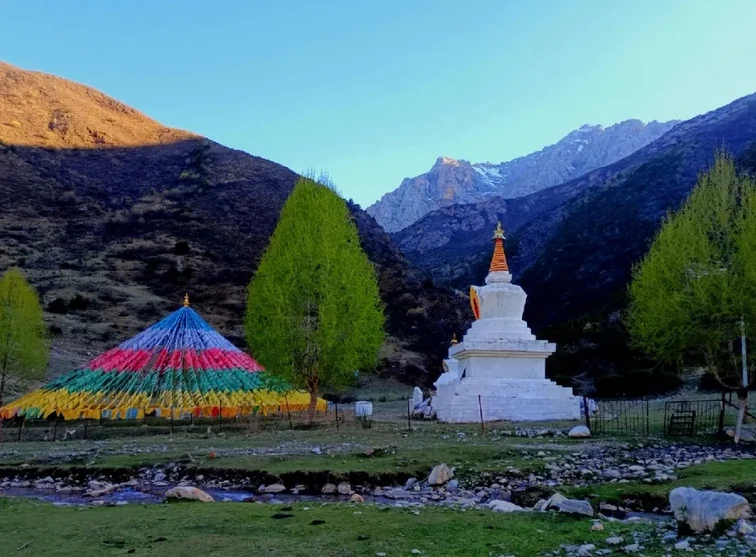
The Lebagou valley’s rock-carving setting, from Yushu’s official tourism page.

Eight lines cut into the cliff

At the mouth of Leba Valley, on the west bank of the Tongtian River, an eight-line inscription is cut into the rock beside a Buddhist image. In 2024, scholars from Qinghai Minzu University revisited the lines and compared their letter forms with inscriptions farther inside the valley. They identified the text as Old Tibetan and proposed an early ninth-century date.

Weathering, cracks and missing sections shape what can still be read. Researchers follow surviving strokes and compare them with nearby inscriptions, treating the cliff as both an image surface and a written record.

Images and words on the same route

The survey connects the entrance inscription with carvings inside the valley, including images of Vairocana, Avalokiteshvara and Vajrapani. Comparison suggests the entrance text and inner-valley images may belong to a broad period around the early ninth century. Researchers relate the group to the religious and political world of the Tibetan Empire and routes through Yushu.

The Tongtian River runs below the cliff, while images and writing remain on the rock above. Reading the valley brings together carved figures, an inscription and the landscape that holds them.

Continue exploring · Yushu ↗
Photo credits and rights
  1. The Lebagou valley’s rock-carving setting, from Yushu’s official tourism page.玉树市文体旅游广电局 · photographer not stated · Rights information Photo source ↗ Proportionally resized and converted to WebP without cropping. No objects were added, removed or reconstructed.