From the journal

Two Scripts on One Stele: Qutan in a Beijing Exhibition

A 2026 exhibition in Beijing displayed a replica of Qutan Monastery’s Rear Hall Stele. Its Chinese and Tibetan inscriptions turned one stone monument into a meeting point for two written traditions.

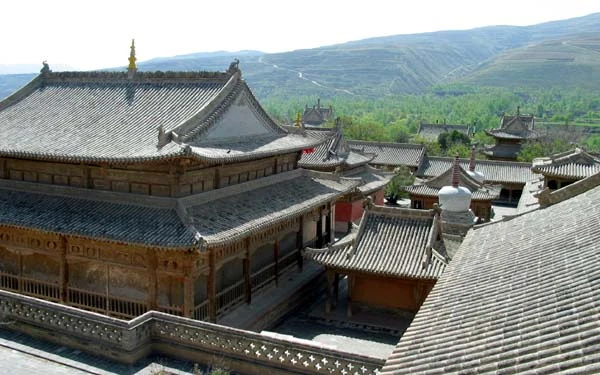
Qutan Monastery and its mountain setting, photographed in 2004.

One stone, two written surfaces

Chinese regular script covers the front of the Rear Hall Imperial Stele replica shown in Beijing’s 2026 exhibition “Highland Silk Road: Light of Qutan.” Tibetan writing occupies its reverse. The two scripts share one monument but a viewer encounters them on separate faces, moving around the stone to see the other text.

The exhibition presented a replica of a monument from Qutan Monastery in Ledu. Its inscription includes the word “China,” according to the exhibition account. The division between front and back makes the stele’s bilingual form visible as a physical arrangement as well as a written record.

From the pavilion to an exhibition

Qutan’s architectural precinct contains two imperial steles: the Imperial Stele of Qutan Monastery and the Imperial Stele of the Rear Hall. A specialist’s account places them in the stele-pavilion courtyard and dates the former inscription to 1408. Their freestanding stone forms sit within a formal complex of halls, courtyards and corridors.

The Beijing replica carried one part of that setting into a gallery. There, visitors could look at the script on each face as an object in its own right; at Qutan, the original monument also belongs to the pavilion and the monastery’s history of imperial patronage.

Continue exploring · Haidong ↗
Photo credits and rights
  1. Qutan Monastery and its mountain setting, photographed in 2004.Andreas Gruschke (Freiburg) · CC BY-SA 3.0 Photo source ↗ Rights information ↗ Proportionally resized and converted to WebP without cropping. No objects were added, removed or reconstructed.