From the journal

Dehua White Porcelain: Looking Closely at the Source

From a kiln’s chambers to a porcelain figure’s fingertips, Dehua reveals the material and human choices behind blanc de Chine.

In the same city · Quanzhou ↗

White gives the eye more work

A white porcelain figure can seem almost without colour until light reaches a fold, a fingertip or the edge of a sleeve. Then the surface becomes a landscape of shadows. Dehua’s celebrated white wares reward this kind of close looking: the form carries much of the expression that a painted surface might otherwise provide.

Dehua is an inland county within Quanzhou, not a neighbourhood beside the harbour. Its name identifies a long ceramics tradition as well as a place of contemporary production. The term blanc de Chine, French for white from China, is widely used for its white porcelain. Beginning with a single object is often the best way to understand the larger reputation. Look at how the clay has been made to suggest something unlike itself: cloth, a petal, a hand at rest.

Before the famous figure, an export industry

The World Heritage component consists of specific Dehua kiln sites, including Weilin-Neiban and Qudougong, rather than the whole county or every modern workshop. Song-Yuan production included white and bluish-white wares in practical forms such as bowls, bottles and pouring vessels. Municipal heritage interpretation traces their movement by land toward Yongchun and then by water to Quanzhou’s port.

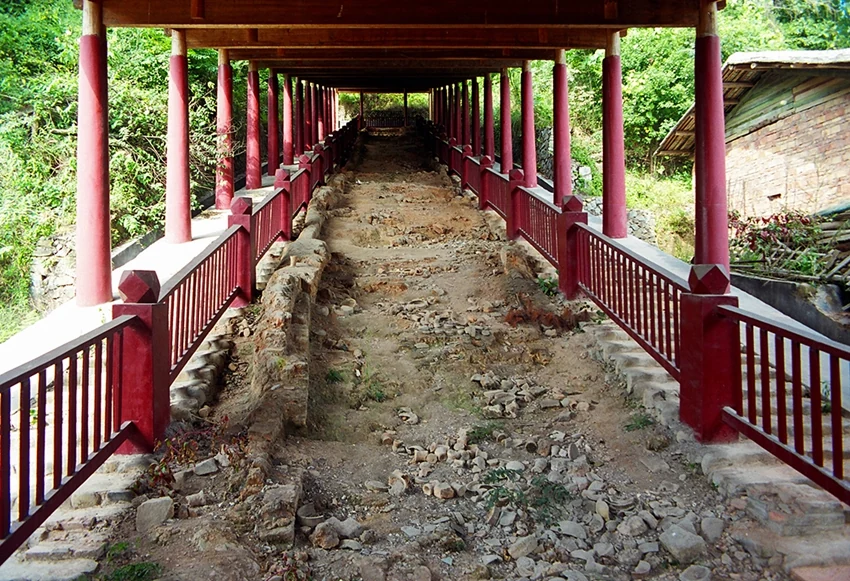
At Qudougong, the excavated Yuan-period kiln had a sequence of chambers climbing a slope. That structure directs attention from the finished object to the organization of heat and production. A bowl arrives in a museum or household as one compact thing; the place that fired it can occupy a hillside. The contrast makes industrial scale visible. Repeated small vessels were part of a substantial system of making and moving goods.

A stepped earthen archaeological site lies beneath trees on a hillside.
A hillside kiln site in the Dehua kiln heritage group.
A long excavated kiln lies beneath a modern roof supported by red columns.
Sheltered kiln remains in the Dehua heritage group.

A mould does not remove the hand

The Victoria and Albert Museum describes Dehua figurine production through piece-moulds: clay is pressed into sections to form the body, while details can be modelled or moulded separately and attached. This helps explain how repeatable forms and individual finishing coexist. A mould can establish the figure, while the joining, surface and added details still demand skilled judgement.

The finished object conceals much of that sequence. Consider where parts meet and how a delicate projection survives as part of a coherent whole. The question is not simply whether a work was handmade or mass-produced; those categories can overlap in a workshop’s actual process. A convincing sleeve or finely formed hand records decisions at several stages. The uninterrupted white surface makes the result look effortless, even though it brings together a chain of material transformations.

An old subject, continuing possibilities

Guanyin, the Buddhist bodhisattva associated with compassion, is a major subject of Dehua porcelain. One useful comparison is the Metropolitan Museum of Art’s eighteenth-century White-Robed Guanyin, an imposing white-glazed figure in its New York collection. It is a reference for understanding the craft, not an object a visitor should expect to find in Dehua.

The county’s ceramic life also includes industrial manufacturing and contemporary art. The V&A’s account places living artists alongside historical makers, showing how porcelain can remain a material for experiment as well as a vehicle for established forms. At the source, these different kinds of production belong in the same broad picture. Let a kiln explain scale, a mould explain repetition and a small finished detail explain judgement. White porcelain becomes less a mysterious substance than the visible outcome of many connected choices.

Continue exploring · Dehua County ↗
Photo credits and rights
  1. A hillside kiln site in the Dehua kiln heritage group.泉州市人民政府美食之都申创官方网站 · Rights status unspecified Photo source ↗ Original aspect ratio retained. Display copies resized only when needed; no enlargement, crop or retouching.
  2. Sheltered kiln remains in the Dehua heritage group.泉州市人民政府美食之都申创官方网站 · Rights status unspecified Photo source ↗ Original aspect ratio retained. Display copies resized only when needed; no enlargement, crop or retouching.