From the journal

Quanzhou: How a Maritime City Worked

Follow a porcelain bowl from inland kilns toward the sea to understand Quanzhou’s bridges, trading institutions and 22 World Heritage components.

Begin with something small

A porcelain bowl is a useful way into Quanzhou. It can sit comfortably between two hands, yet getting it aboard a seagoing vessel required a landscape of labour: clay prepared, a kiln fired, goods packed, loads carried, river crossings negotiated and a cargo assembled. The coast was only the final part of that work. Start with the bowl and the famous port becomes easier to picture than it does through a panorama of sails.

Quanzhou stands on Fujian’s southeastern coast. Its medieval name, Zayton, appears in Arabic and Western accounts. During the Song and Yuan periods, roughly the tenth to fourteenth centuries, it was a major centre of Asian maritime commerce. The important question is how such a centre functioned beyond the moment a ship arrived.
The port begins in the mountains

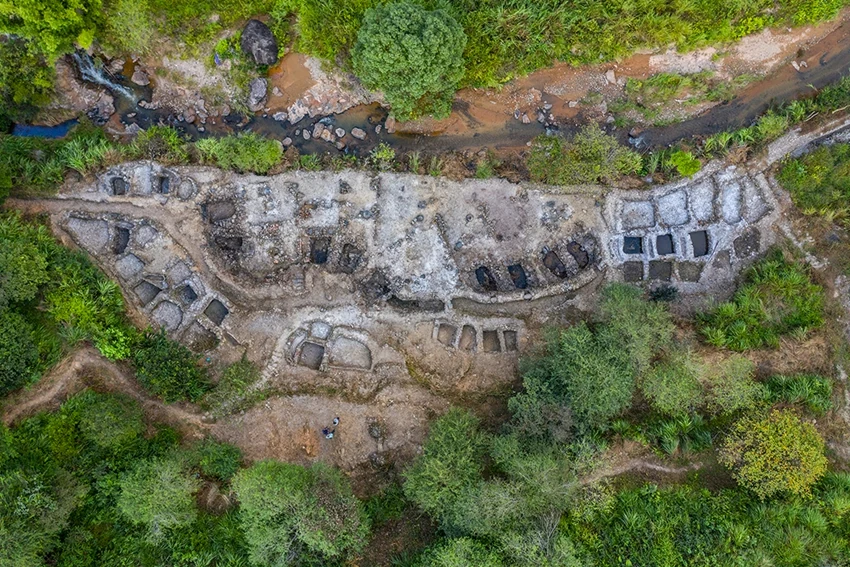
Dehua, inland within present-day Quanzhou municipality, supplied ceramics for overseas trade. The city’s heritage account traces a route south by land to Yongchun and onward along East Creek toward the port. A kiln site and a waterfront therefore belong to the same story, even when they look nothing alike. One made goods; the other brought them into a different transport system.

Think of every transfer as a practical problem. A fragile object has to survive handling. A vessel has to receive supplies before departure. A load cannot simply move across a river because a merchant wants it to. Bridges, paths and navigable water make those connections possible. This is the reason Quanzhou rewards looking inland as well as out to sea: the coast drew its commercial strength from places beyond the horizon of the harbour.

Low stone and earthen remains form a series of compartments in an excavation.
Excavated kiln remains in Dehua, viewed from above.

Trade also needs a city

The UNESCO property includes the Site of the Maritime Trade Office alongside bridges, docks, religious buildings and industrial remains. Their variety is the point. Government institutions gave maritime commerce an administrative setting; religious spaces served communities whose lives extended beyond buying and selling. Merchants needed a place in the city as well as space in a ship.

A port is sometimes pictured as a frictionless meeting of cultures. The surviving remains suggest a more substantial subject: people making institutions, financing structures and sustaining beliefs across long distances. A prayer hall, a commemorative inscription and a production site answer different questions. Read them together and commerce acquires both a public framework and a human scale. The bowl has makers and carriers; the voyage has officials, patrons, worshippers and families waiting for news.

Twenty-two parts, one connected argument

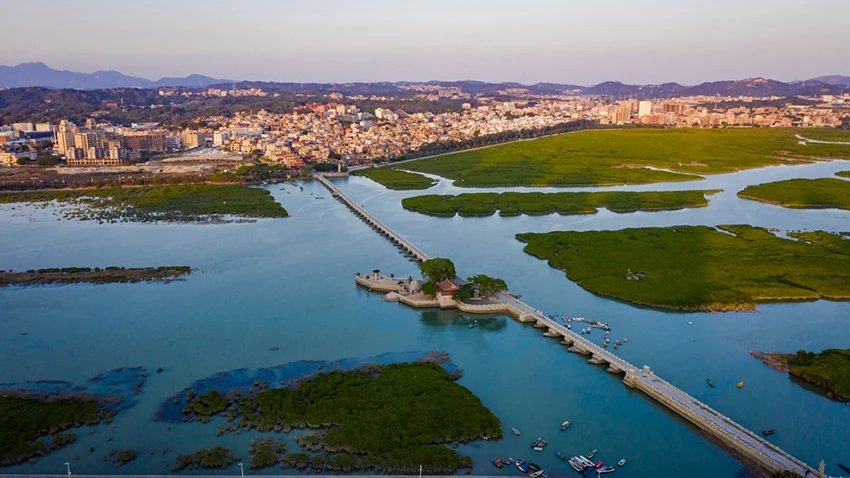
Inscribed in 2021, Quanzhou’s World Heritage property consists of 22 components. It is a selected series, not a designation covering every building or custom in the modern municipality. Among its components are the Dehua kiln sites, Luoyang and Anping bridges, religious monuments, docks and navigation landmarks. The selection explains a historical system rather than offering a list of everything worth knowing here.

That distinction opens the city rather than shrinking it. Nanyin music, Xunpu’s flower-wearing customs and the Maritime Museum can deepen an encounter with Quanzhou without being additional components of the series. Choose a connection to follow: production into transport, transport into government, or seafaring into worship. A bridge then stops being an isolated picturesque object. It becomes a working joint in the much larger body of a maritime city.

A long narrow bridge threads between water channels and green banks.
Luoyang Bridge crosses the river mouth and its wetland landscape.
Continue exploring · Quanzhou ↗
Photo credits and rights
  1. Excavated kiln remains in Dehua, viewed from above.泉州市人民政府美食之都申创官方网站 · Rights status unspecified Photo source ↗ Original aspect ratio retained. Display copies resized only when needed; no enlargement, crop or retouching.
  2. Luoyang Bridge crosses the river mouth and its wetland landscape.泉州市人民政府美食之都申创官方网站 · Rights status unspecified Photo source ↗ Original aspect ratio retained. Display copies resized only when needed; no enlargement, crop or retouching.