Bolts of wire and a glue pot
The workshop in the quiet months looks like a store room with a project in it. Coils of steel wire lean against the wall; rolls of silk and paper stand on end; a pot of glue sits on a low heat. In the middle, a figure the size of a person is being built in pieces. The head is on a bench, the body is a welded frame, and the skin is being cut to fit. The work is not mysterious. It is a sequence of materials, each with its own demand: wire that must hold a shape, cloth that must lie flat, glue that must not stain, and paint that must read at night.
A full-size drawing first
Lantern making begins with a design and a full-size drawing. The drawing is not a sketch; it fixes the height, the width and the pose, so the frame can be welded to match. Workers bend and join the wire into a skeleton, then stretch the fabric over it in sections. Large figures are too big to cover in one piece, so the skin is built up panel by panel and the seams are hidden under paint or trim. The last step belongs to the painter, who adds the face and the colour that will be lit from inside. The order matters: the frame decides the shape, the skin decides the surface, and the light decides what the surface becomes.
A festival with a deadline
Zigong's lantern festival has run for decades and draws on folklore, opera and local history. It is also a production schedule. As winter approaches, the workshops move from repair and design to assembly, and the city's craft network becomes visible: more than a hundred thousand people are described as lantern craftspeople, a network of skills that moves between workshops. After the festival the figures are taken down, stored, repaired or rebuilt. Some are kept for years; others are dismantled and their frames reused. The off-season is not empty. It is when the next set of figures is drawn and begun. The festival is a deadline the whole city can see, and the workshops work backwards from it.
The other workshop
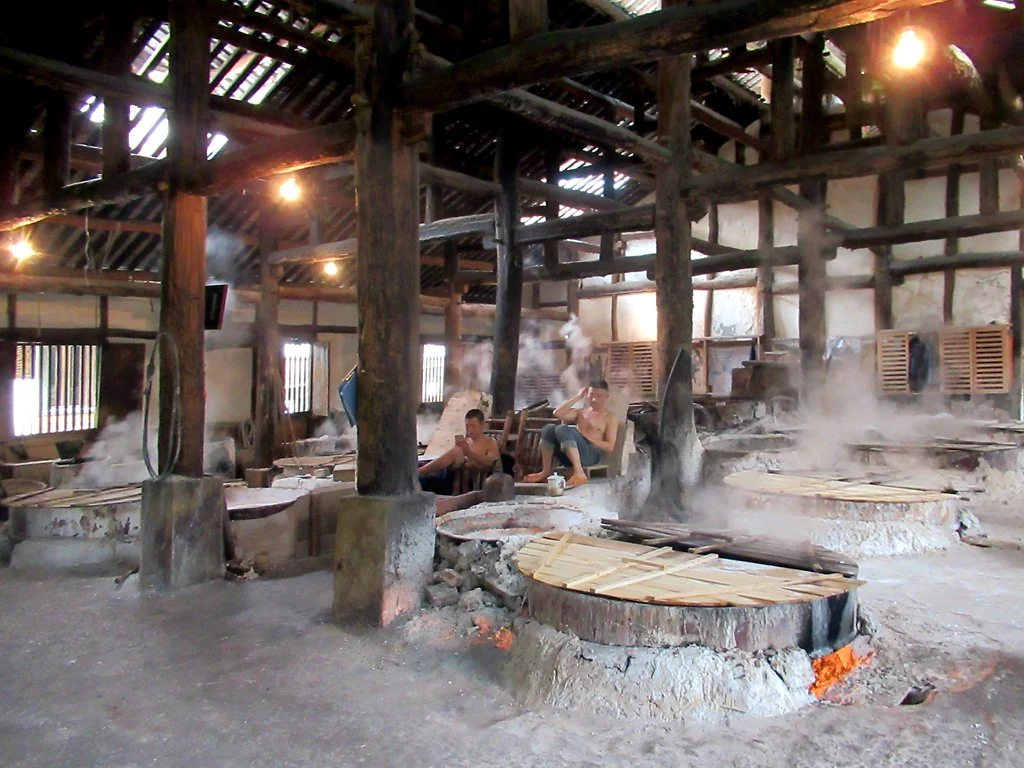
Zigong's older workshop is the salt well. Shenhai was drilled in 1835 to 1,001.42 metres, and its derrick still stands 18.4 metres above the yard. Eight pans are still worked, turning brine into about 2,500 kilograms of salt a day. Salt and lanterns are different trades, but they share a form: a small site, a team of hands, a product that leaves by the gate. One works with heat and brine, the other with wire and light. The city's identity rests on both, and neither is a demonstration. The salt well is a place of measurement and patience; the lantern workshop is a place of drawing and assembly. The pans boil, the frames are welded, and the work continues whether or not there is an audience.