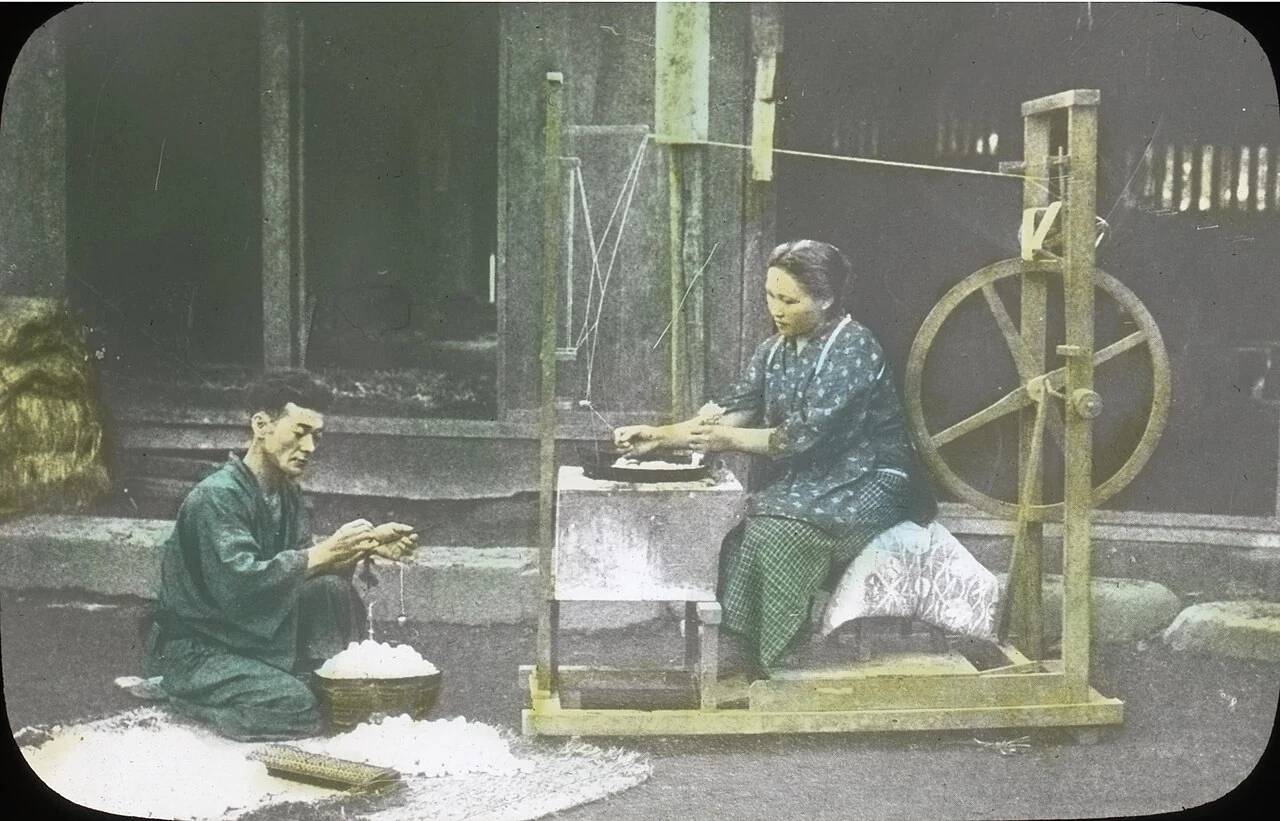
The reeling room
The first thing in the filature equipment hall is the smell. Raw silk has a warm, faintly animal scent, and it stays in a room long after the cocoons have been taken away. The reeling machines stand in rows, their small basins and thread guides set at the height of a standing worker's hands. A filature is a place where a cocoon is unwound into a single continuous filament, and the equipment is built around that one action. The hall keeps the machines as equipment, not as sculpture: belts, spindles and guides are still in their working order. The cocoons themselves are gone, but the machines still show the scale of the work: the whole plant is a machine built around a single, delicate thread.
Asia's largest filature
The Six He filature was once described as Asia's largest. Its size is still legible in the buildings, the rows of machines and the distance a worker would walk in a shift. The park now calls the site a national industrial heritage and an industrial tourism site. That double name is accurate: the buildings are protected, and the place is set up to receive visitors. The route through it is organised as a sequence, from cocoon to silk, so that a raw material becomes a finished cloth in the course of a walk. The scale is not a matter of pride now; it is the reason the site can be walked as a route rather than viewed as a single room.
Looms and demonstration
The rapier loom workshop is the noisiest part of the route. A loom in motion is fast enough to blur, and the workshop fills with a hard, repeating knock. Some machines run for visitors; the route does not depend on every workshop being original. The difference between demonstration and production is the difference between a machine that runs for a photograph and a machine that runs to a quota. The visitor sees the first, and the second is the reason the first is worth watching. The sound is the point: a loom that is running is doing what a loom is for, and a stopped loom is furniture, however well it is labelled.
The train and the count
A steam sightseeing train runs through the park, a small line that turns the factory's own logic into a ride. In 2024 the park received 1.203 million visitors. That number explains both the train and the tie-dye workshops: industrial tourism needs something for a family to do after the machines. The risk of a site like this is that the working parts become a backdrop. The park's answer is to keep the sequence visible at each stop: cocoon, filament, loom, cloth. A visitor who follows it learns what the factory did, not only what it looked like. The count explains the train; it also explains why the working parts need a route to be seen at all.
Reeling silk, historical illustrationUnknown (historical photograph) / No restrictions · No restrictions
Photo source ↗Orientation normalised, proportionally resized and encoded as WebP; no crop or retouch.