Looking into a pit
The pit is a rectangle cut into the floor, two to three metres deep, a little narrower at the bottom than at the top. Its walls are coated in yellow clay brought from Wudu Creek and fixed with bamboo pins. The clay is the working surface: it holds the fermenting material, the moisture and the community of microbes that fermentation depends on. A pit is not a barrel or a tank that can be replaced. It is part of the building, and the building is organised around a row of them. The floor is swept; the clay is dark and slightly damp. A row of pits is a row of containers, and the room is built to give each one enough space to be worked.
Four hundred and fifty years
The 1573 pits have been in continuous use since 1573, the first year of the Wanli reign. By 2026 that is more than 450 years. Continuity is the claim, and it is also the mechanism: the older a pit, the more stable its microbial community is said to be. The hedge matters. A pit is not a machine that can be switched off and restarted without change; the point of the heritage is that it has not been switched off. The date is not a founding legend but a working record, and the brewing has continued through it. That is why the old workshops are still workshops, and why a new pit cannot simply be substituted for an old one.
Sixteen workshops
The site holds 1,619 pits more than a century old and sixteen workshops. It is a national key cultural relic, listed in 1996 and expanded in 2013. In the old workshops production is not mechanised. Workers move between the pits with hand tools, and the heat of the fermenting rooms is part of the working day. A visitor sees a workplace with a route through it, not a display with a rail. The distinction is practical: the floors are worn where people walk, and the pits are open because they are used. The number is large because the site is a district of workshops, not a single building; the route passes from one workshop to the next.
Twenty-four generations
The technique has been passed through twenty-four generations, which is a way of counting continuity rather than a family tree. Each generation learned by doing the work alongside the one before it. That is why the site is protected as a relic and still operates as a workshop: the heritage is not the shape of the pit alone but the habit of tending it. A display pit can show the clay and the bamboo pins. Only a working pit explains why the clay is kept damp and why the pins matter. That difference is the heritage. The count of generations is also a warning: the chain depends on the next person who learns the work.
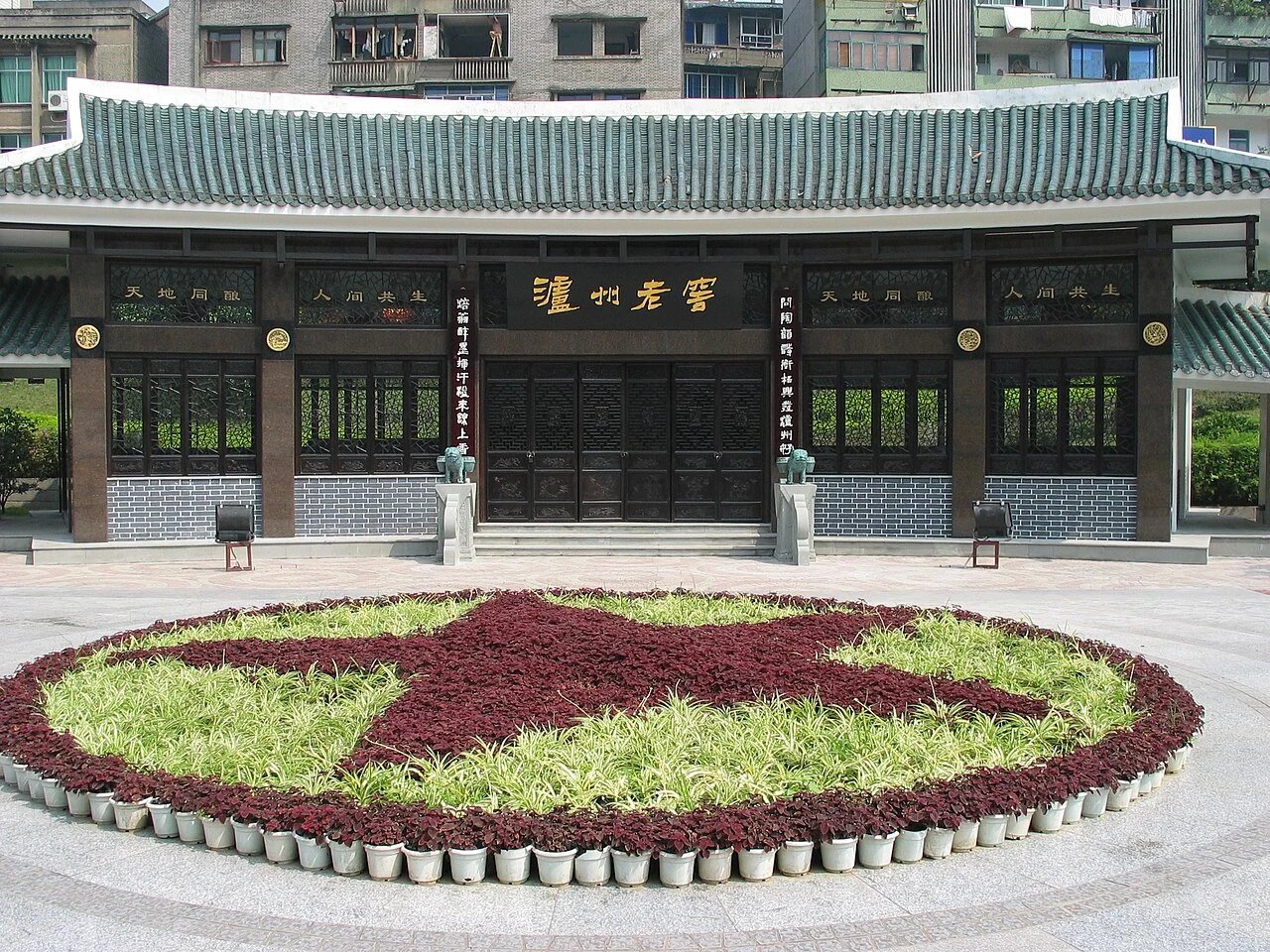
Luzhou old cellarPartake / Public domain · Public domain
Photo source ↗Orientation normalised, proportionally resized and encoded as WebP; no crop or retouch.