From the journal

The school town built across an ocean

Explore Jimei School Town through Tan Kah Kee’s educational ambitions, overseas connections and an architectural landscape made for learning.

In the same city · Xiamen ↗

Begin with a classroom

Jimei becomes easier to understand if the first imagined interior is a classroom rather than a ceremonial hall. Its defining institutions were built for teaching. The striking roofs and substantial buildings belong to a larger idea: education could change the prospects of a home community, and overseas success could be turned into schools.

Tan Kah Kee, also known as Chen Jiageng, founded a primary school in Jimei in 1913. The educational network expanded into fields including teacher training, commerce, fisheries and navigation. These choices give his project a practical texture. It addressed the people who would teach children, manage businesses and work in a maritime economy, not only those pursuing a conventional scholarly career.
A school town is more than one school

The name Jimei School Town can be mistaken for a single campus. It is better approached as an educational landscape whose institutions and buildings accumulated around a sustained commitment. Tan also founded Xiamen University in 1921, but the university and Jimei’s school town should not be collapsed into one place.

The range of subjects matters as much as the chronology. Fisheries and navigation speak directly to the coast; teacher training could extend the project beyond the students initially enrolled. A school for teachers multiplies its reach through other classrooms. Seen in this light, the buildings are the visible infrastructure of a social ambition. Their purpose becomes clearer when the question changes from “Which is the grandest?” to “What kind of future was each intended to make possible?”

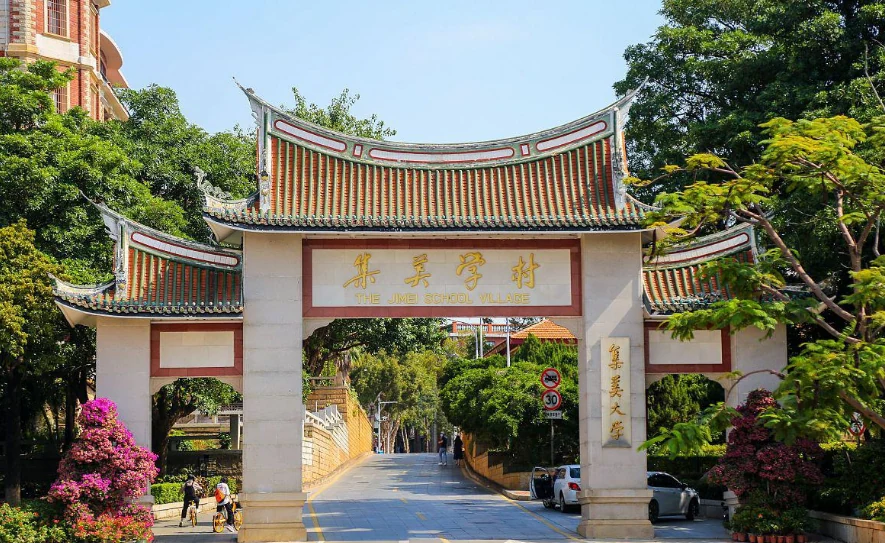
A three-part gateway with upturned tiled roofs spans a leafy street beneath a sign reading Jimei School Village.
The gateway to Jimei School Village, Xiamen.

Read the roofs with the rooms

Official descriptions emphasize Jimei’s combination of Chinese, Western and southern Fujian architectural references. From a public vantage point, examine how a prominent roof meets the more regular arrangement of floors and windows below. The contrast can make a building feel both locally rooted and institutionally expansive.

It is tempting to detach that appearance from function and photograph only the skyline. Keep the imagined classroom in view. Repeated windows, corridors and large volumes belong to buildings meant to accommodate groups of learners. Decorative ambition and everyday use occupy the same structure. Because this is a working educational landscape, a public view can be the appropriate encounter; a striking doorway does not imply that classrooms or grounds are open to visitors.

What a memorial chooses to teach

Tan’s former residence and Turtle Garden add another register to the school town. The garden’s carved subjects extend into areas such as science, geography and agriculture. That breadth is revealing: commemoration here can also take the form of instruction, placing a person’s life beside a wider field of knowledge.

The overseas connection should remain visible throughout. Tan’s business experience and resources outside China were part of what made his educational commitments possible. Jimei gives that movement a durable form. Money earned elsewhere became places where later generations could learn. The most memorable building is therefore not necessarily the most ornate one; it may be the one that makes the distance between a migrant’s working life and a child’s classroom suddenly understandable.

Continue exploring · Jimei School Town ↗
Photo credits and rights
  1. The gateway to Jimei School Village, Xiamen.厦门市文化和旅游局, credited by 闽南文化生态保护区(厦门市) cultural platform · Rights status unspecified Photo source ↗ Original aspect ratio retained. Display copies resized only when needed; no enlargement, crop or retouching.