From the journal

A port in a bowl

Follow Xiamen’s shacha noodles from sauce and noodle pot to the wider maritime connections that shape a flexible coastal food culture.

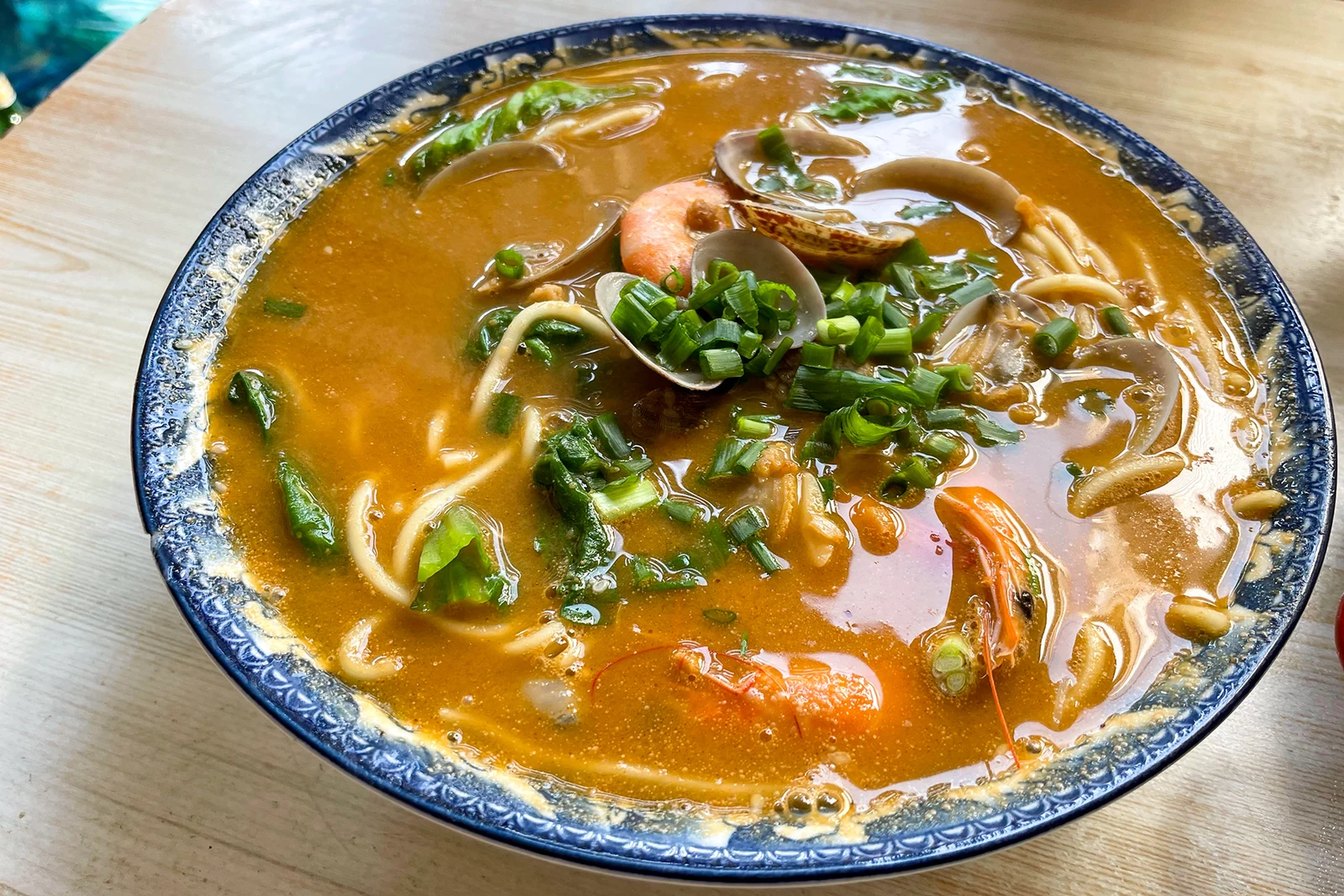
A bowl of orange-red broth with noodles, prawns, squid and green vegetables.
A bowl of seafood shacha noodles in Xiamen.

Watch the order of assembly

A bowl of shacha noodles becomes more intelligible when its components are considered separately. Noodles and greens are blanched; broth and chosen additions bring the bowl together. The result is not a single inseparable recipe delivered unchanged from one kitchen to the next. Assembly makes room for differences in ingredients and preference.

The city’s English-language culinary introduction describes yellow noodles and additions that can include tofu and offal. These details give the dish an everyday practicality. The bowl is built around a recognizable sauce while accommodating several textures. To understand it, begin with the relationship between the noodle pot, the broth and the ingredients selected to join them, rather than looking for the one supposedly definitive version.

A travelling flavour, locally worked

Xiamen’s local-history account gives this movement a name: Chen Youxiang, an overseas Chinese who learned to make shacha in Malaysia and later sold it in Xiamen. Citing research by Yang Jibo, the account identifies him as one of the people who introduced the seasoning, not its sole inventor. It describes his experimentation with ingredients and with a powdered form that was easier to carry and store.

That detail makes the maritime connection tangible. A travelling cook brought skill as well as a product; the product itself could be changed for another journey. Shacha’s connection with Southeast Asian satay does not mean that sauces in different places are identical. In this history, migration, experiment and commerce worked together. A bowl of noodles is the end of one preparation process and a small point within a much longer network.

The sea is also in the seasoning

Coastal food is often represented by a whole fish or a display of shellfish. Seasoning offers a smaller, less conspicuous route to the same geography. Xiamen’s culinary descriptions place shacha alongside soy sauce and shrimp paste in the treatment of local seafood. Dried seafood also appears in published descriptions of shacha ingredients.

This means the sea may be present even when the most visible item in a bowl is tofu or noodles. The flavour structure and the main ingredient are not the same thing. For readers with dietary restrictions, that distinction has practical consequences: an apparently vegetable-heavy bowl should not be assumed vegetarian, and recipes can include ingredients requiring an allergy check. Ask about the actual preparation rather than relying on a translated dish name.

Ask a question the cook can answer

The most illuminating conversation at a noodle counter may be a simple one: what goes into this broth, and which additions are available here? It is a question about the food in front of you, rather than a demand that one kitchen represent an entire city. Different answers can make a familiar dish more interesting on a second encounter.

Xiamen’s port history is often told through ships, buildings and migrant biographies. Food brings those movements to another scale. A sauce name can preserve a distant connection while a bowl records local choices made that day. Neither an elaborate origin legend nor a claim to the “best” noodles is needed. The cultural story is already present in the way a travelling flavour becomes something a city can keep remaking.

Continue exploring · Xiamen ↗
Photo credits and rights
  1. A bowl of seafood shacha noodles in Xiamen.Windmemories, CC BY-SA 4.0, via Wikimedia Commons · CC BY-SA 4.0 Photo source ↗ Rights information ↗ Original aspect ratio retained. Display copies resized only when needed; no enlargement, crop or retouching.