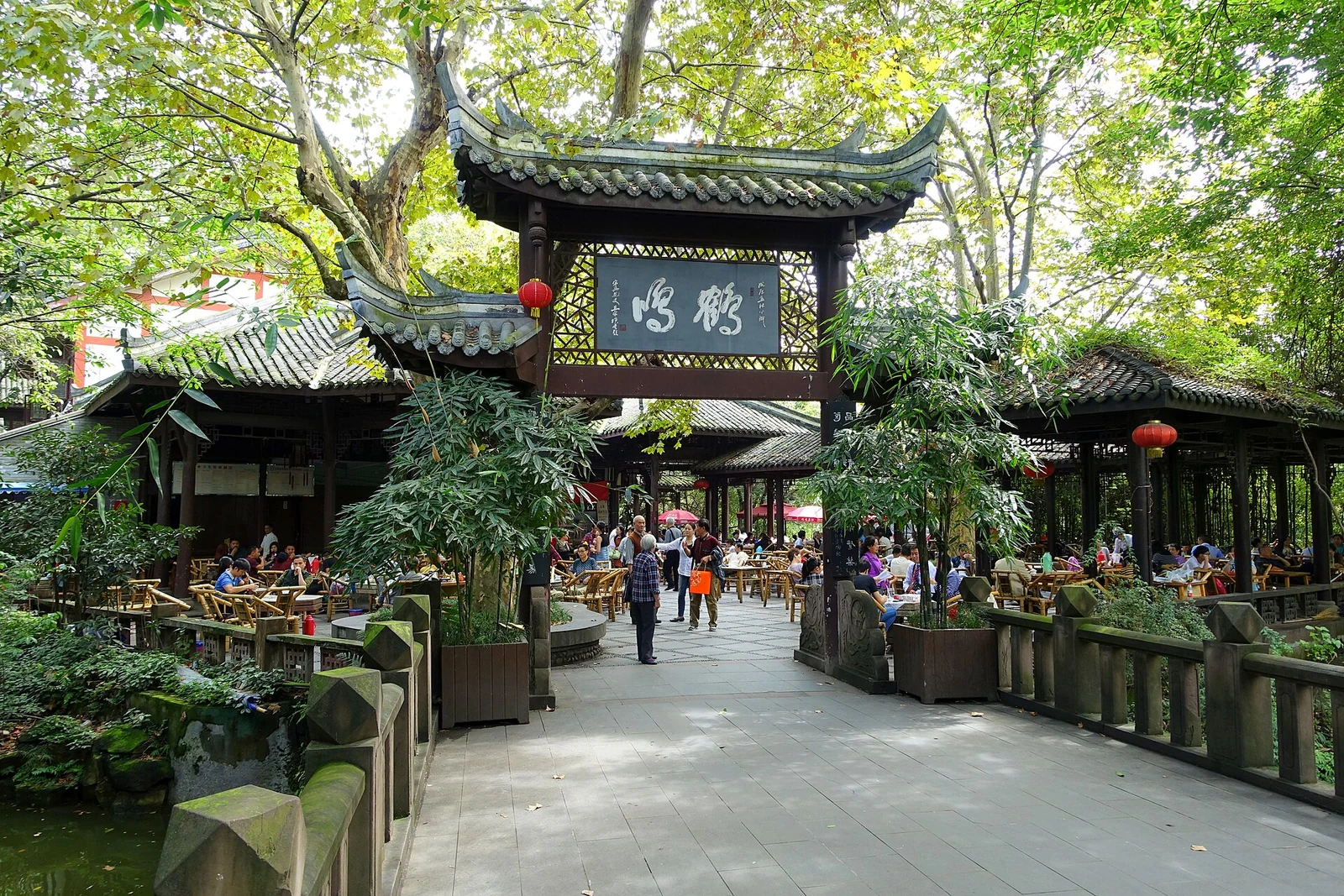
A room from the 1920s
Heming began in the mid-1920s, when a merchant from Dayi County built a pavilion-style hall beside a water channel in what was then Shaocheng Park. The name comes from a dream of white cranes said to have gathered in the pond. The story is a story, told by the park itself. What can be seen is more useful: a low building with red pillars, a tiled roof and a floor that has been repaired many times. In 2012 the city listed it as one of its first protected historic buildings. It is still a tea house, not a museum of one.
Three pieces and a refill
The tea arrives in a set the park calls the three pieces: a saucer, a bowl and a lid. The lid keeps the heat in and the leaves out; it can also be tilted to signal that the bowl is empty. Water came from the Jinjiang, and the house once scented its own tea with flowers. The chairs are bamboo, low enough that people lean back rather than perch. A server walks the rows with a kettle, topping up bowls without being asked. Nothing about the room asks you to leave quickly.
A habit, not a show
Chengdu's teahouse culture took its modern shape in the Qing period and never became a heritage performance. People read, talk, play cards, eat sunflower seeds or do nothing. The room is social without being organised. That is why it belongs near the start of a Sichuan visit: it establishes a pace. The tea itself can be followed west to Mengding, and the same unhurried evening can lead to a Sichuan opera theatre, where the audience is as much part of the room as the stage.