From the journal

Xiapu’s Working Seascape: What Grows Between the Lines

Kelp ropes, laver supports and fish cages make different kinds of sea farming visible along Xiapu’s coast.

In the same city · Ningde ↗

A pattern is not a crop

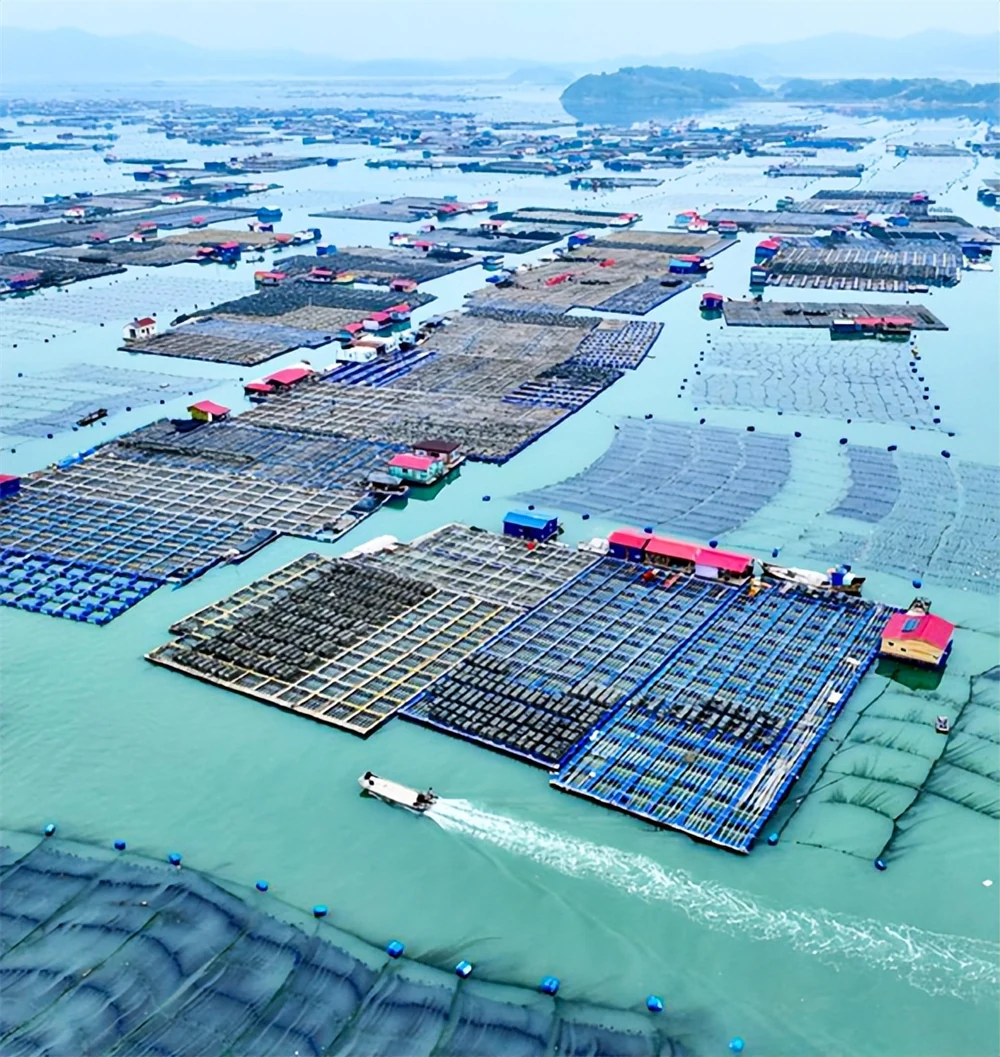
From a distance, Xiapu’s aquaculture can look like one enormous grid. Closer understanding begins by separating its different systems. Kelp, the long-bladed seaweed often sold in strips or knots, is not the same crop as laver, the thin seaweed used in sheets and soups. Fish cages serve another purpose again.

Fujian’s agricultural register identifies distinct production zones for Xiapu kelp and laver. Some places, including Sansha and Shajiang, participate in more than one part of this coastal economy. The categories matter because a pole, a rope and a floating enclosure do different jobs. A photograph’s repeating shapes are therefore the visible edge of several kinds of farming, each with its own material needs and sequence of work.
The crop has to leave the water

The annual harvest turns the seascape into a place of handling and movement. Documentary images from April 2025 show Xiapu’s seaweed harvest under way: the crop that had formed part of the water’s surface now had to be gathered and brought into the next stage of production.

Kelp is a substantial, wet material. Its journey does not end at the boat or landing point. Drying and processing change how it can be stored, moved and eaten. Local reporting describes Xiapu businesses producing dried, salted, chilled and ready-to-eat forms. A May 2026 report from Shajiang village describes cranes easing the handling of the harvest and an automated drying line helping when rain interrupts outdoor drying. Machinery belongs inside this working landscape too. The view from a hill contains only the beginning of a chain that must continue whatever the weather does next.

Chen Wenchai replaces the cages

In a 2022 report, cooperative operator Chen Wenchai described replacing more than two hundred wooden net cages with plastic ones in September 2019. The change followed a county campaign begun in 2018 to address problems associated with expanding offshore aquaculture, including drifting waste from older wood-and-foam equipment.

The account puts a person and a decision inside a large environmental story. Equipment has a working life, and its deterioration affects the water on which production depends. Management changes also included local support for sea-area use, weather information and emergencies. These measures do not make every current farm identical. They show that the apparently traditional coastal landscape is being altered through investment, regulation and the choices of people who earn their living there.

The sea farm has a shore

Processing places, drying space, landing points and homes belong to the same landscape as the offshore structures. Crops grown in water still require room and labour on land. This is why the sea farm cannot be understood as a self-contained patch in a photograph. Its lines extend through a village and onward into markets and kitchens.

The result is a useful reversal of the usual scenic view. Instead of asking how work decorates the coast, one can understand how a working coast acquires its appearance. Rows repeat because tasks repeat; access routes matter because material must move; equipment changes because production has costs and consequences. Xiapu’s beauty survives this practical explanation. In fact, it becomes more specific. The patterns belong to particular crops and livelihoods, rather than to an anonymous idea of timeless fishing life.

Rectangular aquaculture rafts and brightly roofed structures spread across sheltered water as a small motorboat passes.
Sea-cucumber aquaculture in Xinan, Xiapu, as identified by the source feature.
Continue exploring · Xiapu County ↗
Photo credits and rights
  1. Sea-cucumber aquaculture in Xinan, Xiapu, as identified by the source feature.福建绿色食品发展中心 / 福建省农业农村厅 · Rights status unspecified Photo source ↗ Original aspect ratio retained. Display copies resized only when needed; no enlargement, crop or retouching.