From the journal

Fuding White Tea: The Skill of Letting Leaves Change

Withering and drying may sound simple, but Fuding white tea depends on close judgment of leaf condition, air, moisture and time.

In the same city · Ningde ↗

The white is already on the bud

The pale down on a young tea bud gives white tea an immediate visual identity. In Fuding, a county-level city within Ningde, plump downy buds are especially associated with Baihao Yinzhen, often translated as White Hair Silver Needle. Other familiar forms, including Baimudan and Shoumei, bring different proportions of buds and leaves into the finished tea.

The names are a reminder that white tea is not one uniform object. Raw material matters before processing begins. A bud and a developed leaf do not have the same shape or thickness, and a tray of one cannot simply be imagined as a tray of the other. The maker’s first material is a particular harvest, not an abstract category labelled ‘white tea’.
A short process description hides a long judgment

Traditional Fuding white tea is centred on withering and drying, without the frying and rolling associated with some other tea styles. Withering lets the freshly picked leaf lose moisture while internal changes develop its character. Natural oxidation is part of the process; the apparent gentleness of the handling does not mean that nothing chemical is happening.

The national heritage register identifies Mei Xiangjing among the craft’s recognised transmitters. Such recognition makes sense only if the work is understood as skill rather than passive exposure to air. Leaves must reach an appropriate condition before the next stage. The maker is reading a changing material, and weather influences the reading. A brief process diagram can name the stages while leaving most of the difficult decisions invisible.

Why there is no single useful stopwatch

A study published in the Chinese Agricultural Science Bulletin in 2011 tested Fuding Dahao leaves under different withering conditions. Temperature, humidity and duration significantly affected the tea’s sensory quality. The result supports a practical point: time cannot be separated from the conditions in which it passes.

It does not supply a universal recipe for every batch. A successful duration in one controlled trial is tied to that trial’s material and environment. In a workshop, the value of experience lies partly in recognising those differences. Dry air, damp air and changing warmth alter the situation in which the leaves are losing water. A maker needs an endpoint understood through the tea, not merely an elapsed number of hours.

The room can change; the problem remains

Modern Fuding production includes controlled withering rooms and sunlight greenhouses. These spaces help manage conditions and scale, while continuing to address the old problem of how fresh leaves should change. The presence of a controlled room does not erase the craft, any more than a bamboo tray by itself guarantees good judgment.

Drying then brings the tea to a condition suitable for keeping. It is a distinct task from the gradual changes of withering, and it helps explain why ‘minimally processed’ should never be confused with unfinished. In the cup, the intact-looking buds and leaves conceal that sequence of decisions. Fuding white tea invites attention precisely because the intervention is restrained: the maker has to recognise how much change is enough, then stop treating the leaf as fresh harvest and make it into tea.

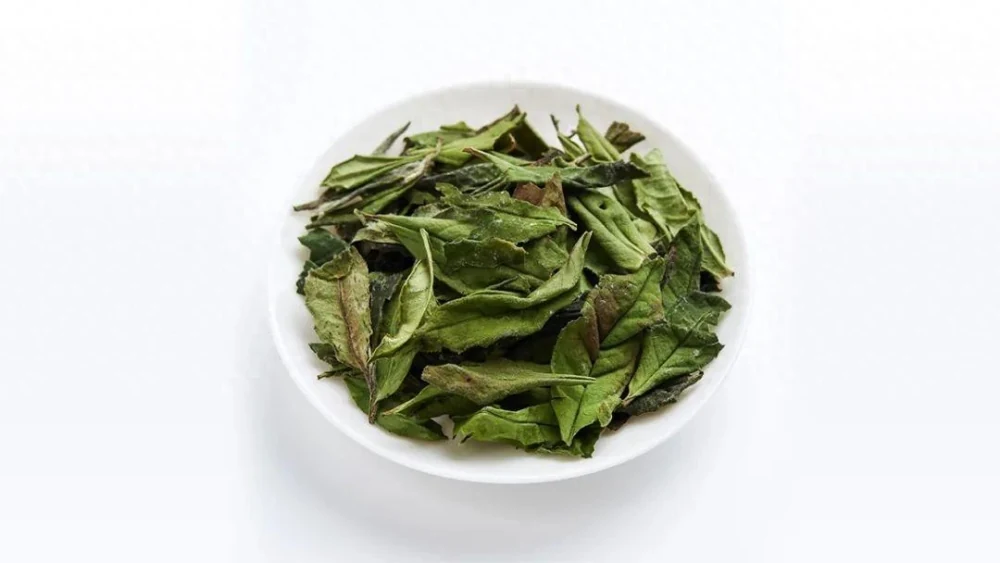
Loose green and pale tea leaves fill a small white bowl on a white background.
Fuding white tea leaves.
Continue exploring · Fuding ↗
Photo credits and rights
  1. Fuding white tea leaves.福建省农业农村厅 / 宁德市农业农村局 · Rights status unspecified Photo source ↗ Original aspect ratio retained. Display copies resized only when needed; no enlargement, crop or retouching.