From the journal

Fuzhou Jasmine Tea: The Night Shift Behind the Fragrance

Fresh flowers and prepared tea meet in Fuzhou’s scenting craft, where opening buds, heat and careful separation shape the finished cup.

A flower is not a tea leaf

A cup of Fuzhou jasmine tea brings together two plants that do different jobs. Prepared green tea supplies the leaf; fresh jasmine supplies fragrance. The craft lies in arranging an encounter between them, then managing what happens while they are together. A scattering of dried petals cannot explain the process.

The tea is already a worked material before scenting begins. The flowers are still living enough to respond to their surroundings and open after picking. One ingredient must be ready to receive aroma, while the other must reach the right stage to release it. This mismatch in their condition is exactly what makes the work demanding. The maker is coordinating two materials rather than simply mixing two flavours.

A worker tends green leaves arranged on many round woven trays.
Tea leaves spread across bamboo trays in a Fuzhou jasmine-tea feature.

The flowers set the clock

Jasmine flowers commonly open at night. Picked buds need care before they are ready for scenting, and the strongest phase of fragrance release brings work into the evening. The tea and flowers are combined so that the leaves can take up the aroma.

A heap of warm, moist plant material cannot simply be forgotten until morning. Heat and moisture must be watched; the mixture may need spreading and ventilation. The distinction between waiting and doing nothing becomes important here. Much of the maker’s work consists of recognising when a process has moved far enough, or when its conditions need changing. The flower’s opening provides the opportunity, but it does not supply a complete set of instructions.

Why the flowers come out again

After scenting, the spent blossoms are separated from the tea. Drying helps deal with moisture taken up during the process, and further rounds may bring fresh flowers into contact with the leaves again. Different products involve different degrees of this repetition; an elaborate many-round tea is not a universal formula for every packet bearing Fuzhou’s name.

The separation is a useful clue to the finished drink. Fragrance has been transferred into the tea, so the visible presence of blossoms is not the measure of success. The flower can leave after doing its work. Each additional round also creates another occasion for judgment about flower condition, tea condition and drying. Repetition builds complexity only when the material is handled well.

A city held together by a scent

The agricultural world behind the cup extends beyond a single workshop. In 2014 the Food and Agriculture Organization recognised Fuzhou’s jasmine and tea culture system as a Globally Important Agricultural Heritage System. The designation brings cultivation and post-harvest knowledge into the same frame. Flower growers and tea makers are connected by the short useful life of a fresh harvest.

That connection helps explain why a familiar city drink can carry so much work. The consumer encounters a stable, portable product; the maker has dealt with buds, changing temperatures and a narrow period of floral readiness. Brewing releases the result into an ordinary moment at a table. Fuzhou jasmine tea is therefore both a local taste and a small coordination of different clocks: the cultivation season, the flower’s night opening, the sequence of scenting and the few minutes needed to make a cup.

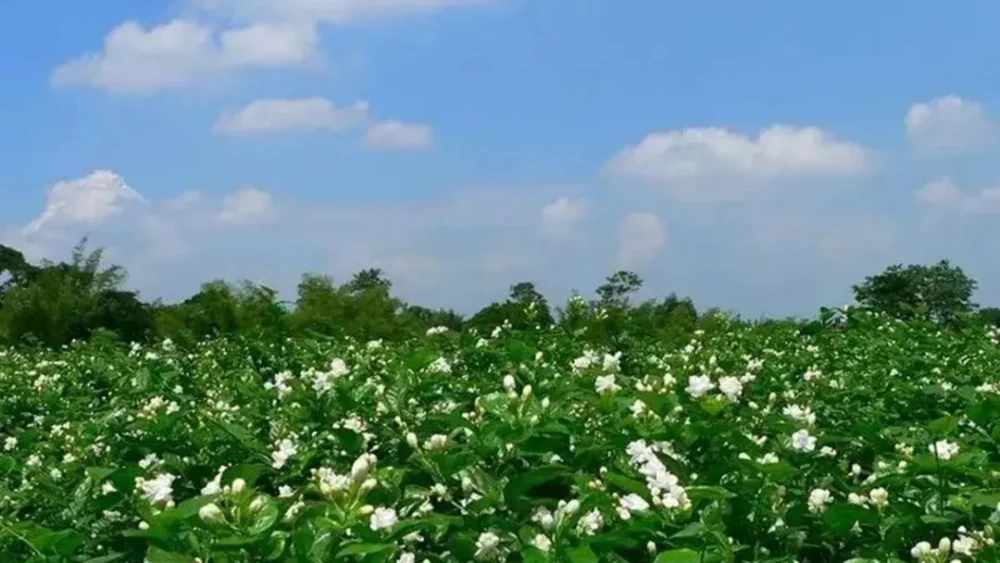
White jasmine flowers and buds rise above green foliage beneath a blue sky.
Jasmine growing in a field, illustrated in a provincial feature on Fuzhou jasmine tea.
Continue exploring · Fuzhou ↗
Photo credits and rights
  1. Tea leaves spread across bamboo trays in a Fuzhou jasmine-tea feature.福建省农业农村厅(图片) / 中国农业品牌公共服务平台(文章来源) · Rights status unspecified Photo source ↗ Original aspect ratio retained. Display copies resized only when needed; no enlargement, crop or retouching.
  2. Jasmine growing in a field, illustrated in a provincial feature on Fuzhou jasmine tea.福建省农业农村厅(图片) / 中国农业品牌公共服务平台(文章来源) · Rights status unspecified Photo source ↗ Original aspect ratio retained. Display copies resized only when needed; no enlargement, crop or retouching.