Narthang began in 1153 as a Kadampa monastery in Tsang, founded by Tumton Lodro Drakpa. Historical accounts remember it for a printing press and an extensive library of woodblocks; in the seventeenth century, it became a branch of Tashilhunpo. These details place printing inside monastic life. A block was at once a carved object, a stored asset and a means of reproducing a text. The press joined the labor of carvers, readers and keepers with the continuing work of teaching and ritual.
From the journal
Narthang Printing House: Woodblocks and the Care of Texts
Narthang’s canon editions and a portrait of the Fourth Panchen Lama show how carved blocks carried Buddhist texts and images across generations.
In the same city · Shigatse ↗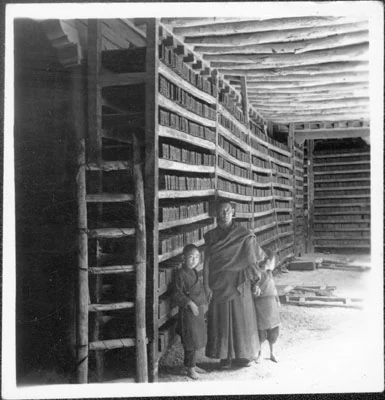
A monastery known for its blocks
A canon edition from the eighteenth century
In the eighteenth century, Narthang was one of three Tibetan printing centres—alongside Chone and Derge—to produce a complete edition of the Buddhist canon. Columbia University Libraries dates its Narthang set to 1730–1732 and notes that it followed an earlier “Old Narthang” canon compiled in the thirteenth century and indexed by the scholar Bu-ston in the early fourteenth. The edition thus links a major printing project to an older sequence of collecting and organizing texts. Each page carried the work of a cutter into a format that could be impressed repeatedly on paper.
A Panchen portrait in carved lines
Narthang’s blocks also carried images. The Rubin Museum identifies a woodblock portrait of the Fourth Panchen Lama, Lobsang Chökyi Gyaltsen, produced at Narthang in the second quarter of the eighteenth century. The portrait belonged to a series of earlier incarnations and could be printed on paper; another version adapted the same design to painted cloth. One carved composition therefore generated more than one object and material. The image travelled through a reproducible design while each printed or painted version retained the marks of its own medium.
A book built for handling and storage
Columbia’s set makes the physical scale of the canon clear. Its folios average about 7.5 by 30 inches; red and yellow cloth wraps them, and painted pine boards protect the volumes. The library records that the set reached Columbia as a gift in 1955 from the Horch family, who had acquired it from Nicholas Roerich during his 1925–1928 Central Asian expedition. A carved block, an inked sheet and a bound folio each preserve a different stage of the same publishing tradition. At Narthang, the blocks made repeated printing possible; in the surviving set, the printed leaves show the book as a substantial object made to be kept, carried and read.