In a 2015 report from the Gyantse carpet factory, the journalist describes Basang weaving a kadian on the floor. Coloured strands of wool lie beside her, and after laying a row she uses a small wooden or iron beater to press it into place. The scene gives the carpet a human scale: the surface grows one row at a time, through the coordination of both hands, yarn and a compact tool. Basang had learned the craft at home with her parents from the age of thirteen. By the time of the report, she had trained eight apprentices. Her workshop story connects a household skill to a factory floor without pretending that one worker represents every maker.
From the journal
Gyantse Kadian: From Wool and Knots to a Soft Pile
A 2015 report from Gyantse follows carpet makers through the work of sorting, spinning, dyeing, weaving and shearing wool into a household textile.
In the same city · Shigatse ↗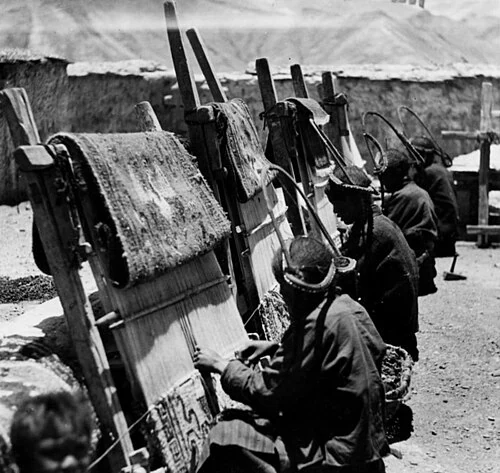
A weaver working at floor level
A sequence of wool work
The same report lists the stages involved in the hand process: carding wool, spinning yarn, dyeing it, winding the yarn, weaving by hand, shearing the pile and washing the finished carpet. Each stage changes what the maker can do next. Carding prepares fibres; spinning turns them into a continuous thread; dyeing introduces colour before winding organizes yarn for the loom. Weaving builds the patterned textile row by row, while shearing evens the surface and washing completes the fabric. The sequence helps explain why a finished carpet carries many kinds of labour inside its regular pattern. It also keeps the word “handmade” specific: it refers to a chain of distinct operations rather than a single moment at the loom.
A pattern learned with others
The article also follows Pubu Zhuoma, a nineteen-year-old apprentice who winds yarn while looking toward a complex design. She told the reporter she had studied for three years and was not yet confident weaving alone; her teacher remained close enough for her to ask questions. The detail reveals how pattern reading and colour matching are taught alongside physical technique. A design is not simply copied from a chart: the apprentice learns to connect its shapes to the yarn being prepared and the next movement of the hands. The report is a snapshot from 2015, so its named makers and factory conditions belong to that moment. Still, the scenes it preserves show how a textile tradition is passed on through observation, correction and shared work.