From the journal

Taining Danxia: How Red Cliffs Make Room for a Temple

Ganlu Temple’s timber structure fits beneath a rock shelter in Taining, where geology, reservoir history and living worship meet.

In the same city · Sanming ↗

A landscape made by removal

Taining’s red cliffs are striking from a distance, but their recesses tell an equally important story. Danxia is the name used for a family of landscapes developed in red continental sedimentary beds. Uplift, weathering and erosion work together to produce cliffs, pillars, gorges and cavities.

At Taining, Cretaceous red beds form deep, winding valleys and early-stage peak clusters. The language of a ‘young’ Danxia landscape describes a stage in the development of its landforms, not young rock in an everyday sense. The important act is removal: material is worn away, leaving steep faces and opening spaces within them. Those spaces later offered possibilities that human builders could recognise.
A timber building beneath a stone shelter

Ganlu Temple, also called Ganluyan Temple, occupies a rock recess beside Dajin Lake. The dramatic central post and the timber structure above it draw the eye, while the overhanging rock supplies a much larger shelter. The building’s form responds to a place already partly enclosed by geology.

This is a different architectural problem from constructing a hall on an open, level plot. The available space has an irregular boundary, a natural ceiling and a limited floor. Timber can be assembled to negotiate those conditions. The effect is often described through the image of a temple supported by one pillar, but the fuller interest lies in the relationship of frame and rock. The builders made a usable place within a cavity rather than competing with the cliff’s scale.

Old rock, a much newer water surface

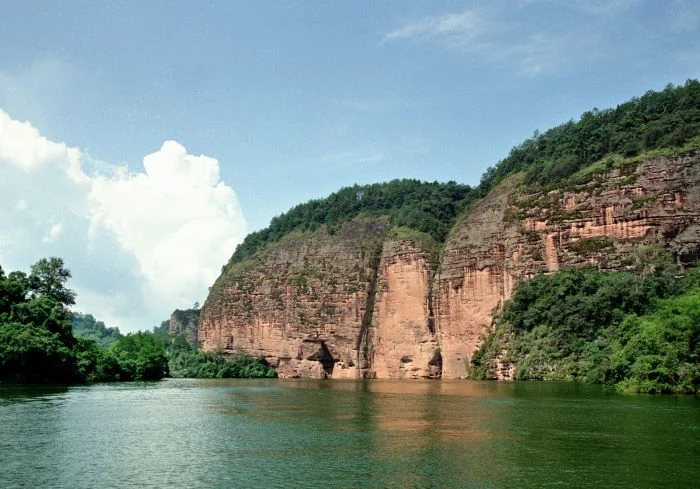
Dajin Lake, also known as the Great Golden Lake, is a reservoir landscape associated with the Chitan hydropower development around 1980. The water now seen beneath the cliffs is therefore much younger than the geological forms around it. The view combines long natural processes with a recent transformation of the valley.

This does not diminish the landscape’s interest. It gives it another layer. Red cliffs and green water can appear to belong to one timeless composition, yet they record different histories. The lake also changes how people encounter the temple and surrounding landforms, making water travel part of the present landscape. What looks like a purely geological scene includes infrastructure and the consequences of a twentieth-century project.

Tree-covered red rock cliffs rise directly above calm green water.
Red cliffs above Dajin Lake in Taining.

Worship has a reason to cross the water

A 2024 waterway authority report offers a revealing detail: a ferry service was established to help local worshippers and temple staff reach Ganlu and nearby Liquanyan Temple. Sightseeing boats had not fully served those everyday needs. The report is a reminder that a picturesque temple is also a destination for people with purposes other than looking at it.

Taining belongs to the six-part China Danxia World Heritage property inscribed in 2010; the wider UNESCO Global Geopark has its own extent and includes other geological settings. These designations help explain the significance of the landscape, while the temple supplies a more intimate scale. Rock creates the recess, timber makes it inhabitable, water shapes the approach and worship gives people a continuing reason to come. The scene becomes richer when all four remain in view.

Continue exploring · Taining County ↗
Photo credits and rights
  1. Red cliffs above Dajin Lake in Taining.三明市河长办 / 福建省水利厅 · Rights status unspecified Photo source ↗ Original aspect ratio retained. Display copies resized only when needed; no enlargement, crop or retouching.