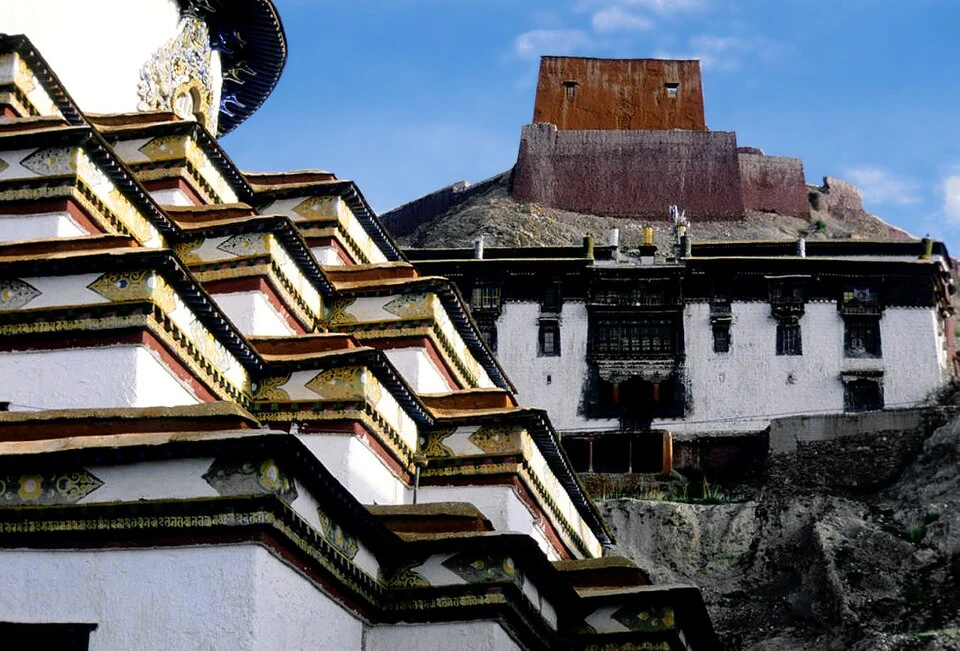
The Palace Museum’s field report names Gyantse ruler Rabten Kunzang (1389–1442) and Khedrup Je (1385–1438) in the founding of Pelkor Chöde. Art historian Shengnan Dong dates its Kumbum, the monumental stupa at the heart of the compound, to about 1427–1442. Its painted chapels belong to a specific fifteenth-century building project, where worship, sculpture and wall painting came together.
From the journal
Inside the Kumbum: Gyantse’s Murals and Painters
A fifteenth-century Kumbum project brought 73 chapels, a Shariputra mural and painters from across Tsang together at Pelkor Chöde.
In the same city · Shigatse ↗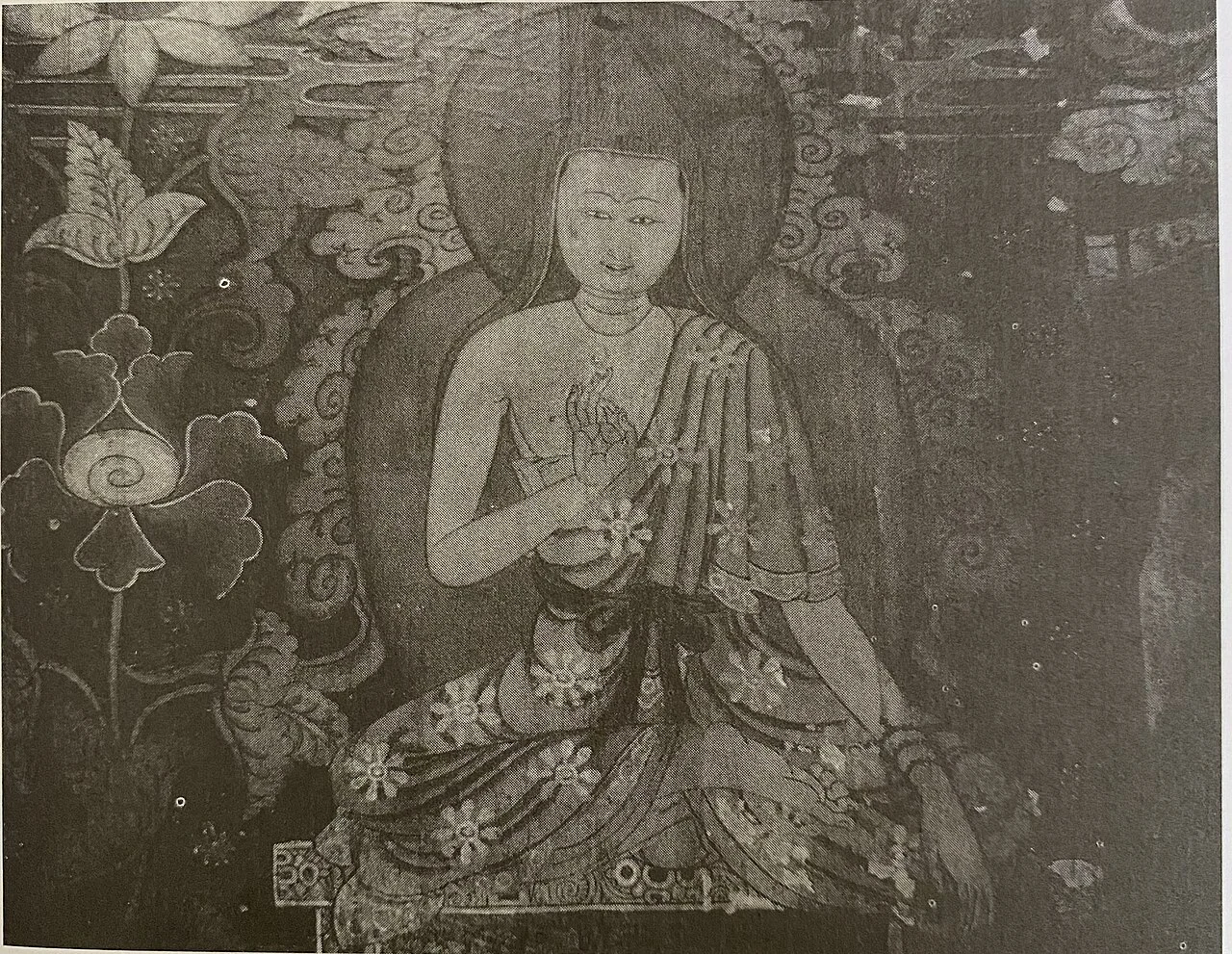
Founders and a fifteenth-century project
Shariputra in a painted world
The mural shown here depicts Shariputra, an Indian Buddhist monk, seated frontally beneath a halo. A raised hand, broad robe folds and a patterned field of flowers, cloud curls and smaller ornaments give the figure a carefully framed presence. The face meets the viewer while decoration moves outward across the wall. The painting’s force lies in how one named teacher is held within an ordered field of detail.
A stupa with many doors
The Kumbum follows the tashi gomang, or Auspicious Stupa of Many Doors, form. A four-tier terrace opens onto chapels across eight stories; art historian Shengnan Dong counts seventy-three chapels, each reached from the open-air path around its level. At the central bumpa, four temples gather around major Buddhist figures. Higher up, a two-story circumambulation route circles the central pillar inside the harmika. The ascent turns the stupa into a sequence of rooms, images and ritual paths.
Painters and a meeting of styles
Inscriptions in the Kumbum’s chapels name at least thirty-nine painters from across Tsang. Dong identifies Rinchen Peldrub, abbot of nearby Nenying Monastery, as overseer; in most chapels, master artists worked with students. The murals surround sculpted deities and combine visual languages: vegetal curls and flowers suggest a strong Nepalese influence, while clouds and naturalistic figures carry Chinese elements. A single wall preserves the work of a team and the record of artistic exchange.