From the journal

Quanzhou Maritime Museum: Stones, Ships and Human Traces

Separate an excavated ship from a reconstruction, and a carved stone from its original building, to see how Quanzhou’s maritime past is assembled.

In the same city · Quanzhou ↗

Begin by locating the object

The Quanzhou Maritime Museum is an institution with more than one venue. Its Donghu campus, by the eastern side of Donghu Park, is distinct from the Quanzhou Bay Ancient Ship Gallery at Kaiyuan Temple. The famous excavated Song-period hull belongs to the ship gallery. A photograph of that hull should therefore send the imagination to the Kaiyuan site, not automatically to the main museum building.

This distinction is more than practical housekeeping. A ship, a museum’s account of shipping and a scale model can all explain maritime history, but they offer different encounters. The museum’s own 2026 announcements continue to distinguish the two venues. Exhibitions and access arrangements change, so identify the relevant gallery before making a particular object the centre of a visit. The institution is also different from Quanzhou Museum, another museum in the city.
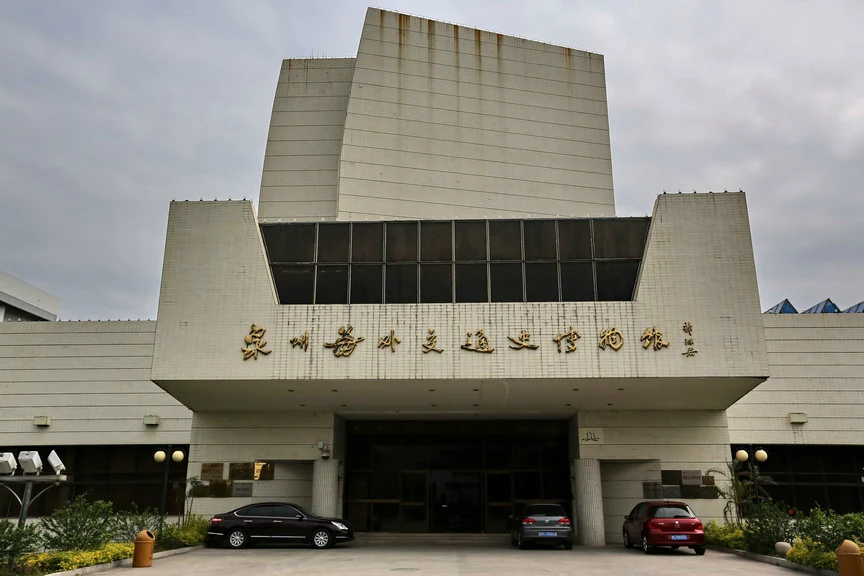
A pale tiled facade shaped like a ship’s sail rises above the entrance and gold museum-name characters.
The Donghu-site building of Quanzhou Maritime Museum, pictured in a 2015 tourism feature.

The hull as a working structure

The seagoing ship excavated at Houzhu in 1974 brought an unusually substantial piece of Quanzhou’s maritime past into view. The dedicated gallery opened in 1979. Its history since excavation has involved conservation as well as display: preserving a large wooden hull is itself an extended technical undertaking.

The vessel is especially rewarding as a structure. Look for how the space inside is divided and how boards, bulkheads and hull relate. A watertight compartment separates one area from the next; the principle is easier to grasp when an actual internal partition can be compared with a diagram. The surviving wood is not a complete ship waiting to sail. It is the material basis from which a fuller account of construction and use can be developed. Associated cargo and labels add another scale, shifting attention from the ship as container to the goods and transactions it carried.

A model is a proposition in three dimensions

At the main museum, boat models form a different kind of collection. The institution’s account of its ship research describes collaboration with scholars and experienced boatbuilders, including a model-development programme begun in 1993. Such work translates evidence and specialist knowledge into a form visitors can examine at a manageable scale.

A model makes the missing upper parts of a vessel imaginable: hull, rigging and deck can be seen as a connected whole. It also makes comparison possible across different boat types. Its smooth completeness is useful precisely because it differs from archaeological survival. Read the label for whether an object is an excavated original, a modern reconstruction or a comparative model. Keeping those categories clear does not diminish the model; it reveals the intellectual work that went into making it.

Stone brings people back into the port

The museum’s religious stone collections give another route into maritime history. A carved fragment or inscribed memorial can retain a personal or communal identity after its original setting has changed. Start with what kind of object it was. A tombstone commemorates a death; an architectural block once helped build or decorate a structure. Their inscriptions and images were made for different purposes.

Then connect the object to its recorded findspot and date. A gallery gathers pieces into a new arrangement so that relationships can be seen, but the city and its surroundings remain the larger setting behind them. This movement between object and context is the museum’s greatest opportunity. A hull makes construction tangible; a model makes a hypothesis visible; a stone gives words or imagery a durable surface. Together they replace a vague picture of global trade with things that people made, used, moved and preserved.

Continue exploring · Quanzhou Maritime Museum ↗
Photo credits and rights
  1. The Donghu-site building of Quanzhou Maritime Museum, pictured in a 2015 tourism feature.泉州市人民政府旅游栏目 · Rights status unspecified Photo source ↗ Original aspect ratio retained. Display copies resized only when needed; no enlargement, crop or retouching.