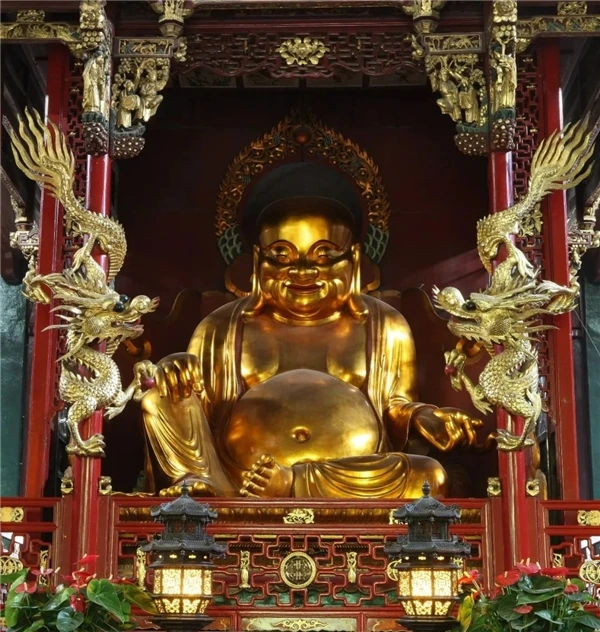
The first hall at Lingyin gives the visitor a smile before the larger roofs appear. Inside the Hall of the Heavenly Kings, Tianwang Dian, the round-bellied figure associated with Maitreya is modelled on Budai, a wandering monk remembered with a cloth sack. Maitreya is the Buddha of the future; this familiar Chinese image makes that distant promise approachable. Around him stand four imposing guardians. Their scale changes the room: welcome and protection share the same threshold.
Lingyin · Architecture
A Temple Courtyard Teaches the Eye
At Lingyin, halls, open spaces and older stone details make architecture something to read in sequence.
In the same city · Hangzhou ↗The smile at the entrance
A guardian faces inward
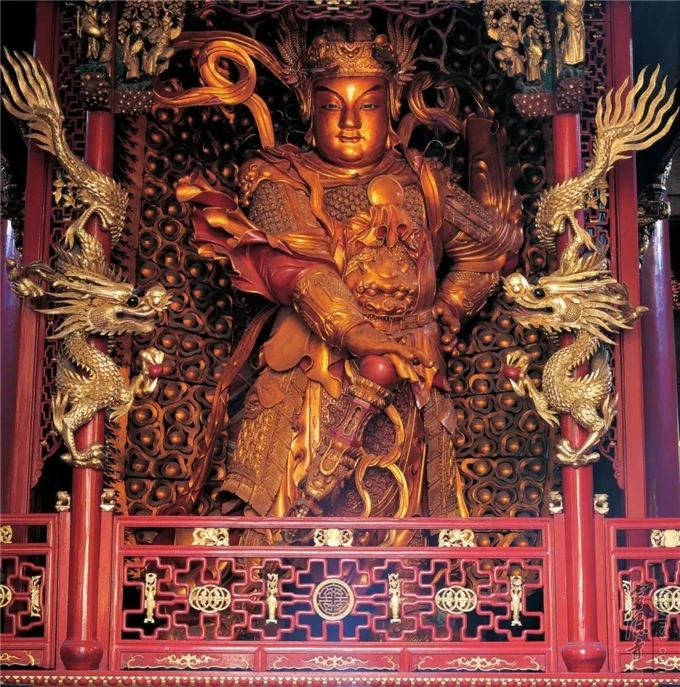
Behind the smiling figure stands Weituo, an armoured protector who faces towards the main hall. His position gives the entrance a second direction. The visitor arrives from the valley, while the guardian watches over the Buddhist community within. Passing out of the hall, daylight returns across the courtyard. The next building appears whole again, its broad roof held above columns. This alternation of enclosure and open air makes the central axis feel like a sequence of arrivals rather than one long corridor.
The great hall and the mountain behind the Buddha
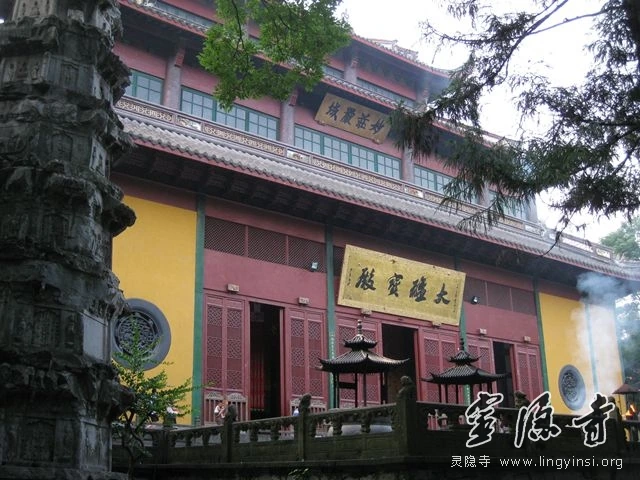
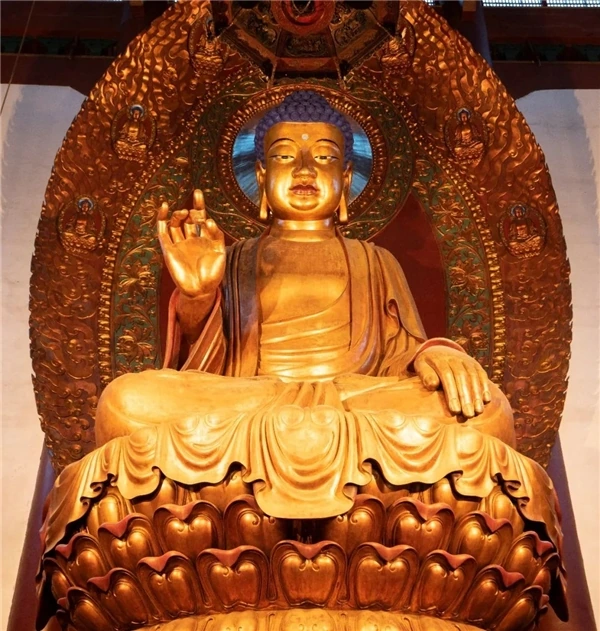
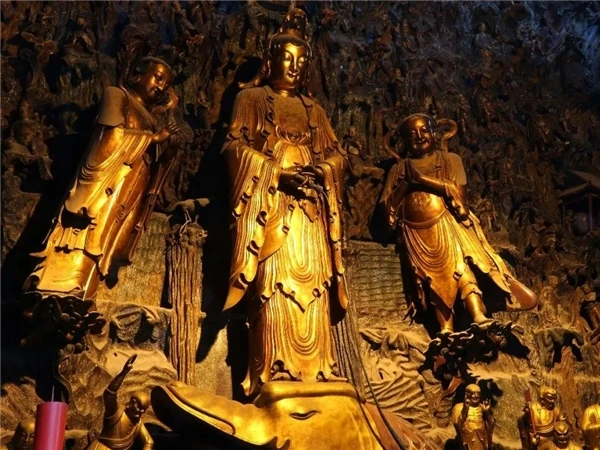
The Daxiong Baodian, often called the Mahavira Hall in English, is dedicated to Shakyamuni, the historical Buddha whose teaching lies at the beginning of Buddhism. His seated figure anchors the room. Behind it, the atmosphere changes: a sculpted landscape gathers Guanyin, the bodhisattva associated with compassion, among clouds, rocks and other figures. The composition draws on the young pilgrim Sudhana's visits to teachers. A Buddha seen from the front and a mountain of encounters behind him offer two different kinds of stillness.
The hall of a human wish
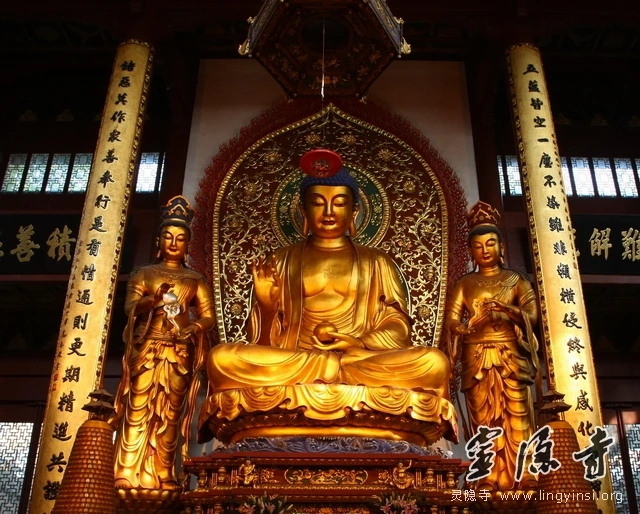
Further along the axis, the Medicine Buddha Hall, Yaoshi Dian, gives a name to the wish for relief from suffering. The central Medicine Buddha is accompanied by the Sunlight and Moonlight bodhisattvas; twelve guardian figures stand at the sides. Their presence belongs to Buddhist devotion, while the wish itself is immediately understandable. Beyond these principal halls, the Dharma Hall and scripture library point towards teaching and study. Lingyin holds places for worship, learning and the daily work of a living monastery.
A stone keeps a different date
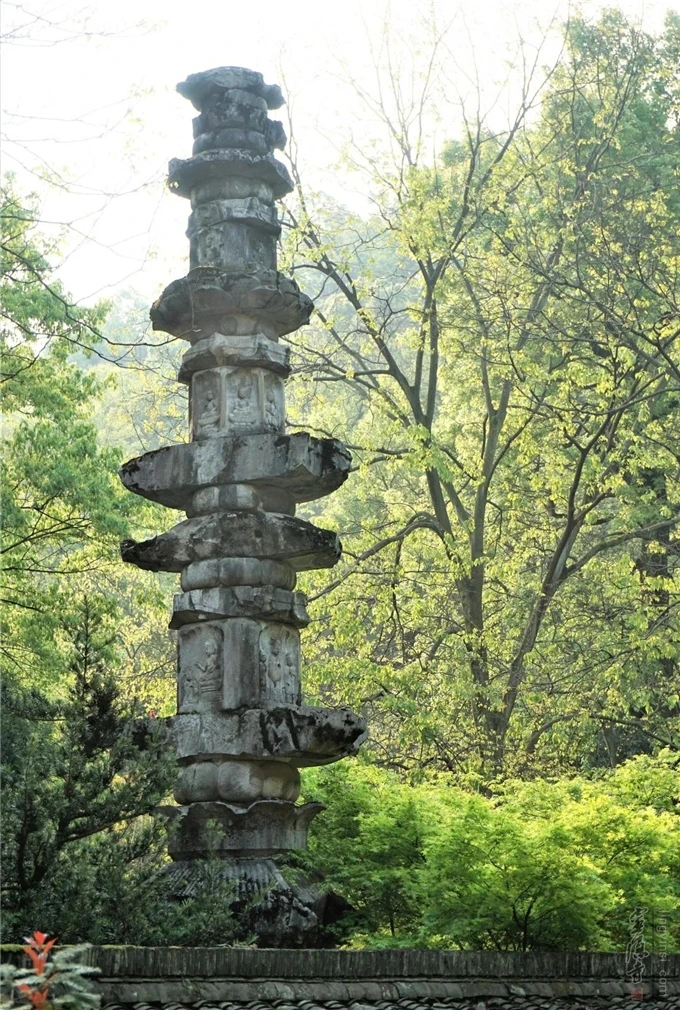
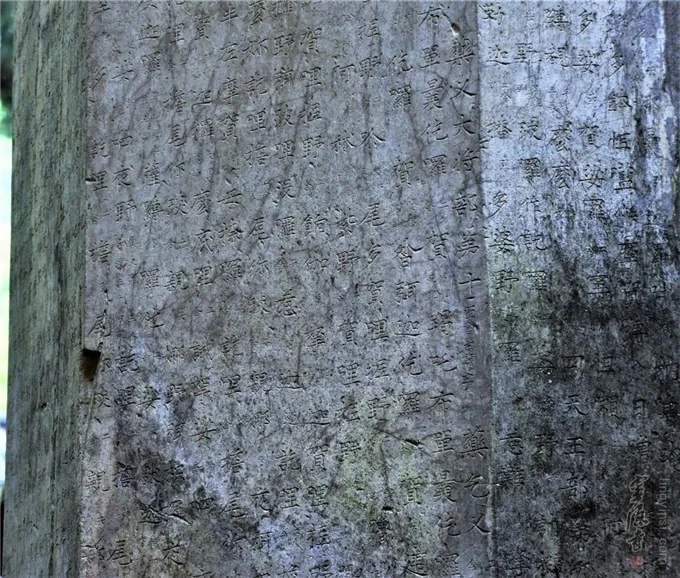
Beside the Hall of the Heavenly Kings stand carved sutra pillars: stone structures carrying sacred writing, small roofs and ornamental layers. The temple dates their making to 969, during the Wuyue kingdom, a regional state that flourished around Hangzhou in the tenth century. They were brought here from another temple. Nearby wooden halls have passed through later rebuilding. The contrast makes the courtyard legible: Lingyin's long history survives through objects of different ages, rather than every surface belonging to its founding year of 326.
The spaces between
Under an eave, a column frames a patch of sky; across a courtyard, a doorway frames another hall. Carved stone, timber, trees and changing light work at different scales. Knowing a few names gives these views more substance. The smiling entrance, the teaching Buddha, the compassionate figures and the wish for healing become distinct presences. Outside, Feilai Feng carries another way of placing Buddhist images in a landscape, with figures cut directly into the rock. The valley continues the conversation begun inside the gates.