In a familiar telling of the White Snake legend, rain on West Lake brings Bai Suzhen and Xu Xian together beneath an umbrella. She is a white snake spirit who has taken human form; he is a young man connected with the medicine trade. Beside her is Xiaoqing, the green snake spirit, a companion with a quicker temper and a fierce loyalty. The lake gives their meeting a place. An umbrella gives them a reason to speak, and a reason to meet again when it must be returned.
White Snake · a living legend
White Snake: An Umbrella, a Marriage, a Tower
A borrowed umbrella begins a life together. Beyond it lie magic, separation and the hope of reunion.
In the same city · Hangzhou ↗Rain makes room for three people
A home beyond the umbrella
Bai Suzhen and Xu Xian marry. Their life gathers around a pharmacy, remedies and the modest hope of keeping a household together. This ordinary wish gives the magic something to protect. Xiaoqing helps, watches and speaks more bluntly than either of them. Xu Xian knows the woman who shares his days, but not the long life behind her human appearance. For the reader, affection and uncertainty occupy the same room: how much of someone must be known before that person can be trusted?
Why the festival changes everything
The turning point comes at Duanwu, the Dragon Boat Festival on the fifth day of the fifth lunar month. Older festival customs included protective herbs and realgar wine, associated with warding off harmful creatures. In the story, the wine breaks Bai Suzhen's human appearance. Xu Xian sees a great white snake and collapses from terror. She goes in search of a magical herb to restore him. A household custom has become the moment when the person he loves and the creature he fears are suddenly the same.
A monk, a river, and a distant monastery
Fahai, the Buddhist monk, insists that the boundary between human and spirit must be restored. Xu Xian is drawn away to Jinshan Temple. That temple belongs to Zhenjiang, another city on the Yangtze; the legend travels beyond Hangzhou before returning to the lake. Bai Suzhen and Xiaoqing summon water in an attempt to bring him back. The great flood gives visible force to a private longing. Fahai's certainty and Bai Suzhen's desire to remain with her family leave little room between them.
The tower on the other shore
Bai Suzhen is eventually confined beneath Leifeng Pagoda. Across the lake, the tower becomes the shape of a separation: a home can be imagined, yet cannot be reached. Later tellings give the family further chapters, sometimes a son's devotion and sometimes Xiaoqing's return to free her companion. On stage and screen, the ending keeps changing its emphasis. The recurring objects remain easy to remember: an umbrella, a cup, a medicinal herb, a tower. Large emotions settle into things a visitor can picture.
Where a walk meets the tale
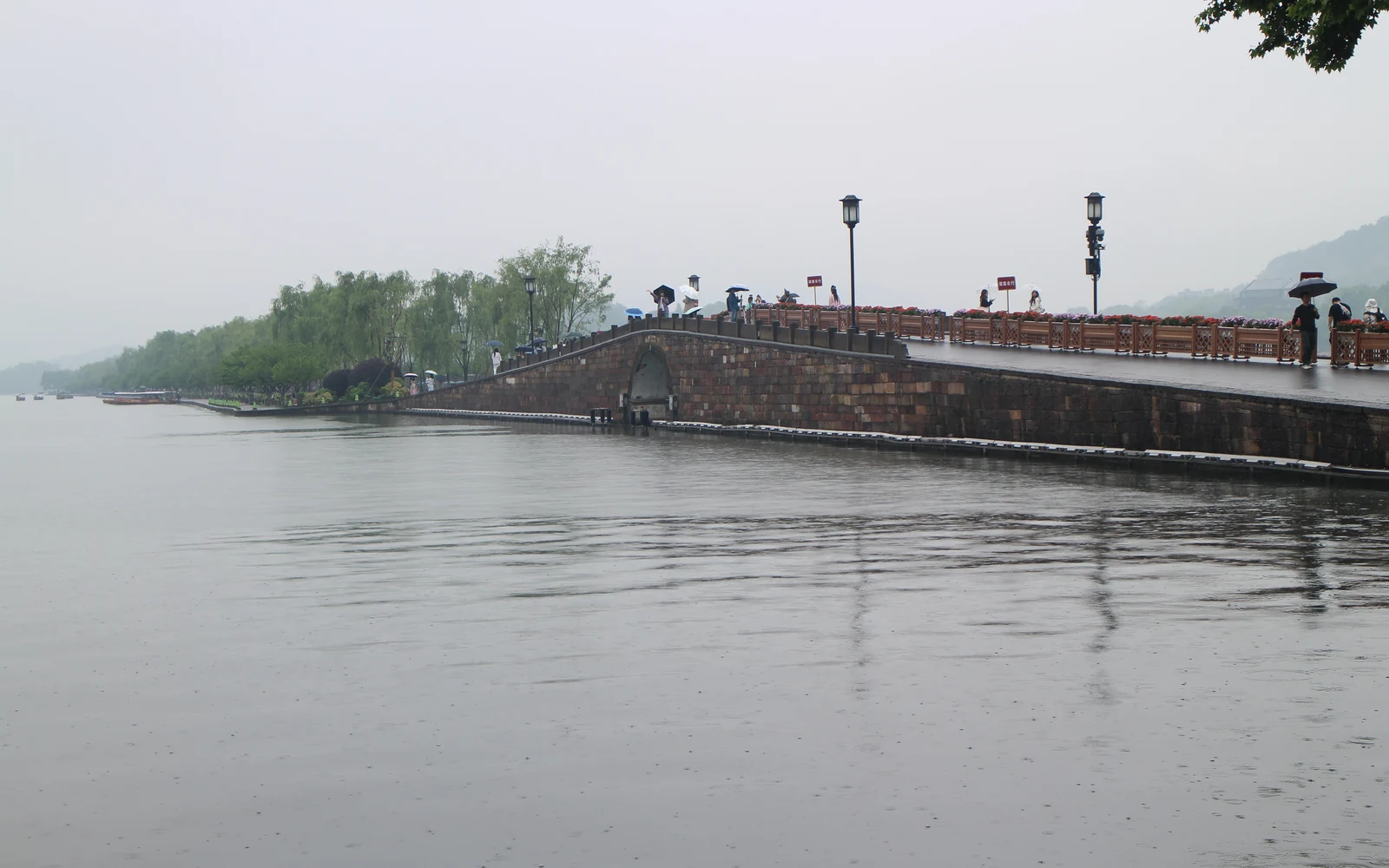
Broken Bridge on the north-eastern side of West Lake is associated with the lovers' meeting and reunion; Leifeng Pagoda rises on the southern shore. They give the story two distant anchors across the water. Between them lies the everyday lake: raincoats, boats, couples pausing for photographs. Reading the legend adds another layer to that view. Xiaoqing's loyalty, Xu Xian's hesitation and Bai Suzhen's wish for an ordinary life linger differently with each reader. The lake leaves space for all three.