Suzhou

How to Read a Suzhou Garden

At the Humble Administrator’s Garden, follow water, framed views and a disappointed official’s choice of words.

In the same city · Suzhou ↗

A name with an argument inside it

The English name Humble Administrator’s Garden sounds like a compliment to an efficient public servant. Its Chinese name, Zhuozheng Yuan, carries a more complicated joke. Wang Xianchen returned to Suzhou in 1509 after a troubled official career. In naming his garden, he drew on Pan Yue, an earlier writer who described growing vegetables and tending a household as a form of administration suited to an unskilful man. Withdrawal could thus become a statement about service, disappointment and personal dignity.

Knowing that story changes the question to ask here. Instead of looking only for luxury, look for how a prosperous residence presents its owner as someone who would rather cultivate a small landscape than compete for power. The modest name and elaborate setting do not cancel each other out; their tension is part of the garden’s interest.
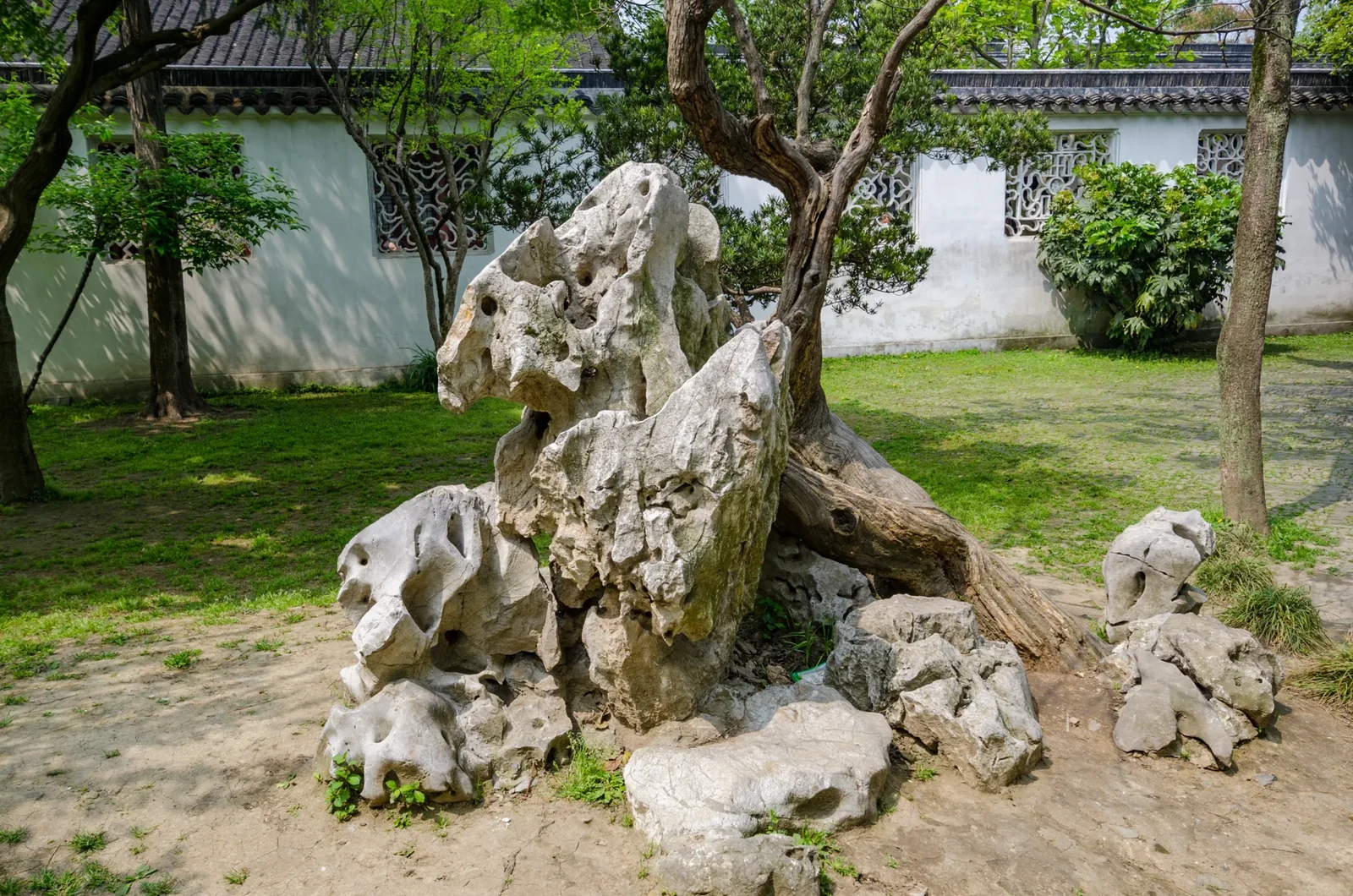
Weathered scholar's rocks beneath a tree in the Humble Administrator's Garden, Suzhou.
A close look at rock forms, planting and a white boundary wall in Suzhou's Humble Administrator's Garden.

Let the pond explain the buildings

At Yihong Pavilion, near the division between the eastern and central parts, the central garden opens as a composition of water, planted islands and buildings facing the pool. Start by finding a place to stand still. Which structure draws your eye across the water? Which roof is partially concealed? Then take a few steps and compare.

This is an observation exercise rather than a search for one correct photograph. An island can screen the far bank; a building can supply both a destination and a viewing position. The route makes those relationships unfold. Treat a pavilion as a place from which to look, not simply an object to collect in a picture.

A room can be an instrument for seeing

Xiangzhou, a boat-shaped structure, offers views in several directions, including towards Jianshan Tower and the Lotus Wind Pavilion. Its windows turn the surrounding garden into a set of compositions. This helps explain borrowed scenery: a view belongs to the experience of a space even when the things within it stand elsewhere.

Try separating three layers in a window: the near frame, the middle water or planting, and the distant building. Move sideways. What disappears, and what enters? These small adjustments reveal how architecture directs attention. The practice is closer to reading a sequence of pictures than surveying a lawn from a single terrace.

A shaded wooden pergola curves beside planting in the Humble Administrator's Garden.
A garden walkway reveals how shade and framed views shape a visit to the Humble Administrator's Garden.

Do not mistake continuity for an unchanged original

The garden has been divided, rebuilt and altered over centuries. Much of the visible architecture reflects later history, including nineteenth-century rebuilding, rather than an untouched scene from Wang’s retirement. Its eastern, central and western areas therefore need not feel identical.

The seasons also rearrange the composition. Lotus leaves change the balance between open water and vegetation; bare branches reveal relationships hidden by summer foliage. A garden can retain its identity while its surfaces and uses change. That is a more useful understanding of heritage than imagining that every beam or planting has remained fixed since 1509.

A miniature landscape, not a miniature wilderness

UNESCO recognises nine gardens in this heritage group, celebrating the crafted relationship between residences and condensed landscapes. Water, stone, planting and buildings work together; none needs to impersonate untouched nature.

Before leaving, choose one view and explain it without the words beautiful or peaceful. Perhaps a dark roof makes a pale wall legible, or a corridor hides the next turn. Naming what the maker has done gives you a way into the garden. It also prepares you to notice what another Suzhou garden does differently.

Continue exploring · Humble Administrator’s Garden ↗
Photo credits and rights
  1. A close look at rock forms, planting and a white boundary wall in Suzhou's Humble Administrator's Garden.xiquinhosilva · CC BY 2.0 Photo source ↗ Rights information ↗ Resized and converted to WebP.
  2. A garden walkway reveals how shade and framed views shape a visit to the Humble Administrator's Garden.xiquinhosilva · CC BY 2.0 Photo source ↗ Rights information ↗ Resized and converted to WebP.