From the journal

At Shimen, a road became writing

Road repairs, waterworks and passing lives were carved into the cliffs. The Shimen inscriptions carry a landscape into Hanzhong Museum.

Writing where people passed

Shimen means Stone Gate. Here, near the southern end of the Baoxie Road, a tunnel brought movement through the rock rather than over the ridge. People building and reopening the route left records on the cliffs around it. An Eastern Han inscription commemorates work carried out between 63 and 66 CE. Later pieces added further repairs, praise and names.

A text in this setting had an audience already moving through it. The achievement it described was also under the traveller's feet. Stone could make a road's practical success public, and give a particular person credit for it.
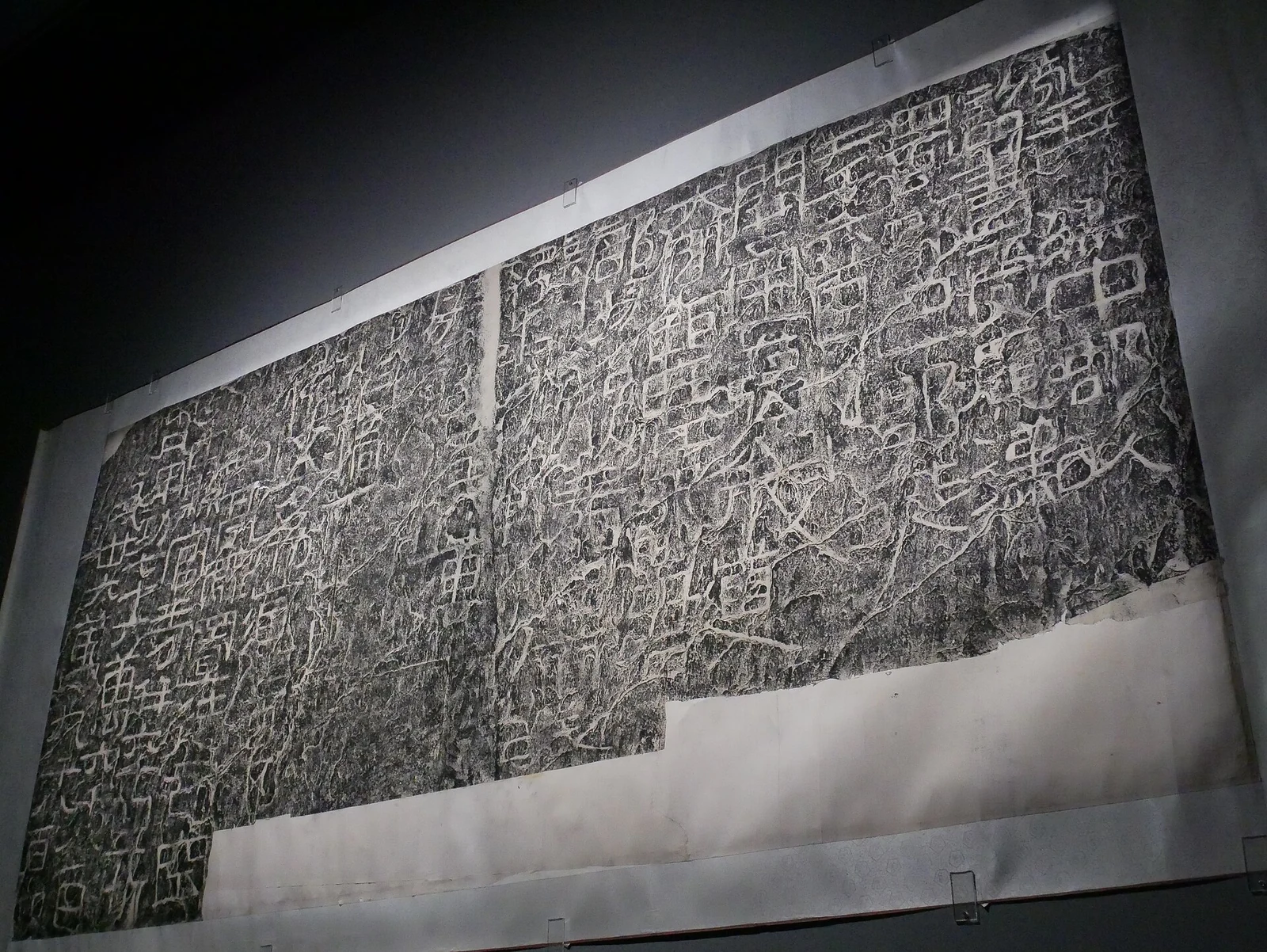
A displayed rubbing of the inscription recording the opening of the Baoxie Road; the photograph shows a rubbing, rather than the original rock face.

A valley had more than one story

The inscriptions did not all concern the same subject. Some recorded the opening or repair of the road; others concerned the Shanhe weir and the use of water beyond the valley. Short inscriptions also named features of the surrounding landscape. Works grouped together today therefore retain different reasons for being written.

The celebrated collection called the Thirteen Shimen Inscriptions includes pieces from different periods. Its familiar alternative name, the Han–Wei Thirteen, can conceal that range: Southern Song texts belong to it too. Read as a group, the stones connect transport, water and commemoration. They also preserve handwriting transformed by carving into something that would remain outdoors.

A rubbing of Shimen Song, also known as the Eulogy for Yang Mengwen.

When a stone changes address

Around 1970, the construction of the Shimen reservoir threatened to submerge important inscriptions. Selected cliff carvings were removed and taken to Hanzhong Museum. The old tunnel and the museum collection now occupy different places in the story.

Preservation kept writing available to later readers, while changing the circumstances in which they meet it. In a gallery, the carved surface can be examined closely. Its former relation to moving water, a narrow passage and other marks on the cliff is harder to see. Historical photographs and studies of their viewpoints help restore some of those relationships. A photograph is evidence of a particular moment, rather than an interchangeable picture of an unchanged ancient scene.

The valley and the collection

The old road supplies a reason to care about the lettering; the lettering returns names, effort and remembered achievements to the old road. A person can begin with either.

At Shimen, the history of a route grew into a history of reading. Builders wanted passage to remain open. People who carved records wanted an act to be remembered. Much later, those who removed the stones wanted the records to remain readable when the valley changed. These are different kinds of work, held together by the survival of a surface on which words were cut.

Continue exploring · Hanzhong ↗
Photo credits and rights
  1. A displayed rubbing of the inscription recording the opening of the Baoxie Road; the photograph shows a rubbing, rather than the original rock face.氏子 / CC BY-SA 4.0 · CC BY-SA 4.0 Photo source ↗ Rights information ↗
  2. A rubbing of Shimen Song, also known as the Eulogy for Yang Mengwen.氏子 · CC BY-SA 4.0 · CC BY-SA 4.0 Photo source ↗ Rights information ↗