The Jockey Club Creative Arts Centre occupies the former Shek Kip Mei Factory Estate, a nine-storey building completed in 1977. The factory building was later converted into an arts centre, which opened in 2008. Those dates make the change concrete: a purpose-built industrial block stood for three decades before its spaces were reorganised for studios, exhibition and cultural activity. The factory’s industrial frame remains visible in the centre’s new cultural role.
From the journal
New Work in Shek Kip Mei’s Factory Estate
A nine-storey factory building from 1977 became a centre where studios and public cultural activity occupy former industrial space.
In this district · Sham Shui Po ↗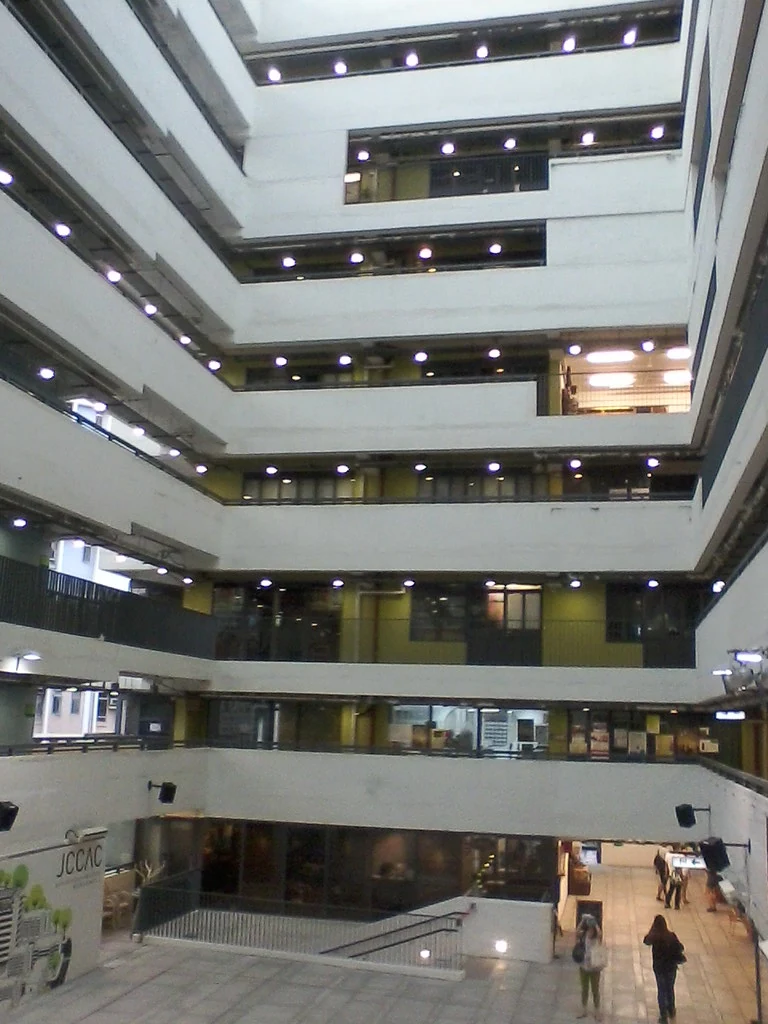
A factory block with a second life
Industrial scale, different work
Factory estates were designed to accommodate work at a scale and rhythm unlike a domestic interior. At JCCAC, that inherited scale now houses creative practice. Workrooms and shared areas bring individual making into the same large building, while visitors encounter the centre through its public activities. Artists and cultural organisations continue to work in the building, while exhibitions and events bring visitors into the former factory. Its industrial frame remains part of the experience of the new work.
A university-led project
The Hong Kong Yearbook records that the centre was initiated by Hong Kong Baptist University and opened in 2008. That institutional beginning matters because reuse involves more than changing a building’s interior. It requires a programme, management and a community of people willing to make the new spaces function. Those arrangements, alongside the renovation, turned the factory block into a cultural centre. Its identity therefore rests on both the robust industrial shell and the organisations that brought a new purpose into it.
Continuity through adaptation
Shek Kip Mei’s manufacturing history did not disappear when production moved elsewhere. Across Sham Shui Po, former industrial buildings took on commercial, exhibition, trade and logistics roles. JCCAC is one particular path through that change: the building became a home for artistic work and public culture. Nearby streets continued to support specialised commerce, creating a district where old and new forms of work coexist. The centre’s story is one of adaptation: an industrial structure continues to serve the district in a new form.