From the journal

Qingjing Mosque: Reading the Stone and the Open Sky

Quanzhou’s historic mosque reveals its long life through a monumental portal, the remains of a prayer hall and inscriptions recording repair.

In the same city · Quanzhou ↗

A threshold with a long memory

The stone portal of Qingjing Mosque is a strong beginning. Its arched opening makes the passage from the street feel deliberate: an entrance is also an announcement of the place beyond it. The masonry draws attention to outline, depth and proportion before any inscription is read. For a visitor used to imagining Chinese sacred architecture chiefly as tiled roofs and timber halls, it offers an immediate change of visual language.

The mosque was founded in 1009 and was known as Masjid al-Ashab. A major rebuilding in 1310 helped establish the layout whose remains are interpreted today. Those dates place it within the centuries of Quanzhou’s expanding overseas connections. They also begin a longer history of maintenance, damage and repair. The entrance has to be read as part of that history, rather than as the untouched doorway of a single moment.
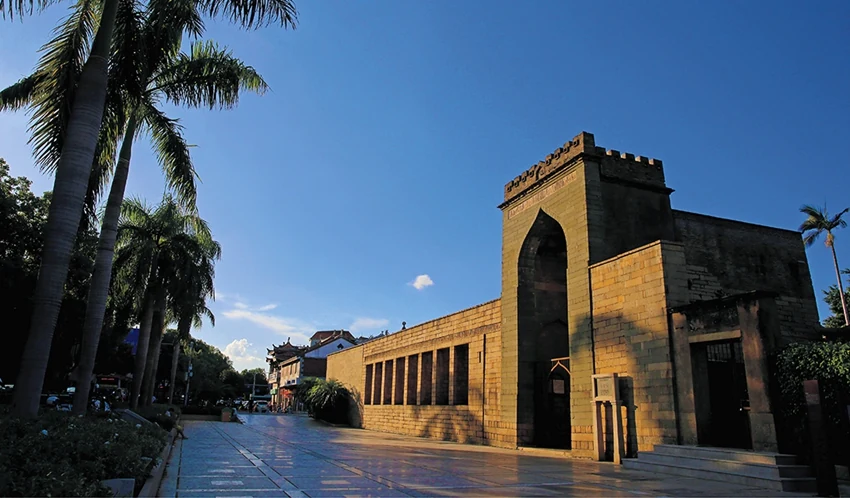
A tall pointed gateway rises above a long stone street wall.
The stone gateway of Qingjing Mosque, Quanzhou.

Read the space as well as the walls

A roofless or incomplete building requires a different kind of looking. Instead of allowing a complete interior to organize the view, follow the surviving boundaries and imagine the work they once performed: separating spaces, carrying weight and giving a congregation an orientation. The open sky becomes visually striking, but the missing enclosure remains important to understanding the building.

The former prayer hall, known as Fengtiantan, stands west of the portal. Its western wall has seven niches with Quranic inscriptions, giving the roofless space a clear focus toward Mecca. The carvings join worship to the concerns of a trading community: the city’s account identifies passages about religious obligations amid commerce and ships travelling by divine favour. Stone here preserves both a direction for prayer and words that connected daily work with belief.

Stone columns stand in grass within walls pierced by arched openings.
The roofless prayer-hall remains at Qingjing Mosque.

Repair is part of the monument

The city’s religious-affairs account describes earthquake damage in 1607 and the work recorded in a 1609 repair inscription. Written records give names and dates to changes that might otherwise appear only as breaks in the fabric. They make repair a human action rather than an anonymous patch in an old wall.

An inscription need not be fully readable to reward attention. Its location, scale and relationship to the building can show that someone intended a memory to endure publicly. A translation or site label then adds the specific event. This is a good place to slow down over one text instead of treating all carved writing as ornament. The labour of restoring a place, and of recording that restoration, belongs to the mosque’s historical significance just as surely as its earliest foundation does.

A mosque, a monument, a city

Qingjing’s surviving structures include more than its celebrated portal: the prayer-hall remains, Mingshan Hall, a well and historical steles together give the site its texture. Different elements answer different questions about water, gathering, worship and remembrance. Looking at the whole complex prevents the entrance from becoming a detached emblem of an imagined foreign world.

This is an Islamic religious heritage site within a living city. Follow the boundaries and photography guidance set by its custodians, particularly around any space used for prayer. The care is part of looking well. Quanzhou’s trading history becomes tangible here through a particular religious community and a particular building, with its own dates and changes. The open space is moving precisely because the stone has survived enough to suggest the fuller life that once passed through it.

Continue exploring · Qingjing Mosque ↗
Photo credits and rights
  1. The stone gateway of Qingjing Mosque, Quanzhou.泉州市人民政府美食之都申创官方网站 · Rights status unspecified Photo source ↗ Original aspect ratio retained. Display copies resized only when needed; no enlargement, crop or retouching.
  2. The roofless prayer-hall remains at Qingjing Mosque.泉州市人民政府美食之都申创官方网站 · Rights status unspecified Photo source ↗ Original aspect ratio retained. Display copies resized only when needed; no enlargement, crop or retouching.