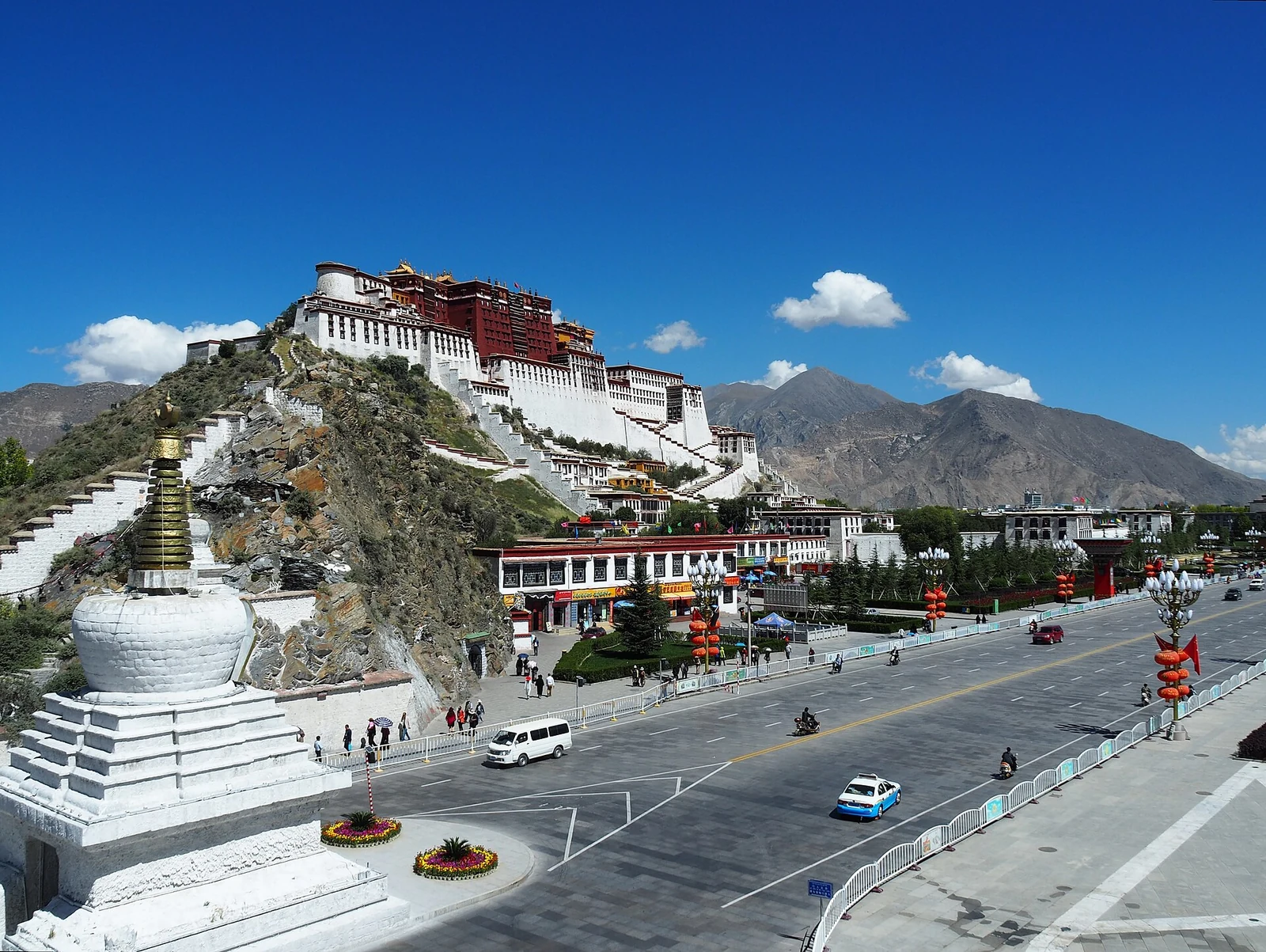
A mountain palace is not understood only by looking upward. Around the Potala, the wider Lhasa Valley matters just as much as the summit. The low ground gives the eye room to travel before it reaches the building, while Red Mountain provides a distinct rise within that open setting. The palace can therefore be read both as an immense construction and as one element in a much larger landscape.
UNESCO locates the complex on Red Mountain in the centre of Lhasa Valley. That simple geographical description explains much of its visual force. The eye recognises the building’s stepped mass against rock and sky before it begins to separate individual windows or roofs.
UNESCO places the complex about 3,700 metres above sea level and describes its main fabric as the White and Red Palaces with their ancillary buildings. At the centre of the valley, that high, mountain-backed silhouette becomes a marker in Lhasa’s broad basin. The elevation gives a precise scale to a palace that photographs can make seem detached from ordinary urban ground.