Tholing’s White Temple stands in Zhada County’s Sutlej valley. The east wall is a painted architectural surface inside a sacred building, not a detached collection of panels. A 2017 report from the Tibet Department of Culture and Tourism dates its paintings broadly to the fifteenth and sixteenth centuries and describes cross-regional artistic exchange. That account gives the wall a historical frame; the room itself supplies another kind of context, with 42 columns across a 555-square-metre interior. The wall’s scale and placement matter to how it was seen and to the work of recording it.
From the journal
Murals of the Sutlej Valley
A thousand photographs and a stitching system turned Tholing’s White Temple east wall into a high-resolution record and a near life-size museum reconstruction.
In the same city · Ngari ↗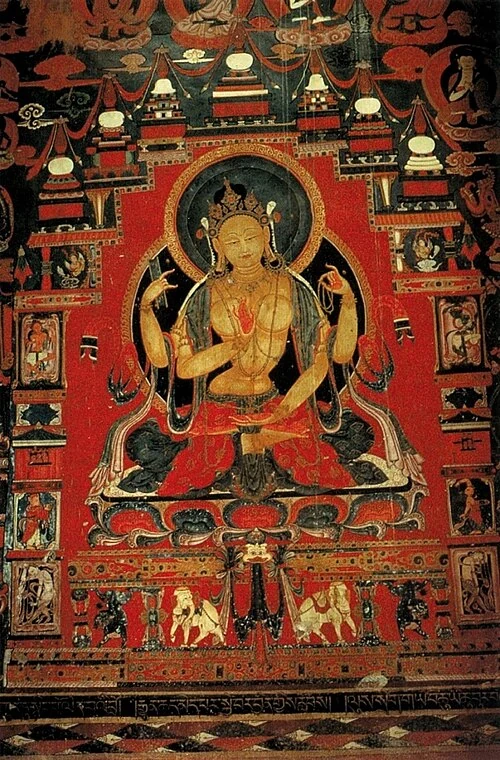
A painted wall in its setting
More than a thousand photographs
A Zhejiang University team documented the east wall with a camera system that moved across the painted surface under even lighting. The department’s report says the equipment took more than a thousand photographs of a single wall. Each frame captured only a portion; the team then developed a precise stitching system to combine them into one high-resolution image. This process turned many overlapping views into a continuous record. It allowed details of colour and brushwork to be reviewed together, while keeping the image tied to its original position in the temple.
A digital image becomes a full-size encounter
The completed image also supported a physical reconstruction of the east wall for a museum presentation in Jiangnan. The report describes the reproduced surface as about four metres high and more than twenty metres long. Visitors could approach a continuous wall at near architectural scale, rather than seeing isolated details in a book or on a small screen. The replica and the White Temple remain distinct: one is a reproduction assembled from digital records, the other the original painted interior in Zhada. The route from temple to museum broadened access without relocating the historic wall.
What the record can preserve
Digital photography preserves a visual record, not the whole experience of standing inside the White Temple. The report presents the work as a high-fidelity collection and reconstruction; it does not claim that the image replaces the building, its rituals, or the local custodians who care for it. The distinction is important for conservation. Researchers can inspect a joined image repeatedly, while a visitor encounters paintings in a room with its own proportions, light, and religious use. The project’s achievement lies in making a detailed view portable while leaving the original’s location and meaning attached to Tholing.