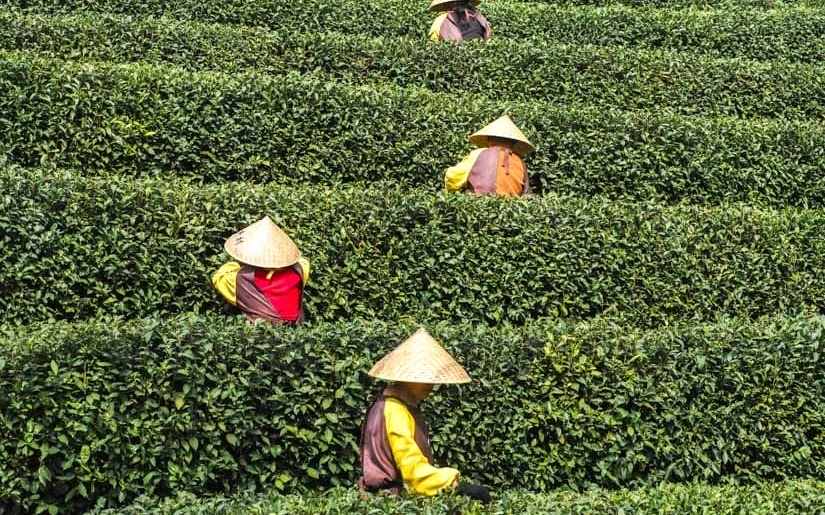
Beyond West Lake, paths rise into low rows of tea bushes. A picking basket slowly fills with tender shoots: buds and young leaves, selected for their stage of growth rather than gathered in handfuls. The familiar flat Longjing leaf begins here as something soft and easily bruised. Spring weather changes the pace of the work. The maker's choices begin on the slope, before a pan is heated and long before fragrance rises from a glass on a table.
Living craft
The Landscape Inside a Tea Leaf
Around Longjing, a leaf’s familiar shape leads into a living craft and the hills that sustain it.
In the same city · Hangzhou ↗The leaf before the cup
A name with a hillside inside it
Longjing means Dragon Well. West Lake Longjing is tied to a particular growing area around Hangzhou; the flat style is also made elsewhere under the broader Longjing name. Within the West Lake landscape, villages such as Longjing and Meijiawu carry tea into their daily rhythms. Mingqian means picked before Qingming, usually around early April; yuqian refers to the period before Grain Rain later that month. These names mark a spring calendar. Cultivar, weather and careful making also shape what eventually reaches the cup.
First the leaf rests, then the heat arrives
Fresh leaves are spread in a thin layer to lose some moisture before pan work. Then comes qingguo, the first heated-pan stage. Heat slows the leaf's natural oxidation, helping the tea retain its green-tea character; the maker also begins shaping it. This is different from roasting food until browned. The leaf must change without losing the freshness the maker is trying to keep. A panful moves through lifting, shaking and light pressure as moisture escapes and the texture becomes more pliable.
The flatness is learned by hand
Between pan stages, the leaves rest so that moisture can redistribute. In huiguo, the later finishing stage, they are dried and their shape refined. Traditional making is described through ten hand techniques, including shaking, grasping, pressing and rubbing. These are a working vocabulary, chosen and combined as the leaves change. Too much pressure can break a tender leaf; too little leaves the shape unfinished. The smooth, flat result records a sequence of judgements that a finished packet no longer shows.
What opens in warm water
Dry leaves offer one fragrance; warmed leaves and the brewed tea offer others. Longjing can suggest fresh beans or chestnut, with a soft sweetness following the first sip. In a clear glass, the flattened leaves gradually open, making part of the craft visible again. Water temperature and steeping time change the balance: very hot water and a long wait can bring more bitterness. Drinking becomes a small experiment in attention, with another infusion giving the same leaves a different pace.
A craft that returns to daily life
The spring season brings picking, sorting and pan work close together, while the tea is enjoyed through the year. A village conversation over a glass and the delicate tea note in Longjing shrimp extend the leaf's life beyond its production. Nearby Hupao, Tiger Running Spring, adds another local thread: water and tea have long been paired in Hangzhou's imagination. Following those connections takes the reader from hillside to hand, from hand to cup, and from a cup back into the city.