From the journal

The village between the tulou

Explore Hekeng in Nanjing County through its streams, bridges and varied earthen buildings, reading a whole village beyond its UNESCO-listed cluster.

In the same city · Zhangzhou ↗

Start by loosening the count

Hekeng is often introduced through its thirteen World Heritage-listed tulou. The village is larger than that selection. A Zhangzhou local-history account published in 2024 records fifty-three earthen buildings, with square, circular and less familiar forms. The distinction matters: a heritage component identifies particular buildings within a settlement; it does not exhaust the place around them.

Instead of trying to collect thirteen façades, begin with the spaces that connect them. A stream bank, bridge or turn in a lane can explain the relationship between structures that look separate in individual photographs. Hekeng rewards this change of scale. The village is the subject, and the monumental buildings are some of its most substantial participants.
Follow the connections made by water

The same local history describes intersecting watercourses, stone-lined banks and old bridges. Those are useful things to look for because they give the settlement a structure beyond the footprint of any one tulou. Water creates edges; crossings reconnect them. A path that seems indirect on a diagram can make sense when understood beside a stream.

From a permitted public route, look first along the water, then back toward the buildings. Which entrances face the shared route? Where does a crossing draw movement together? These questions allow the valley to become legible without assigning every feature a symbolic explanation. The physical tasks of reaching a neighbour, moving goods and crossing water already supply a strong account of why the spaces between buildings matter.

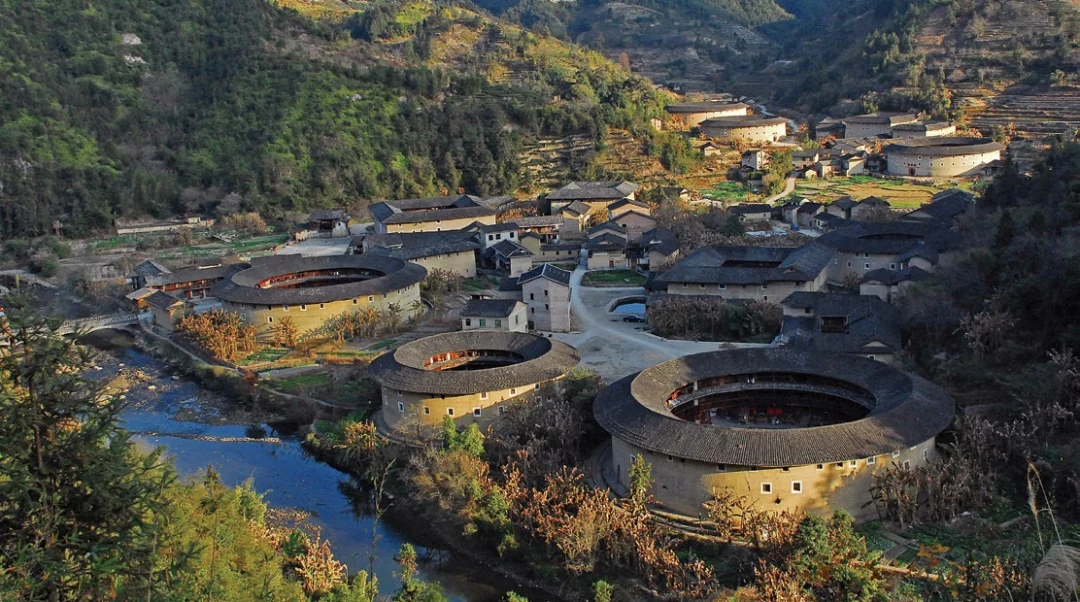
Circular earthen houses, smaller dwellings and fields occupy a wooded valley.
Hekeng’s tulou spread through a stream valley.

A circle is only one answer

The international image of tulou is dominated by enormous rings. Hekeng makes that shorthand difficult to sustain. Its local inventory includes forms compared with a chair and a carpenter’s square as well as the familiar round and square plans. Variety is part of the settlement’s identity.

A visitor need not master all the architectural terminology to notice its consequences. Different outlines create different edges, corners and relationships with adjacent paths. A curved wall leads the eye continuously; a corner interrupts it and reveals another face. Compare these effects at street level rather than treating shape as a ranking. The less instantly recognizable buildings help show that earthen construction supported a range of solutions, not one iconic object endlessly repeated.

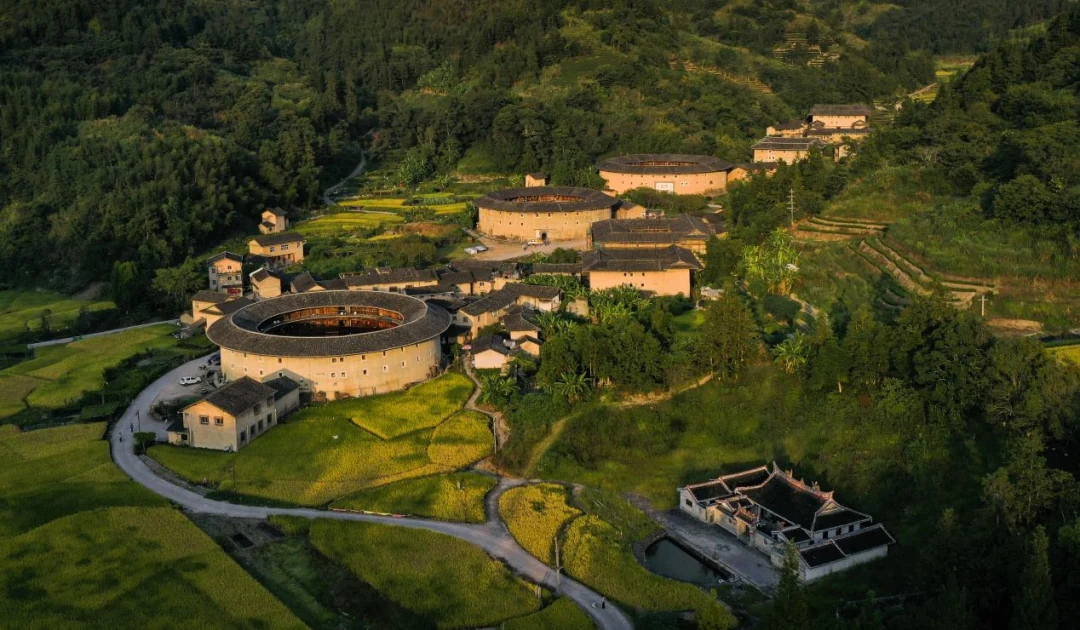
Large circular houses stand beside rice fields, a curving road and a smaller courtyard complex.
Hekeng’s tulou, fields and a courtyard building within the valley.

Protection at village scale

Fujian’s published protection boundaries include Hekeng as a village area. That administrative fact supports a way of seeing: connections deserve attention alongside individual structures. A building can be carefully conserved yet become harder to understand if the route, watercourse or neighbouring fabric that explained it is ignored.

The wider Fujian Tulou inscription likewise recognizes relationships between communal dwellings and their rural setting. At Hekeng, that relationship is particularly tangible in the alternation of buildings and connecting spaces. Give a bridge or stream bank the same attention as a famous roofline. The quieter parts of the walk are where a collection of impressive earthen structures becomes a village, with an internal geography that cannot be reduced to the number on a heritage list.

Continue exploring · Hekeng Tulou Cluster ↗
Photo credits and rights
  1. Hekeng’s tulou spread through a stream valley.福建省住房和城乡建设厅;转载传统村落博物馆公众号 · Rights status unspecified Photo source ↗ Original aspect ratio retained. Display copies resized only when needed; no enlargement, crop or retouching.
  2. Hekeng’s tulou, fields and a courtyard building within the valley.福建省住房和城乡建设厅 · Rights status unspecified Photo source ↗ Original aspect ratio retained. Display copies resized only when needed; no enlargement, crop or retouching.