From the journal

Pear Blossom Season in Ledu, with a Visit to Qutan

A spring report from Ledu places pear blossoms and Qutan Monastery in the same seasonal landscape. The monastery’s Ming halls and painted corridors offer a second way to read the region after the flowering trees.

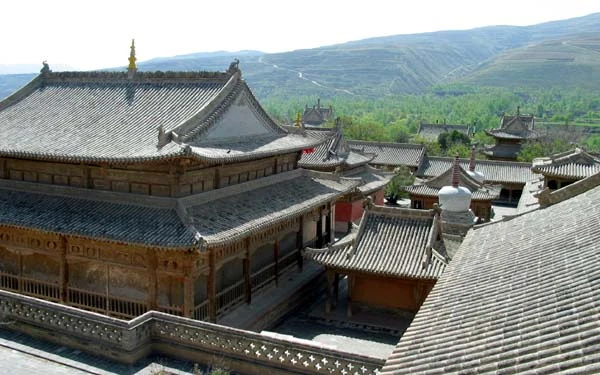
Qutan Monastery and its mountain setting, photographed in 2004.

A flowering valley in Ledu

In late April 2026, a report from Ledu described pear blossoms covering the district. It recalled visitors following spring blossoms toward Qutan Monastery in earlier years. Flowering orchards and an old temple formed two different parts of the same seasonal journey: one spread across the valley, the other gathered within halls and courtyards.

The blossoms belonged to Ledu’s spring landscape. Qutan, in the country south of the Huangshui River, offered a place to continue looking after the flowering orchards, through a sequence of architecture and painted narratives.

Halls and corridors beyond the orchards

Qutan’s halls face east and follow the slope toward Longguo Hall, whose design a specialist connects with Beijing’s former Fengtian Hall. Corridors join the buildings and carry mural narratives. In one painted mountain scene, devotees bring milk and butter as offerings.

The 2026 spring report also followed Qutan’s heritage to Beijing, where an exhibition presented replicas and artifacts related to the monastery and Qinghai’s Silk Road. The valley orchards, the monastery and the exhibition are separate settings joined by the report’s spring journey. Each offers a different scale of looking, from a flowering landscape to a hall, a painted scene or an object in a case.

Continue exploring · Haidong ↗
Photo credits and rights
  1. Qutan Monastery and its mountain setting, photographed in 2004.Andreas Gruschke (Freiburg) · CC BY-SA 3.0 Photo source ↗ Rights information ↗ Proportionally resized and converted to WebP without cropping. No objects were added, removed or reconstructed.