From the journal

A garden with the sea outside its walls

Read Shuzhuang Garden on Gulangyu through Lin Erjia’s family connections, shoreline composition and the changing scale of rocks, paths and sea.

In the same city · Xiamen ↗

A family memory on another shore

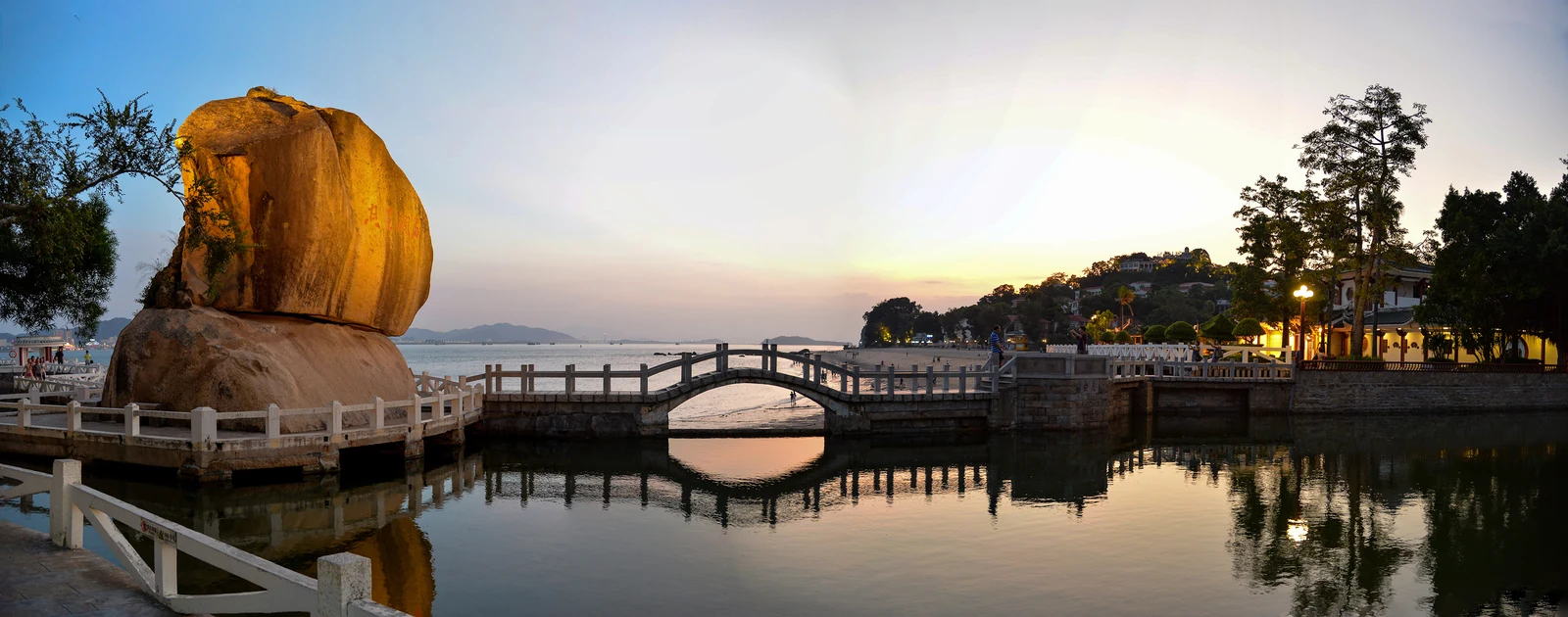
At Shuzhuang Garden, the sea changes the scale of everything nearby. A rock arrangement can be examined at arm’s length; beyond it lies a horizon that cannot be enclosed. Moving between those two scales is central to understanding the garden. It is an intimate composition placed against an expansive coast.

Xiamen Museum’s research connects the garden, established in 1913 by Lin Erjia, with his family’s garden at Banqiao in Taiwan. That connection gives the place a human geography. Garden-making could carry a remembered landscape across water without reproducing it exactly. The important relationship is between recollection and a new site: the inherited vocabulary of a family garden encountered Gulangyu’s exposed shoreline.
Near rocks, distant water

The heritage documentation distinguishes Shuzhuang’s Canghai and Bushan garden areas and names features including the Forty-four Bridge and Twelve Grottos. Names are useful anchors, but the composition is better understood through movement. A path brings a rock close, a turn opens a longer view, and a bridge changes the relation between feet and water.

Pause where a foreground feature and the sea can be seen together. The garden’s small-scale forms do not have to compete with the coast. They provide a frame of reference: a railing, pavilion or stone gives the eye something near before it travels outward. The sea, in turn, makes a deliberately arranged space feel less self-contained. Read that changing relationship rather than collecting features as separate attractions.

A stone bridge crosses still water beside a large rock at sunset.
Shuzhuang Garden brings bridges, rocks and the sea into one view.

A garden that was also written

UNESCO’s photographic documentation includes inscriptions by Lin Erjia at Shuzhuang. Their presence is a reminder that a Chinese garden can be read as well as viewed. A name or inscription directs attention, attaches memory to a location and proposes a way of understanding what is in front of it.

For a reader without Chinese, the first useful step is simply to notice where writing appears. Is it encountered before a view opens, beside a rock, or at an architectural threshold? Placement can be understood even before the words are translated. Avoid treating every inscription as an ancient, anonymous saying. Here, at least some of the recorded writing belongs to a named person whose family history is part of the garden itself.

From an open horizon to a keyboard

The Piano Museum above the garden introduces an unexpected change in scale. Its collection includes instruments of markedly different shapes and sizes, from small forms to long grand pianos. Where the garden asks the eye to move between rock and horizon, these objects invite attention to cases, keyboards and the furniture-like presence of an instrument in a room.

The juxtaposition is worth keeping rather than smoothing away. A coastal garden and a piano collection tell different stories of exchange, taste and memory on the same island. One arranges living plants, stone and views; the other preserves objects made to produce sound. Together they offer two ways of thinking about what people choose to bring into a place, care for and leave behind.

Continue exploring · Gulangyu ↗
Photo credits and rights
  1. Shuzhuang Garden brings bridges, rocks and the sea into one view.厦门市鼓浪屿文化旅游发展中心 · Rights status unspecified Photo source ↗ Original aspect ratio retained. Display copies resized only when needed; no enlargement, crop or retouching.