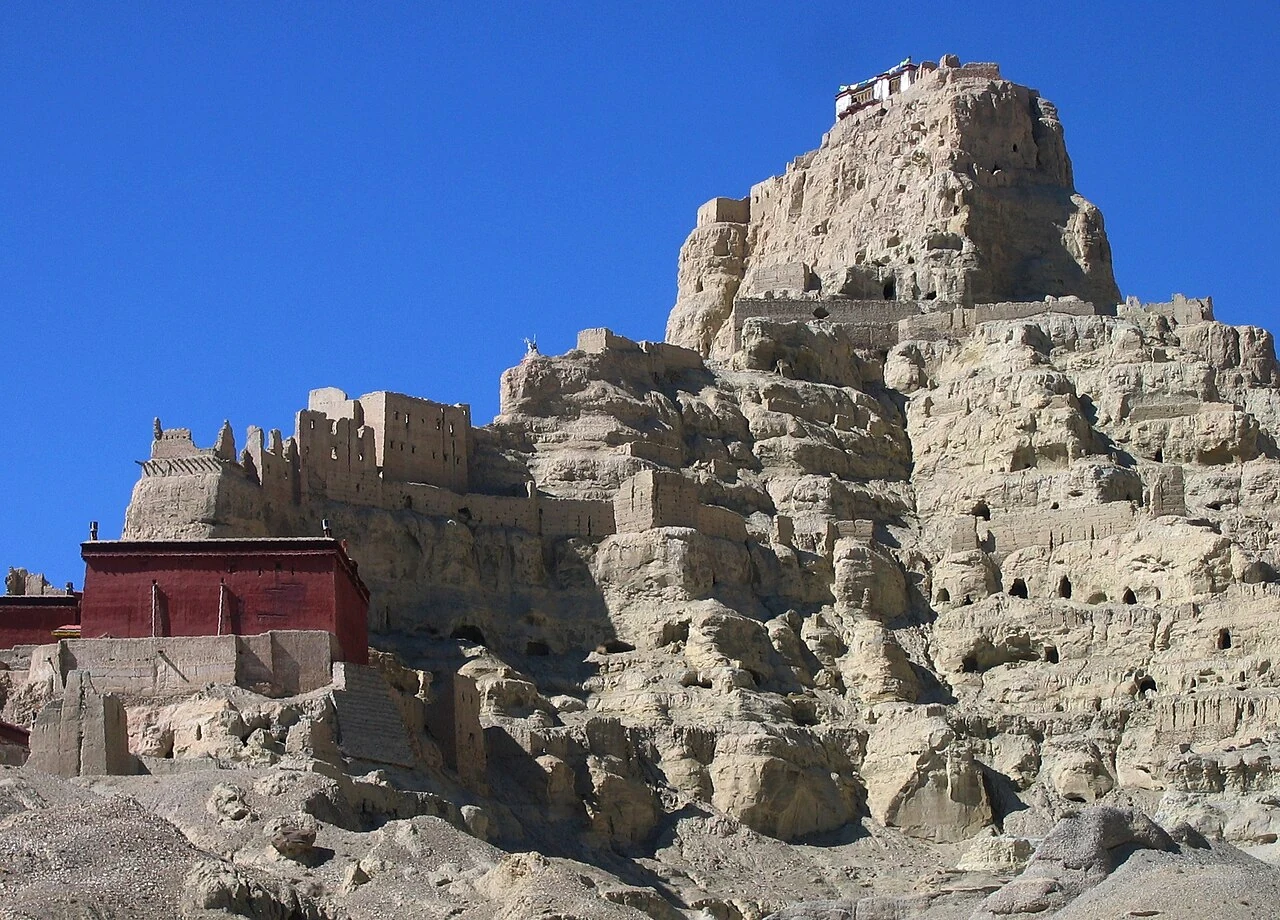
The Guge ancient city at Tsaparang is not a single palace set against an empty horizon. Archaeologists describe a complex of more than 1,400 structures, including palaces, caves, and religious monuments such as the Mandala Hall and White Temple. From a distance, the settlement appears to climb the steep ridge in layers; at close range, its remains belong to different kinds of spaces and different histories. The PLOS ONE study published in 2026 identifies Tsaparang as the later political and cultural center of the Guge kingdom, whose capital was concentrated here from about the fifteenth century until the kingdom’s end around 1630.
From the journal
Guge: Palace, Monastery, and Home on a Ridge
Tsaparang gathers palace remains, caves and Buddhist monuments on a steep ridge above the Zhada landscape. Recent radiocarbon and textual research refines the dates of several structures, showing a capital built and adapted across distinct periods.
In the same city · Ngari ↗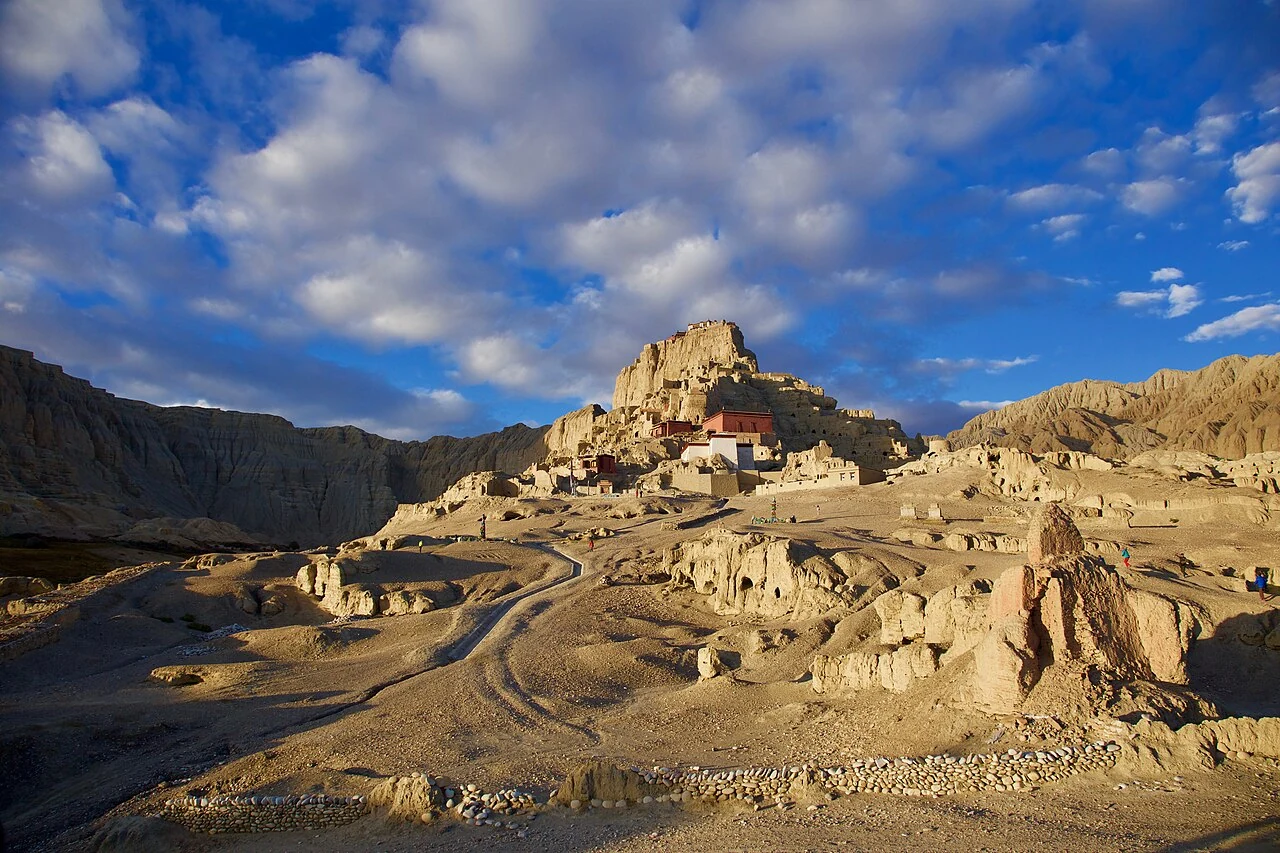
A capital stacked on the ridge
Dates from small plant remains
A new chronology came from a surprising scale of evidence: twelve plant specimens, including short-lived herbaceous stalks and structural timber. Researchers combined accelerator-mass-spectrometry radiocarbon dating with Bayesian modeling and Tibetan historical texts. One temple complex, VIF27, falls within 1457–1471 CE in their model. The White Temple phase is associated with Buddha statues dated to the mid-sixteenth century, with the production interval ending between 1556 and 1560. These ranges concern particular sampled structures and objects; they do not date every house, cave, or wall on the ridge.
A city that changed with its rulers
The same research identifies a later defensive phase in which a watchtower was reinforced sometime between the mid-seventeenth and late eighteenth centuries. The authors present more than one possible historical context for this work, and the available evidence does not choose decisively between them. That caution makes the chronology more useful, not less: Tsaparang was not frozen at the moment its political power ended. Buildings could be repaired, repurposed, or strengthened as regional circumstances changed. The ridge records a sequence of construction and adjustment rather than one finished city abandoned in a single instant.