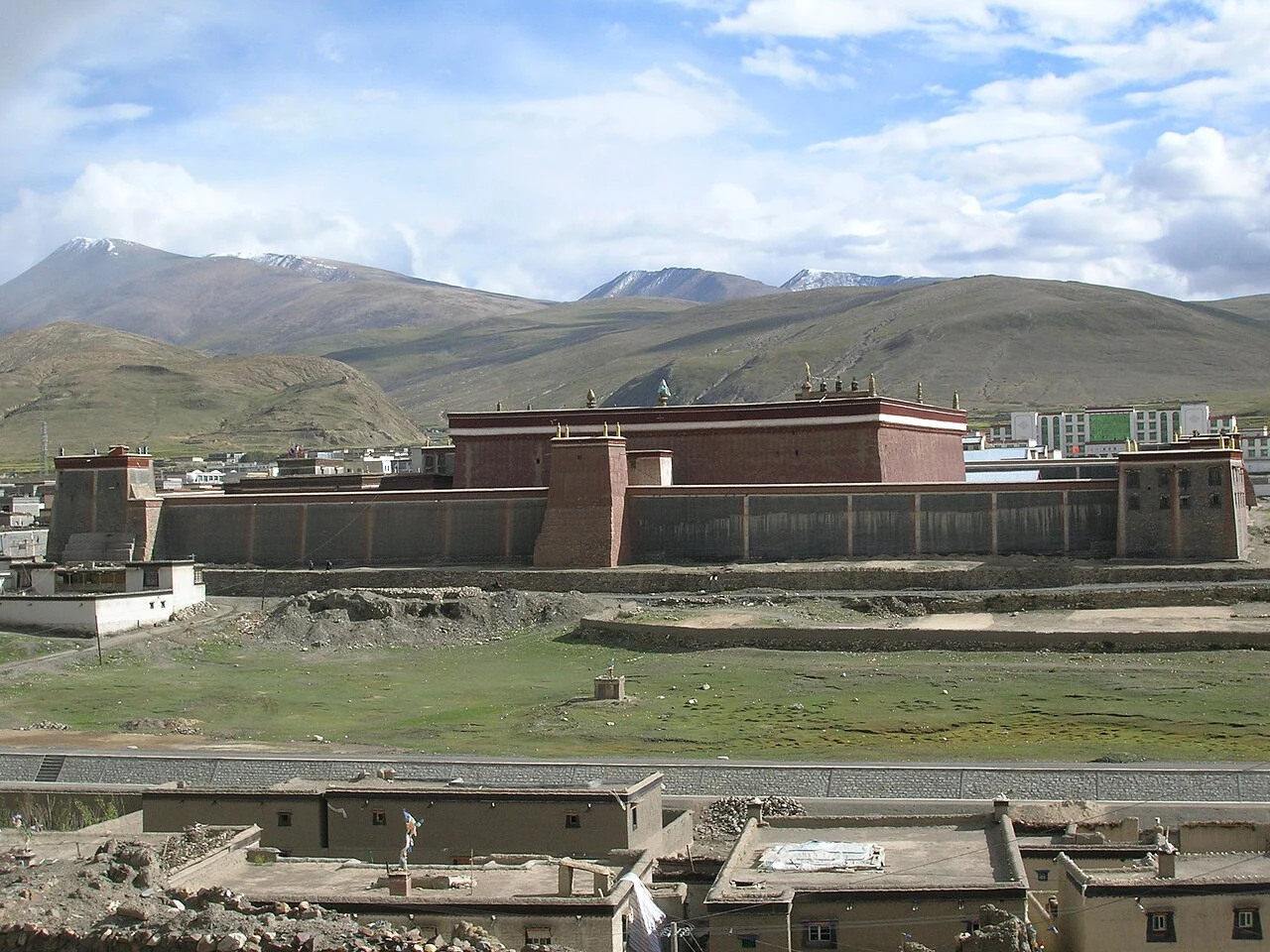
In 1073, Khön Konchok Gyalpo built a monastery beneath Bonpo Mountain and established the Sakya school, according to a Palace Museum lecture on Phagpa’s life. The founding placed a religious institution within the history of the Khön family, whose descendants became influential in the Sakya tradition. The monastery’s story would continue through teachers and relatives who carried both religious authority and learning from one generation to another.
From the journal
A Family Line, a Monastery, and the Education of Phagpa
Sakya Monastery’s 1073 founding and Phagpa’s childhood within the Khön family show how religious learning and lineage shaped a centre of Tibetan Buddhist life.
In the same city · Shigatse ↗A monastery founded by the Khön family
Phagpa’s childhood in a scholarly family
The Palace Museum lecture records that Phagpa was born in 1235 at Rukong, in Angren County in Tsang, and was the eldest son of Sangcha Sönam Gyaltsen and Kunga Gyi. His uncle, Sakya Pandita, was a leading Sakya teacher. This family setting linked a child’s early life to the monastery’s wider religious world: kinship connected him to established teachers, while study prepared him to take part in that tradition.
A curriculum known as the Five Major Sciences
The Palace Museum lecture describes Phagpa’s study through the traditional framework of the Five Major Sciences: grammar and language, logic, medicine, arts and crafts, and Buddhist learning. The list gives a sense of how broad scholarly training could be. Religious education sat alongside disciplines concerned with reasoning, health, expression and making. In the lecture’s account, this learning was part of the preparation that connected Phagpa to the intellectual life of the Sakya school.
From Sakya to Liangzhou
In 1244, the Mongol prince Köden invited Sakya Pandita to Liangzhou to discuss the region’s political future. Sakya Pandita set out with Phagpa and the boy’s cousin Chagna Dorje, according to the Palace Museum lecture. The party reached Liangzhou in 1246; in January 1247, Sakya Pandita and Phagpa met Köden there.
The three dates mark distinct stages: invitation and departure, arrival, then the meeting itself. The journey carried the Khön family’s young successors beyond the Sakya region and into a new political setting. Phagpa continued his Buddhist studies with his uncle in Liangzhou, while Chagna Dorje entered Mongol court life. A family journey thus became part of the story of how Sakya’s religious lineage met the Mongol court.