At Puji Temple, the approach opens beside Haiyin Pool, also known as the Lotus Pool. Water gives the entrance a pause before the halls gather the eye. A bridge crosses the pool, and the gate, courtyards and principal buildings make a central axis easy to follow. The effect is not simply grand scale: each threshold changes what can be seen and where people move. A visitor may arrive with a camera, a question or a prayer, then find the larger complex becoming understandable through small transitions—over water, through a courtyard, beneath a roof. The pool belongs to the approach, not to a separate garden detached from the temple.
Mount Putuo
Two temples, read through their spaces
Puji’s pool and central halls meet Fayu’s rising sequence of buildings; architecture also makes room for the ordinary work of a temple.
In the same city · Zhoushan ↗Puji begins with water
Fayu climbs with the slope
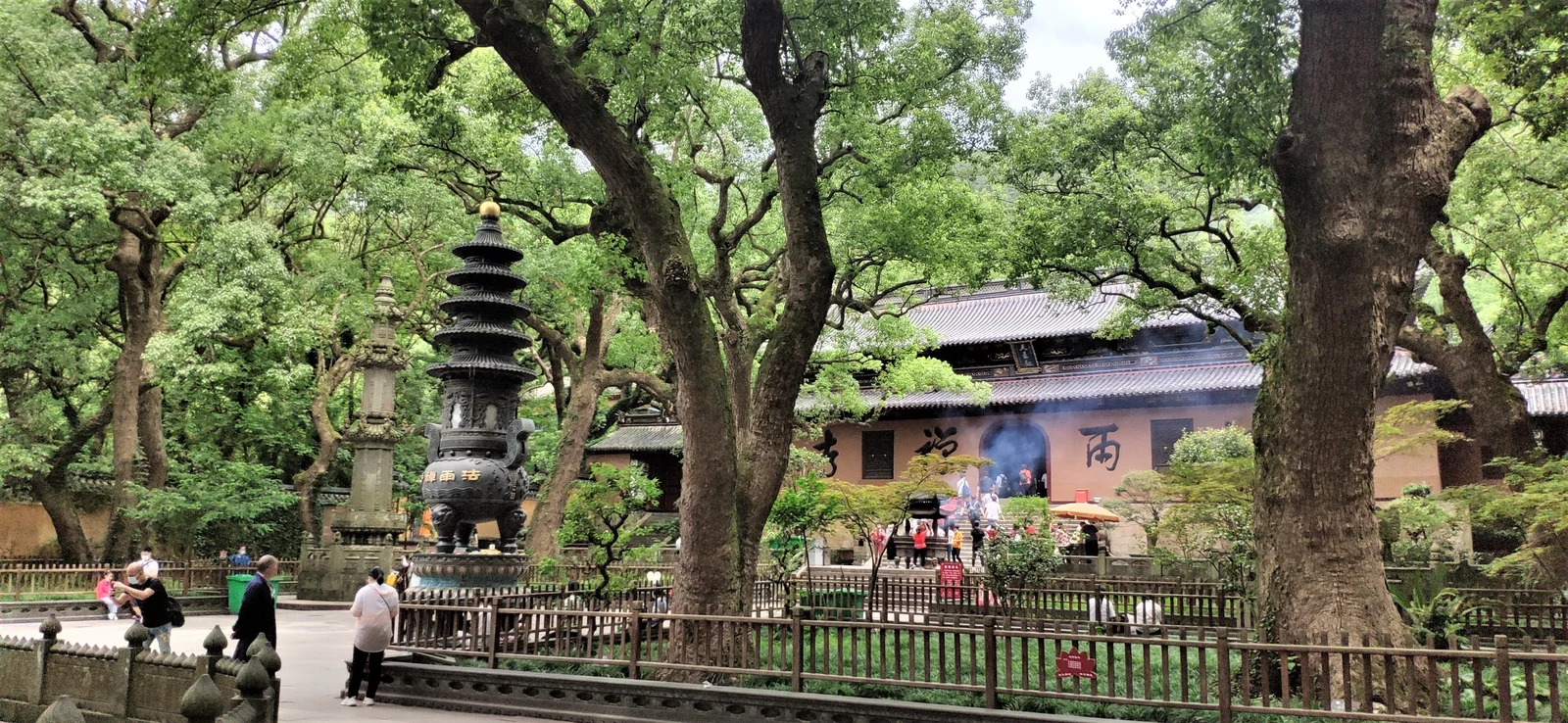
Fayu Temple offers another kind of reading. Its buildings rise in stages along the hillside, so the ground itself helps organise the visit. The successive halls reveal themselves one after another rather than all at once. Rooflines, courtyards and retaining walls respond to the slope; the architecture turns elevation into a sequence. The arrangement has a measured pace: a courtyard offers a landing, then another flight carries the eye higher. The two temples are often distinguished as the island’s front and rear temples, but that shorthand is less useful than noticing how differently they occupy their land: Puji gathers around a more level central space, while Fayu unfolds upwards among trees.
Architecture used every day
These are active religious places, not empty monuments. A worker sweeps the courtyard, tends a lamp or carries supplies; visitors pass through the same shaded thresholds and pause near the incense vessel. At Puji, the pool and bridge sit directly on the approach to the halls. At Fayu, each rising courtyard leads to another roofline. A roof shelters a pause from the sun; a broad paved court allows people to cross without entering a hall. These ordinary movements show how the buildings support worship, upkeep and visits at once. The architecture is not just a historic style: it is a working arrangement of paths, shelter, gathering places and rooms for devotion.