Guanyin is a bodhisattva in Mahayana Buddhism, a being oriented towards awakening who remains responsive to the suffering of others. In Chinese traditions, Guanyin is especially associated with compassion and with hearing the cries of the world. The name is a shortened form of Guanshiyin, often rendered as ‘one who hears the sounds of the world’. That meaning gives the figure a clear human concern: another person’s distress should not go unnoticed. In Buddhist teaching, a bodhisattva’s awakening is bound up with a wish to help other beings. A visitor unfamiliar with Buddhist vocabulary can begin with that idea of attention before learning the stories and images gathered around the island.
Mount Putuo
A listening presence across the sea
Why Guanyin became closely associated with Putuo Island, and how compassion gives the island’s sacred landscape its meaning.
In the same city · Zhoushan ↗A bodhisattva who listens
A story carried by the sea
A familiar Buddhist tradition connects Guanyin with Mount Potalaka, a sacred mountain described in texts and imagination. Over centuries, Chinese readers and pilgrims associated that distant, ideal landscape with places closer to home. Putuo Island, set among the islands of Zhoushan, became one such focus. The sea is part of the story’s geography: it marks distance, but it also gives the island its approach and its sense of being set apart. In the island’s name and temple landscape, a sacred mountain from Buddhist tradition meets a real coast in Zhejiang. Devotion gathered around temples, images and journeys; the landscape became legible through acts of attention as much as through its coastline.
Room for more than one way of seeing
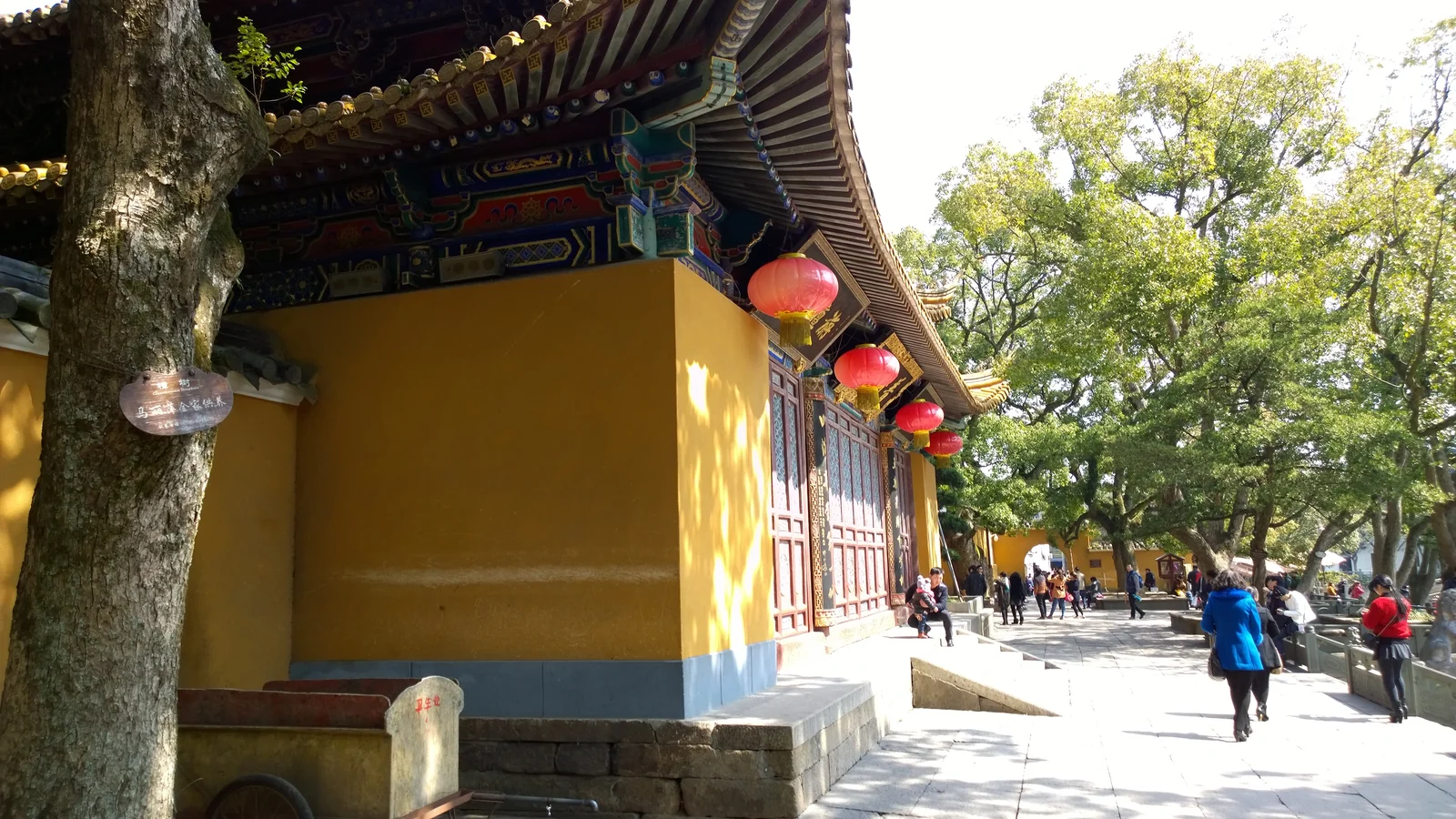
On Putuo, the idea of listening meets a very particular landscape. The rocky coast opens onto channels and other islands; a small gilded figure can be seen on a wooded headland. In temple courtyards, incense vessels, thresholds and shaded places give visitors room to pause, while residents and temple workers keep the grounds in use. A person may come to pray, to study the architecture or simply to walk quietly. The island’s hills and shoreline are close enough to enter the same view: a path through trees can end with sea between islands. The setting is concrete—a figure on the headland, a path through trees and the sea beyond.